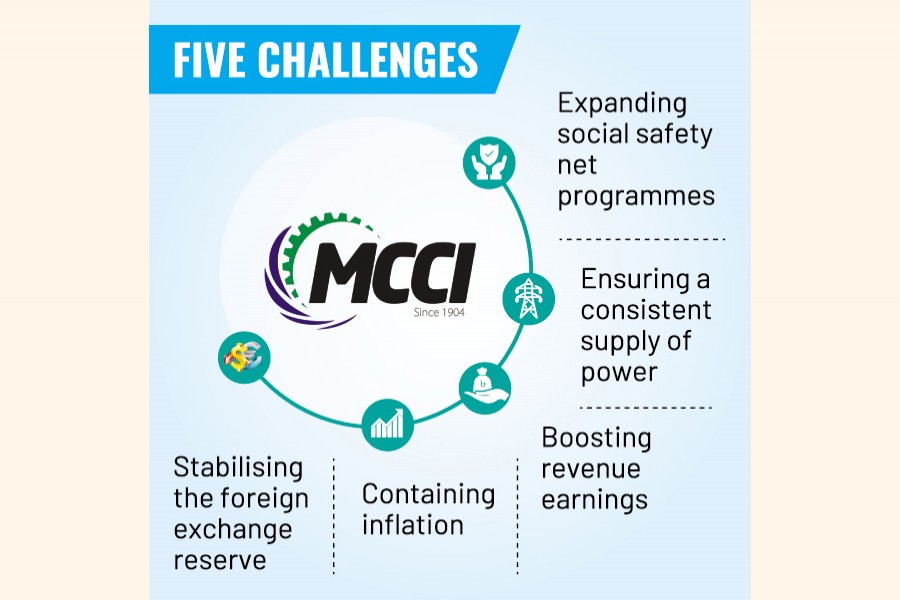
Further actions to stabilise the foreign-exchange reserves, control inflation, boost revenue, ensure consistent supply of electricity and gas and expand social safety-net programmes are imperative, says a review report on Bangladesh's economy.
Metropolitan Chamber of Commerce and Industry, Dhaka (MCCI) has offered the recommendations for government action in its latest quarterly report released Tuesday.
In the quarterly review covering April to June 2023, the country's elite trade organisation made the economic-recovery recommendations on the basis of its findings on progress and problems ahead.
The chamber, however, acknowledges that the government has swiftly implemented decisive measures to address the challenges stemming from the Russia-Ukraine war.
"Foreign-currency reserves are still somewhat in a satisfactory position but into a weaker trajectory. Although the exchange rate had long remained stable, it depreciated notably in recent months," notes the MCCI in its economic review.
Several of Bangladesh's economic indicators have shown a decline since the outbreak of the war in Ukraine in February 2022.
According to MCCI's quarterly review, the war has caused supply-chain disruptions, rise in global oil and food prices, a widening current-account deficit, Taka depreciation, reduced foreign-exchange reserves, and weak remittance inflows.
The review report also has highlighted revenue-collection shortfalls and slow public spending and so, with their domino effects.
"Challenges include unemployment, low investment and higher inflation," says the trade chamber in its report.
It says exports and imports are the key drivers of the economy, noting that both areas have performed relatively well despite the present situation.
However, the review has pointed out that the manufacturing sector's growth has been hindered by factors such as reduced domestic and external consumption due to high inflation, import restrictions resulting from a US-dollar crisis and inconsistent gas and electricity supply in recent months.
The manufacturing sub-sector recorded a lower growth of 9.23 per cent in FY23 compared to the previous fiscal year's 11.41 per cent, as per MCCI findings.
The disbursement of foreign aid decreased $1.47 billion or 21.52 per cent to $5.36 billion in July-March period of FY2023 from $6.83 billion in the corresponding period of FY2022.
On the other hand, development partners' commitments of foreign aid declined by $2.35 billion or 43.28 per cent to $3.08 billion in July-March of FY2023 from $5.43 billion in July-March of FY2022, it noted.
The net foreign direct investment (FDI) in FY2023 decreased 11.82 per cent to $1,611 million from $1,827 million in the previous fiscal year (FY2022).
And the gross inflow of FDI during July-June of FY2023 also decreased year on year by 2.82 per cent to $4,503 million from $4,636 million.
The FDI flow into Bangladesh is lower compared to that in many other countries at similar levels of development, the chamber says in its review report.
Overall, the MCCI projects upturn in some economic indicators of the country by the end of this month, riding on gradual global turnaround. The country's export earnings are expected to come to US$ 4.86 billion while the import value might increase to cross $5.37 billion in September.
Besides, the volume of inward remittance is likely to surpass $2.19 billion for the current month, the MCCI says in its projections, adding that the rate of inflation (point to point) might stand at 9.35 per cent at the month-end.
jasimharoon@yahoo.com
© 2026 - All Rights with The Financial Express

