A major cut in the interest rate on standing deposit facility (SDF) can hardly stop affluent banks from loading their surplus funds into the state-guaranteed deposit instrument despite lower gains than that from interbank lending.
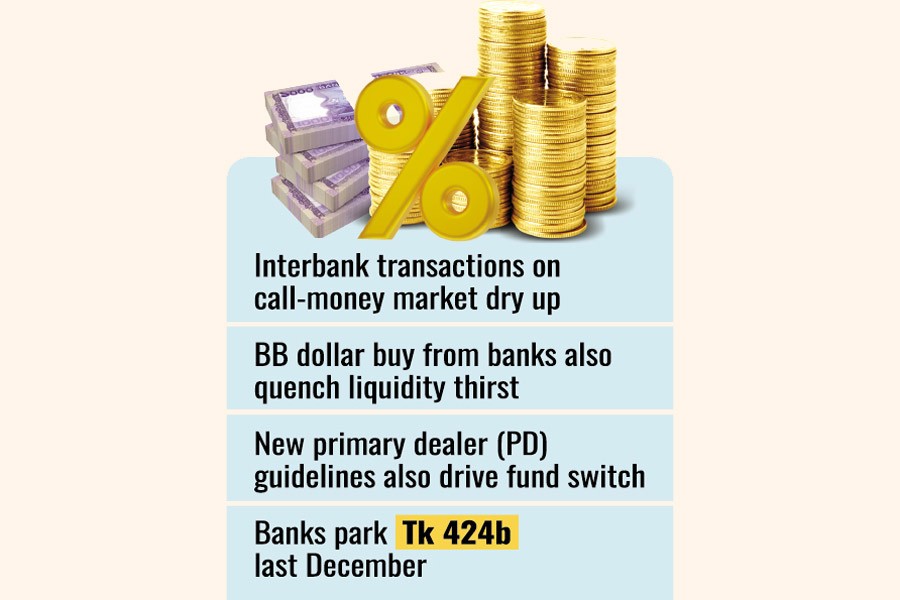
A cardinal cause is lower call from the call-money market for funds as commercial banks can now meet their liquidity hunger from different other sources and dollar sales, sources say.
Officials and money-market analysts say the demand on the interbank call-money market drops because of gradual fall in arbitrary benefits from investment in government securities following squeezing yields.
On the other hand, banks seem to be cautious in long-term investment keeping in mind primary dealer (PD) guidelines, expected to be implemented from February. As a matter of fact, according to them, the affluent commercial banks having "counterparty limitations" prefer to keep their surplus credits in the low-paying SDF.
Earlier on July 15, 2025, the Bangladesh Bank (BB) cut SDF rate by 50 basis points to 8.0 per cent in a move to revitalise the call-money market.
Belying the regulatory intervention, the fund switch into SDF continues swelling as banks find the instrument comfortable under the current economic sluggishness that dulls business-industry needs for funds.
According to the central bank statistics, the affluent banks parked Tk 261.47 billion in the SDF in July when the regulator cut the rate. Since then, the volume had grown to Tk 267.65 billion, Tk 365.32 billion, Tk 669.55 billion, Tk 404 billion and Tk 424 billion in August, September, October, November and December respectively.
Seeking anonymity, a BB official says the demand for short-term credits on the call-money market dropped in recent weeks. And the downturn in the weighted average interest rate (WAIR) on call money was the reflection.
"Now, the WAIR dropped to 9.77 per cent from over 10 per cent couple of months ago," he told The Financial Express about the money-market jitters.
The BB official says the central bank's recent fund injection into the market in the form of purchasing the US dollar to stabilise the foreign-exchange market helps many banks overcome liquidity pressure, which also plays a key role in lessening demand for funds on the call-money market.
"Foreign banks are the major participants in the SDF. Now, some state-owned banks are seen parking their surplus funds in the instrument, also called reverse REPO," the central banker further explains.
According to the BB data, the monthly call-money transactions were recorded at Tk 1.47 trillion in September last year. Afterwards, the transactions went on a climb-down to reach Tk 1.43 trillion, Tk 1.33 trillion and Tk 1.06 trillion in October, November and December respectively.
Chief Executive Officer of Standard Chartered Bank Naser Ezaz Bijoy says they started depositing day-end surplus funds into the SDF from later last year after completing necessary formalities. Bank prefers to place surplus in SDF as risk-weighted assets high for interbank call money.
Earlier, he says, they kept the day-end excess funds in the cash forms in the bank's current account with the central bank. "Now, we park funds amounting to over Tk 10 billion per day in the SDF as we have limited counterparty limit for call money," the seasoned banker told the FE.
He mentions that Standard Chartered Bank has the highest counterparty trade limits on local banks in Bangladesh amongst international correspondent banks.
On condition of not to be quoted by name, the chief financial officer of a state-owned commercial bank says the banks used to invest in government securities amid business slowdown when the yields were very lucrative and actively participated in the call money to cover the funds.
As the yields are not rising in recent weeks, he says, the arbitrary benefits of the banks are also squeezing. And the demand fall on the call-money market is the consequence.
The banker says the new PD guidelines are expected to be implemented from February. Under the guidelines, only PD banks can participate in the auctions of treasury bills and bonds--and it might change the money-market dynamics significantly.
"So, the banks are not interested to part their funds in middle-and long- term investment. They now prefer short-term instrument, like in SDF. Under the current investment scenario, 8.0 per cent is still a higher bet," he adds.
jubairfe1980@gmail.com
© 2026 - All Rights with The Financial Express

