Government's highest economic-policy body Monday endorsed an ambitious Tk3.0-trillion annual development programme (ADP) for the upcoming fiscal year with nearly one-third of the money earmarked as block allocations.
Economists forewarn that such huge block allocations could create room for misuse of the public funds and undertaking "politically motivated" projects, but the finance minister says ADP structured on well-defined strategic parameter.
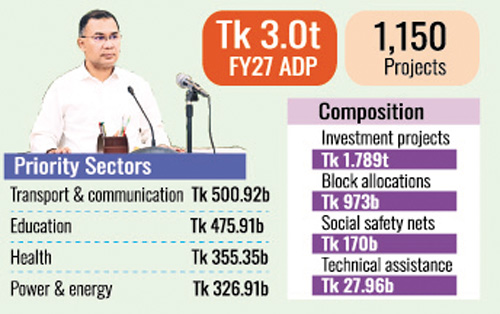
The ADP outlay for fiscal 2026-27 is 30.43-percent higher than the Tk 2.30-trillion original ADP outlay and 50-percent higher than the Tk 2.0 trillion revised one of the outgoing FY2026.
Of the new development-budget outlay, the government has kept aside Tk 973.04 billion as block allocations.
The National Economic Council (NEC) approved the massive ADP for the upcoming FY2026-27 taking implementation challenge after a massive blow in the current fiscal.
Till March this fiscal, the government agencies had executed only 35.57 per cent of the Tk 2.0- trillion RADP.
The NEC in a meeting held at the Planning Commission in Dhaka with NEC Chairperson and Prime Minister Tarique Rahman in the chair gave the seal of approval.
Briefing reporters following the meeting, Finance and Planning Minister Amir Khosru Mahmud Chowdhury said out of the total Tk 3.0 trillion worth of ADP outlay, the government will finance Tk 1.90 trillion from its domestic resources, while the remaining Tk 1.10 trillion will be sourced through foreign loans and project grants.
"This ambitious development roadmap marks an approximate 50-percent increase from the revised ADP of the current fiscal year, signaling government's intent to ramp up public investment and enhance macroeconomic implementation capacity," he adds.
To a question, the Finance and Planning Minister said, "If we want to reap benefit of our continuous 'population dividend', we have no way but to enhance investment in the education and health sectors for human-capital development.
"Besides, we need more private investment from home and abroad which would be attracted through improving our infrastructure."
The minister explains that the ADP is structured around five key pillars derived from the country's proposed Five-Year Strategic Framework for Reform and Development
The framework transitions Bangladesh from an infrastructure-only model toward a balanced, inclusive framework, he adds.
The five key pillars include state system reforms focusing on digitisation and the efficiency of law enforcement, inclusive socioeconomic development giving maximum precedence to education, healthcare, and social security.
Besides, Khosru says, economic restructuring, securing energy grids and investing in renewable energy, regional balanced development by improving logistics hubs and coastal infrastructure and socio-cultural cohesion with enhanced social harmony and cultural welfare have also been given focus in the newly formed ADP.
In a departure from traditional infrastructure-heavy development blueprints, the newly approved ADP prioritizes social protection, agricultural assistance, and human-resource development.
"This shift aligns closely with the government's electoral promises to insulate low-income households from inflationary pressures."
To facilitate new social protection schemes and welfare initiatives, the government allocated a record Tk 170 billion for the social safety-net programmes, including "Family Card", "Farmer Card", and "honorarium" to the religious leaders within the development framework.
In the new ADP, the government allocated Tk 1.789 trillion for investment and study projects, Tk 27.96 billion for technical-assistance projects, Tk 39.85 billion for "development fund", Tk 592.76 billion block allocations for different ministries and divisions, Tk 380.274 billion block allocations for Programming Division of the Planning Commission and Tk 170 billion for the social safety-net programmes.
The total number of projects in the upcoming ADP is 1,150 wherein 983 are investment projects, 23 for feasibility study, 109 TA and 45 self-funding.
Former World Bank Lead Economist in Dhaka office Dr Zahid Hussain says since the ministries could apply discretionary powers for getting the funds from the massive block allocations, it could create a room for misuse of the public funds and taking "politically motivated" projects.
"In another way, since the funds are not specified yet for any specific projects, the government could be able to cut the ADP size at the end of the fiscal if agencies fail to implement those fully or if the revenue generation becomes low like in the previous years," he told the FE.
The NEC also approved a Tk 89.248 billion worth of development budget for the autonomous and semi-autonomous government bodies.
Planning Commission officials say those funds will ensure flexible financing for flagship initiatives, such as the expanded "Family Card" and "Farmer Card" programmes, alongside targeted social-development assistance.
While social-safety initiatives heavily influence the budgetary philosophy, the transport and communications sector retains the highest traditional sectoral funding at Tk 500.92 billion or 16.7 per cent of the total ADP.
The education sector follows closely with Tk 475.91 billion, while healthcare is set to receive Tk 355.35 billion and the power and energy sector has been allocated Tk 326.91 billion.
Among ministries and divisions, Local Government Division has been accorded the largest individual share, totalling Tk 337.35 billion.
Addressing longstanding implementation challenges, the NEC has directed all ministries and divisions to strictly prioritize projects that are scheduled to be completed by June 2027.
The Planning Ministry emphasizes that stricter oversight mechanisms and new criteria for appointing project directors will be deployed to optimize fiscal discipline and curb discretionary spending during the upcoming
fiscal year.
© 2026 - All Rights with The Financial Express

