Bilateral trade between Bangladesh and China finds a bonanza even in crunch time with huge necessary imports of capital goods by the former heavily tilting the balance towards Beijing.
Official data show the annual turnover in the two-way trade in the past fiscal year hit a record high at around taka 2.2 trillion or US$20 billion as, analysts say, Bangladesh had to make bulk import of goods for running industries and maintaining supply the consumer market, despite belt-tightening amid forex crunch.
In the merchandise trade between the two countries in the fiscal year 2022-23 China import payments accounted for a 27.7-percent share in the country's total import cost, according to data from the Bangladesh Bureau of Statistics or BBS.
The growing business ties made the world's second-largest economy Bangladesh's biggest trading partner for the 15th year in a row since 2009.
Until 2008, there had been a neck-and-neck position between India and China in respective share of Bangladesh's market that has a huge output gap that makes the country heavily reliant on imports, for consumption and production both.
The two neighbouring giant economies used to dominate the country's external trade alternately until 2008. If India topped in a year, then the following year China would tip the scales in a seesaw in doing business with Bangladesh.
China maintained the same pace of growth in Bangladesh's total imports in 2023 as it was almost the same in fiscal 2022, notwithstanding the central bank taking a tightfisted approach to import.
The Bangladesh Bank tightened in the wake of depleting its foreign- exchange reserves in early fiscal year 2023. Total import payments were recorded $72.2 billion, down by nearly 14 per cent from that of the 2022 fiscal.
In the last fiscal year, Bangladesh imported goods worth Tk 2.09 trillion or $19.2 billion from China. Bangladesh's merchandise exports to China fetched Tk 81.56 billion or $749 million, according to the BBS data.
Overall, Bangladesh had a large trade deficit with China, worth around Tk 2.01 trillion or $18.5 billion, in the fiscal year 2022-23 ending June 30 last.
Economists are not worried about such a big trade gap with China-they strongly believe that Dhaka's excessive dependence on China is conducive to the country's robust economic expansion, especially for its export-driven clothing sector.
China stands out as a global hub of chip and raw-material supplies, let alone for Bangladesh supplies, they point out with regard to trade imbalance.
In this context, they mention that China has granted duty-free access for 97 per cent of Bangladeshi products. But, they wonder, it is inconceivable why Bangladesh cannot cut its trade gap with world's factories.
"Bangladesh will never achieve a trade surplus with China …" says renowned economist Professor Dr Wahiduddin Mahmud in view of its import imperatives.
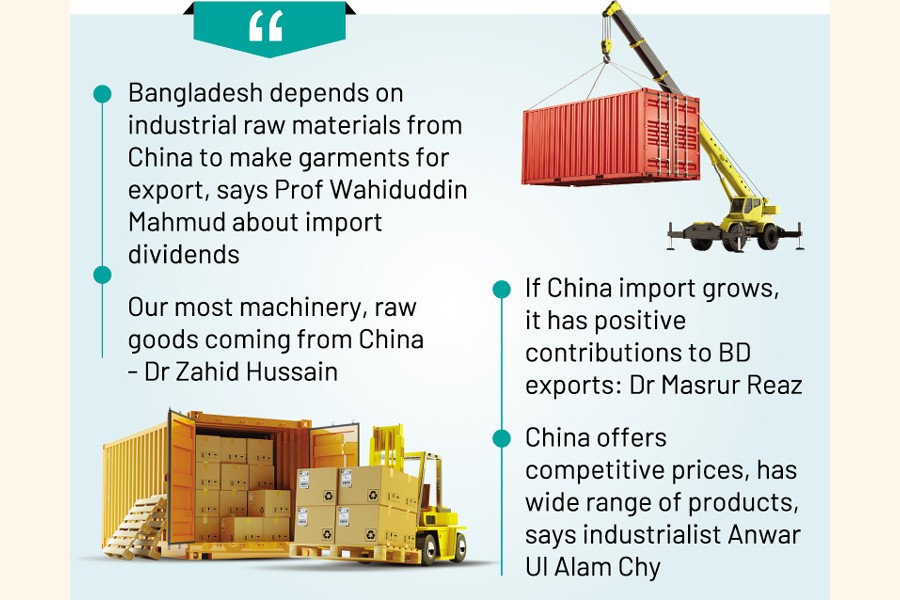
Dr Mahmud, a member of the UN development-policy body, notes that Bangladesh is dependent on industrial raw materials from China to manufacture garments for export.
"Bangladesh buys at competitive prices for its manufacturing sector."
He believes the export destination of Bangladesh's goods is western economies, the 27-member European economic block, and the North American economies, especially the USA, the single-biggest market of Bangladesh's exports.
"Actually we have comparative advantages over western economies in clothing and similar goods," he says.
In 2009, China replaced India as Bangladesh's top trading partner in total goods, after around a decade. However, India is still the second- biggest trade partner of Bangladesh.
In the 1980s and early 1990s, India had dominated Bangladesh market because of import demand for cereals and other food items as well as textiles.
In trade transition over the years, rapid industrialization, especially tremendous growth of the clothing industry alongside diversified demand for consumer goods, made China best option for sourcing.
Dr Zahid Hussian, an independent economist of Bangladesh, told the FE that the country's dependence on China is because of its demand for industrial raw materials.
"Our most machinery and raw goods are coming from China," he said, adding that those who manufacture or assemble electronic goods also depend on China.
"To my mind, both export-oriented industry and domestic demand for manufacturing electronics gave China a strong footing in trade in Bangladesh," says Dr Hussain, who once worked at the Dhaka office of the World Bank.
China also stands out as the origin of Bangladesh's highest investment from a single source and of bilateral strategic partnership.
Foreign direct investment (FDI) from China since the country joined its Belt and Road Initiative (BRI) in 2016 has risen as Bangladesh received more than $2.6 billion in FDI from China over the past 10 years.
A large credit line in dollar has been held out by the Chinese president for investment in Bangladesh, including development financing that bankrolls megaprojects.
The Chinese FDI funds have been invested in industries such as garments, telecommunications, energy, manufacturing, infrastructure, leather and leather goods, chemicals, and so on
Dr M Masrur, another economist who worked with the World Bank's private-sector arm - the IFC-told the FE the Chinese factories in Bangladesh are also major importers from China.
He thinks if import from China grows, it has positive contributions to Bangladesh's exports.
"Buyer's credit which has opened a new era since 2012 also gave another strong instrument to widen trade imbalance with Bangladesh," says the economist about the trade arithmetic.
Dr Masrur, who is now chairman of Policy Exchange of Bangladesh, the newest think-tank here, feels that Bangladesh should not worry about China trade deficit rather think on how to make Bangladesh's overall trade surplus by boosting its exports.
Entrepreneurs argue that Chinese goods grabbed Bangladesh's market mainly because of its competitive prices and offering of a wide array of products.
"China offers competitive prices and it has a wide range of products," says Anwar Ul Alam Chowdhury, former BGMEA president and managing director of Evince Group.
First vice president of BGMEA Md Nazrul Islam told the FE that China is providing around 60 per cent of raw materials to Bangladesh, and capital machinery has a stake of over 75 per cent.
"We prefer RMG's Chinese machinery as it is cheaper," he said, adding that Japanese and many European manufacturers have built their plants in China and make world-class supplies.
He terms the automated machinery better than that of many European manufacturers.
Bangladesh mainly imports nuclear reactors, boilers, machinery, and mechanical appliances, cotton, electrical machinery and equipment, knitted fabrics, manmade filaments and staple fibers, plastics, iron and steel, pharmaceuticals, organic chemicals, and fertilisers. These are around 70 per cent of imports from China, according to Bangladesh Bank statistics.
Bangladesh exports jute yarn, tanned equine and bovine hides, and knit T-shirts.
In the meantime, business-biggie China has an individual trade surplus with 174 countries and territories, including the United States, as of 2022 statistics.
Its largest deficit is with breakaway island-territory Taiwan, primarily coming from integrated circuit imports. China also has trade deficits with Japan (-$11.9 billion) and South Korea (-$37.8 billion), the region's second-and fourth-largest economies respectively, largely due to electronics and machinery imports to feed Dragon.
China has deficits with oil-producing countries like Russia and Saudi Arabia, too. It also has a trade deficit with Australia, a key supplier of raw goods such as iron, gold, lithium, and liquefied petroleum gas.
(US$1 = 108.9 Taka)
jasimharoon@yahoo.com
© 2026 - All Rights with The Financial Express

