Country's property market has been going through a sluggish trend in recent months with the sales of both apartments and residential plots reaching rock bottom, business-insiders said.
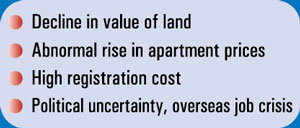
In a sort of paradox created by a number of adversities, house prices skyrocketed beyond the reach of the limited-income people while land prices plummeted due to the decline in demand for overvalued apartments.
Officials and people familiar with land-registration process have attributed the current sluggish trend primarily to factors such as a substantial fall in land prices, enhanced official cost in executing sale or purchase deeds and higher registration cost.
Some of them also held many buyers' unwillingness to invest their 'hidden' money in property in order to avoid any possible hassle from taxmen. The prevailing political uncertainty is also blamed for the stagnation.
Besides, sluggishness on the capital market and a squeezed overseas job marker for Bangladeshis are also being cited as dampers.
Given the prevailing situation, government's revenue collection from the sector is set to see a substantial fall this fiscal year (2014-2015) over that of the previous fiscal, officials concerned said.
Usually, the government earns revenue amounting to at least Tk 50 billion on an average a fiscal year from 13 areas related to the property business.
The revenue-generating sources are registration of transfer deeds, including fees, certified copies of the documents, stamp fees, tax at source, renewal fees, land handover fees and other kinds of fees.
But the total revenue receipt from the sector in the first quarter (Q1) of the FY'15 was recorded less than 15 per cent of the overall annual target. The gap creates doubt about getting to the goal at the end of the fiscal.
Official figures revealed that revenue collection from land property transfer fell by nearly 32 per cent in the July-September period of the ongoing FY over the preceding three months (April-June) or the last quarter of the previous fiscal.
The Directorate of Registration collected over Tk 4.40 billion in the forms of registration charges, fees for certified copies of registered deeds and also stamp fee in the Q1 against Tk 6.45 billion collected in the April-June period of the last FY (2013-2014).
During the same period of the previous fiscal, the amount was around Tk 4.79 billion.
Talking to the FE, Inspector of Registration Office (IRO) Sharafat Ali Khan confirmed the downtrend in land sales in recent months.
He noted that the fall in the prices of land prompted many of the sellers to change their heart. "Land prices recently fell by 15 to 20 per cent. So, many sellers have adopted a wait-and-see policy to get higher prices in the future," he said.
He said expatriate Bangladeshis on an average account for nearly 25 per cent share of annual land transfer. "But they are now facing many difficulties, especially in Malaysia and Middle-Eastern countries, which is casting a negative effect on this sector."
Seeking anonymity, another senior official of the IGR Office said the government was unlikely to reach the revenue target if the trend continued further.
"Sales of the land property dropped more than 40 per cent in comparison with the volume in 2009 and 2010. Since then, the downward trend in the sale continues to happen," he said.
He also cited higher registration and other forms of fees as reasons for remaining a number of flats or apartments unregistered in the capital and elsewhere. "Sales of land property have declined remarkably. Now, we can hardly register 500 documents a month. The number was more than 1000 couple of years ago," Sub-registrar of Dhaka Sadar land office Md. Zahurul Islam said.
It reflects that people's buying capacity for land property is gradually being eroded, he observed.
Experts also suggested that the government take immediate and strict measures to remove various kinds of anomalies in the country's century-old property-registration system to ensure hassle-free and faster registration.
The scenario was almost same in the capital as a total of 45,438 documents were registered in the Q1 of the current fiscal, down by 25 per cent from 60555 documents recorded in the previous three months (April-June period of FY' 14), according to Dhaka district land-registry office.
A sub-registrar of Dhaka said the amount that the directorate collected from the registration-related purposes has declined in the city because of high registration cost that left many apartments unregistered.
"There is no scope for fake documentation of lands as all kinds of updated documents are required for the sale of land. It is another reason for the downturn," he claimed.
Land and apartment buyers normally pay a minimum of 8.0 per cent and a maximum of 14.0 per cent of the land prices to government exchequer in the form of fees and charges, depending on the location of the property.
The issue of high registration cost also has come as a major blow for the realtors as a number of their customers started staying at the unregistered apartments.
"We've repeatedly been knocking our buyers to get their flats registered. But they pay no heed to our reminders because of the high registration fees (11.50 per cent)," General Secretary of the Real Estate and Housing Association of Bangladesh (REHAB) Md. Wahiduzzaman said.
He said they had requested the government several times for lowering fees for registration of transfer deeds in case of apartments.
The REHAB general secretary said government earnings from the sector would certainly increase to a satisfactory level if the rate is fixed at a maximum of 6.50 per cent of the value of the property.
Currently, apartment buyers pay 14 per cent, including gains tax at 3.0 per cent, stamp duty at 3.0 per cent, registration fee at 4.0 per cent and value-added tax (VAT) at 1.50 per cent.
The registration cost is 7.5 per cent in Pakistan, 7.0 per cent in India, 5.0 per cent in Sri Lanka and 4.5 per cent in Nepal, according to the REHAB.
Around 15,000 flats are built a year in Bangladesh, the REHAB figures indicated.
"Thirty per cent of the apartments have remained unregistered," another REHAB official said. He said the housing industry has been facing a very difficult time since in July 2010 when the government suspended fresh gas and power connections to households.
Md. Humayun Kabir, a lawyer of the Supreme Court, who deals with land-related matters, said the land sales have gone down significantly in recent times. "People might have felt insecure to invest in land at the moment because of current confrontational politics," he observed.
He also mentioned lengthy procedure involved in mutation as it takes five to six months, causing sufferings to the buyers of land.
Meanwhile, other sources noted that many potential buyers of land and apartments were not in a position to show their funds matching the deed value because of a large amount of money remaining still undisclosed, for a variety of factors.
Such buyers fear about getting into tax-related troubles later on, if their wealth statements, submitted along with annual tax returns, do not provide reasonable grounds for explaining properly and the sources of funds for purchases of land or apartments, the sources added.
jubairfe1980@gmail.com
© 2026 - All Rights with The Financial Express

