Bangladesh's garment exports to the United Kingdom are expected to receive a significant boost even after the country graduates from the least-developed country (LDC) status.
A recent change in the UK's trade rules will allow Bangladeshi exporters greater flexibility in sourcing raw materials while continuing to enjoy duty-free access to the UK market.
Industry leaders and trade experts say the revised rules of origin under the UK's Developing Countries Trading Scheme (DCTS) will help Bangladesh maintain its competitiveness on the apparel market, particularly for woven garments that rely heavily on imported fabrics.
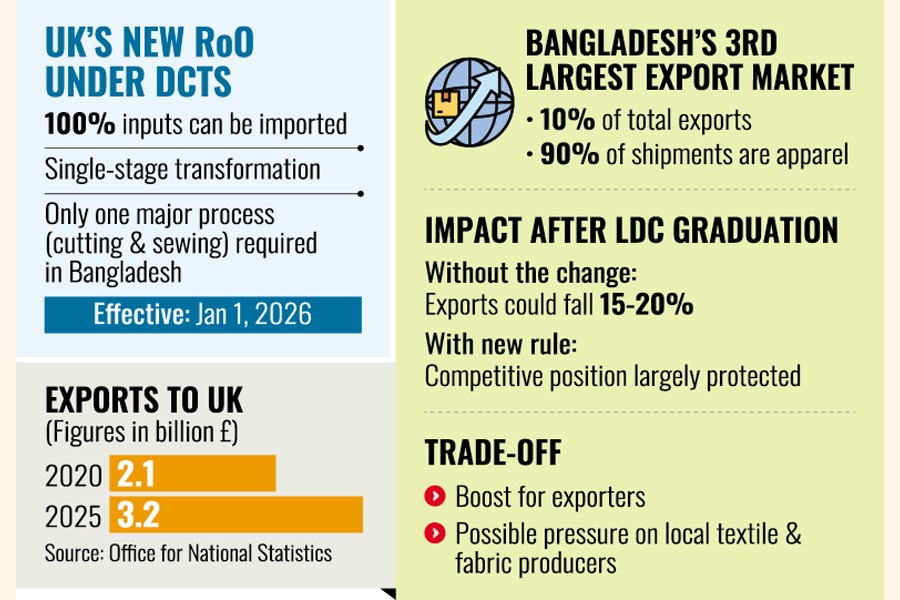
The UK's latest 'Improved Rules of Origin' allow up to 100 per cent of inputs or raw materials to be sourced from other countries, provided that one significant manufacturing process, such as cutting and sewing, takes place in a DCTS country.
The new rules of origin came into effect on January 1 this year, according to a UK update published on January 19.
The DCTS is a tiered arrangement similar to the EU's GSP, with different levels of market access linked to income level and development status.
At the top tier are LDCs, which qualify for Comprehensive Preferences, offering duty-free market access with the least restrictive rules of origin, including single-stage transformation for apparel.
The second tier, Enhanced Preferences, is intended for economically vulnerable non-LDC countries. It provides duty-free access to most products but with more stringent conditions.
The third tier, Standard Preferences, applies to other countries and offers more limited tariff reductions.
When asked, MA Razzaque, chairman of Research and Policy Integration for Development (RAPID), said: "The changes mean that even after graduation, Bangladesh will continue to access the UK apparel market on the same terms it currently enjoys as an LDC."
LDC graduation means Bangladesh will move from 'Comprehensive to Enhanced Preferences', which previously required double-transformation rules of origin for apparel.
Countries under 'Enhanced and Standard Preferences' were required to undertake both fabric production and garment assembly domestically to qualify for duty-free access.
"The latest changes allow Enhanced Preferences beneficiaries to source up to 100 per cent of apparel inputs from abroad while still qualifying for duty-free entry to the UK," Mr Razzaque explained.
Local exporters are largely dependent on imported fabrics for woven garments and, with the latest changes, they will also enjoy duty-free access to the UK market using imported fabrics, he said.
Under the earlier double-transformation requirement, a large share of woven exports would have failed to qualify for preferences and faced standard tariffs, he added.
Extending single-stage transformation under Enhanced Preferences substantially reduces post-graduation risks and moderates competitive pressure from other exporters, mainly India and Vietnam, which enjoy tariff-free access through UK trade agreements.
With single-stage transformation and duty-free market access, the negative impact of intensified competition from India and Vietnam will be less, he said, adding that Bangladesh's garment exports to the UK could otherwise fall by 15 to 20 per cent because of the double-transformation requirement and increased competition.
Talking to the FE, Mahmud Hasan Khan, president of the Bangladesh Garment Manufacturers and Exporters Association (BGMEA), said the changes would help increase Bangladesh's garment exports to the UK, as exporters of woven garments could obtain duty-free access even when using imported fabrics.
However, he noted that local backward linkage industries, including textile and fabric producers, may face challenges because the single-stage transformation rule allows imported raw materials for duty-free market access.
SM Khaled, managing director of Snowtex Group, said the changes would help Bangladesh maintain its export levels to the UK even after 2029.
The UK earlier announced that Bangladesh would continue to enjoy its existing duty-free facility for an additional three years after graduation, until 2029.
Echoing the BGMEA president, he said that due to high utility prices and a gas crisis, entrepreneurs are reluctant to invest in backward linkage industries, particularly in the woven segment.
Those who have already invested are struggling, he said, adding that Bangladesh ultimately needs to invest in backward linkages for long-term sustainability to reduce lead times, transportation and other costs.
The United Kingdom is Bangladesh's third-largest export market, accounting for about 10 per cent of total merchandise exports.
Apparel makes up more than 90 per cent of these shipments.
According to the UK's official statistics authority, the Office for National Statistics (ONS), Bangladesh exported garments worth £3.2 billion in 2025, up from £2.1 billion in 2020.
Munni_fe@yahoo.com
© 2026 - All Rights with The Financial Express

