 A herd of buffalo along with their caretaker enjoys a fun time as they are bathing in the Jamuna River to cool them off in the scorching heat that has been sweeping across the country. The photo was taken in Sariakandi upazila of Bogura. — FE photo
  Most Asia-Pacific countries are “insufficiently prepared” to face extreme weather events and natural disasters, which are growing in intensity and frequency due partly to climate change, according to a new study by a United Nations regional commission.
While the region suffers the worst consequences of climate change, it is also a key perpetrator — accounting for over half of the world’s greenhouse gas emissions — said the Bangkok-based U.N. Economic and Social Commission for Asia and the Pacific (ESCAP), releasing its “Race to Net Zero” report Monday.
Over the past 60 years, temperatures in the Asia-Pacific region have increased faster than the global mean, Radio Free Asia said quoting the ESCAP report.
“Six of the top 10 countries most affected by these disasters are in the Asia-Pacific region, where food systems are disrupted, economies damaged, and societies undermined,” ESCAP said.
The average annual economic losses across the region caused by natural and biological hazards are estimated at U.S.$780 billion, which is forecast to rise to $1.1 trillion in a moderate climate-change scenario and $1.4 trillion in a worst-case scenario, according to Monday’s report.
The Asia-Pacific countries lack the sizable financial means to support adaptation and mitigation efforts and the data necessary to inform climate action. At the same time, existing infrastructure and services are insufficiently climate resilient, the report said.
U.N. Under-Secretary-General Armida Salsiah Alisjahbana, executive secretary of ESCAP, said the case for regional climate action in Asia and the Pacific is clear.
“In fact, just last month, the severe heat waves we experienced here in Bangkok and throughout the country have been described as the worst April heatwaves in Asian history,” Alisjahbana said at the report’s launch.
“These extreme temperatures also affected other countries such as Bangladesh, China, India, and Lao PDR … Climate change puts our region’s sustainable development in jeopardy.”
The report will guide and inform the 79th session of ESCAP next week, focusing on accelerating climate action for the first time.
According to a March report by the U.N.-related Intergovernmental Panel on Climate Change (IPCC), the Asia-Pacific region accounted for 57% of global emissions from fuel combustion in 2020, three-fifths of which was generated from coal.
The emissions have more than doubled since 1990, driven by the electricity and heating, manufacturing and construction, and transport sectors, ESCAP said.
According to the U.N. report, 85% of Asia and the Pacific’s primary energy supply comes from fossil fuels, while 60% of the region’s energy-related CO2 emissions come from coal and one-third from gas and oil.
The report said that to limit temperature rises to 1.5°C, oil and gas must be radically phased down by 2050 and coal wholly phased out.
Three-fourths of global emissions in manufacturing/construction are from the region, ESCAP said.
Only six countries have laws to tackle climate challenges
A large majority of 49 countries in the Asia-Pacific region have already made carbon neutrality pledges by 2022, with commitments varying from achieving carbon neutrality or net-zero carbon dioxide, to net-zero greenhouse gas emissions by mid-century.
Sangmin Nam, director of the environment and development division at ESCAP, said the Asia-Pacific region lacked regional cooperation to “really speed up the action” under the Paris Agreement, unlike the European Union or the African Union.
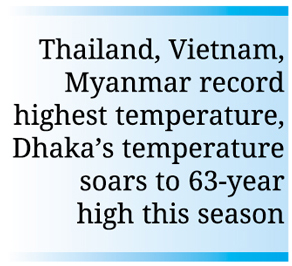
A BBC report adds: Vietnam has recorded its highest ever temperature, just over 44C (111F) — with experts predicting it would soon be surpassed because of climate change.
Thailand reported a record-equalling 44.6C in its western Mak province.
Meanwhile Myanmar’s media reported that a town in the east had recorded 43.8C, the highest temperature for a decade.
Both countries experience a hot period before the monsoon season but the intensity of the heat has broken previous records.
Further west, the Bangladeshi capital Dhaka recorded its highest temperature since the 1960s while Indian authorities said parts of the country were experiencing temperatures that were three or four degrees above normal.
In April, Spain recorded its hottest-ever temperature for that month, hitting 38.8C at Cordoba airport in the south of the country.
In March climate scientists said a key global temperature goal was likely to be missed.
Governments had previously agreed to act to avoid global temperature rises going above 1.5C. But the world has already warmed by 1.1C and now experts say that it is likely to breach 1.5C in the 2030s.
In its report, the UN’s Intergovernmental Panel on Climate Change said “every increment of global warming will intensify multiple and concurrent hazards”.
© 2026 - All Rights with The Financial Express

