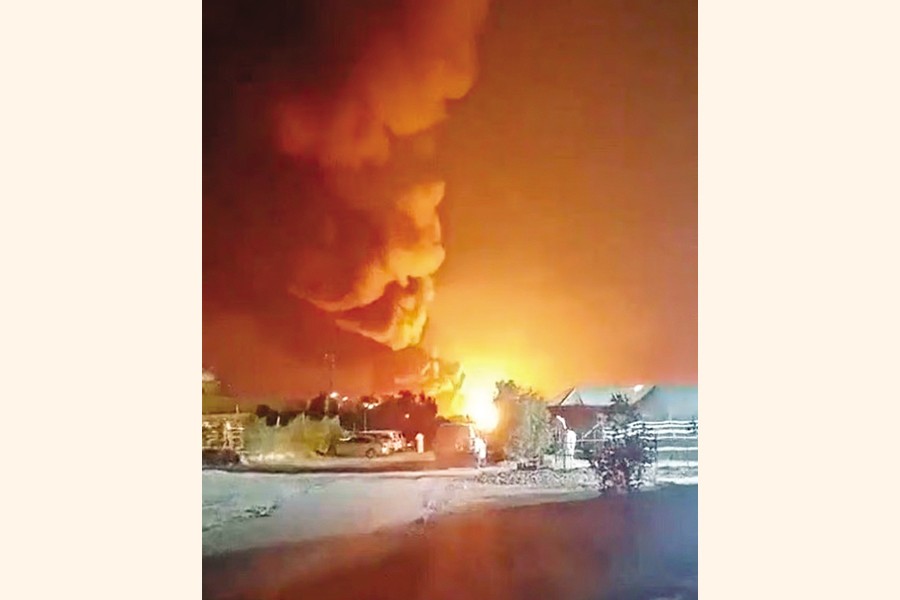
 Smoke billows from an explosion near the Ali Al Salem Airbase in Kuwait on Friday. — Reuters
 An Iranian missile strike Thursday sparked a blaze at Bahrain's main state-owned oil refinery as Iran pressed attacks across the Gulf, reports AFP.
 Some Western embassy staff in Riyadh were meanwhile told to shelter in place, diplomatic sources said, following an attack on the US embassy compound earlier this week.
The war in the Middle East has engulfed the otherwise stable Gulf region as Iran retaliates against US and Israeli strikes that killed its supreme leader, launching attacks on Israel, the wider region and beyond.
At least 13 people have been killed in the Gulf, including seven civilians, since Iran began its strikes on Saturday. Washington said six US servicemen were killed, including four in Kuwait.
A fire broke out at Bahrain's Bapco Energies refinery following the Iranian attack but was later contained, the kingdom's communications centre said.
There were no reported injuries from the strike at the refinery on the island of Sitra and operations continued, the government media arm added.
Earlier, Britain said it was temporarily withdrawing some embassy staff and their dependants from Bahrain due to the security situation.
A witness said the diplomatic quarter in the Saudi capital Riyadh had been closed off after some Western embassy staff in Riyadh were told to shelter in place, diplomatic sources told AFP.
The witness and diplomats spoke on condition of anonymity to discuss the sensitive security matter.
On Thursday evening residents in Abu Dhabi reported hearing a series of loud explosions and authorities said air defences were responding to a missile threat.
Air defences also confronted a missile threat in the emirate of Fujairah, home to a major port where Iranian attacks have already targeted an oil storage and trading hub.
- Waves of explosions -
In an earlier barrage in the Emirati capital, six Pakistani and Nepalese nationals were injured, officials said.
Fresh waves of explosions, most from interceptions, also rocked Dubai, Doha and Manama on Thursday.
In Doha, AFP journalists saw a plume of smoke rising and reported loud blasts across the city.
Qatar's defence ministry said its forces intercepted 13 Iranian ballistic missiles on Thursday, while one fell in Qatari waters, and four drones were also shot down, with no casualties reported.
Reuters adds: Iran has spent decades and billions of dollars preparing foreign proxy fighters like A.J., a commander in a pro-Iranian paramilitary group in Iraq, for a moment just like this. Since the U.S. and Israel went to war on the Islamic Republic a week ago, A.J. has been awaiting marching orders from Tehran.
But they have yet to come. And so as the leadership in Tehran faces a potentially existential threat, many of the fighters and militia groups the Iranians cultivated in Iraq have so far not entered the fight for them. There has been no mass mobilization of Iran's proxies inside Iraq, one of the last redoubts of the Islamic Republic's once-formidable system of alliances stretching from Gaza, Lebanon and Syria to Yemen and Iraq. Some pro-Iranian groups in Iraq have claimed attacks in recent days, to be sure. One group said it had fired drones at "enemy bases in Iraq and
the region," and several explosions rocked the northern city of Erbil, a Kurdish stronghold that hosts a U.S. base. But most missile and drone attacks have come directly from Iran, Kurdish officials say. The more than two-dozen attacks claimed online in the name of the Islamic Resistance of Iraq - a label used by various militants - have caused no significant damage, and in some cases there is no evidence of the attacks.
Even if direct orders do come from Tehran, A.J. believes that they'll only be issued to two or three of the dozens of Iraqi Shi'ite Muslim paramilitaries nurtured by Iran. "I just don't think most of them are reliable anymore," he told Reuters. "Some will act. Others would have front groups that could launch attacks with deniability. But many are just looking out for their own interests these days."
The trajectory of A.J.'s personal journey as a member of an Iranian-backed force in Iraq tracks the rise and fall of Iran's strategy of spreading proxy militias through the region, under the leadership of the elite Islamic Revolutionary Guards Corps and its expeditionary Quds Force, to fight America and Israel. His is the story of how the Israelis and Americans wore down and diminished most of these proxies, leaving the Islamic Republic facing its most perilous moment largely alone.
A.J., who is from Shi'ite-majority southern Iraq, spoke on condition he not be identified, for fear of being targeted by Israeli or U.S. strikes. Reuters is using the initials of one of his nicknames for clarity.
A.J. blamed several factors for the reduced military potency of Iran's Iraqi proxies: Israel and America's war of attrition against other regional allies, the loss of Syria as a supply line, and the transition of key commanders into Iraqi political and economic life.
His assessment is shared by more than two dozen people interviewed by Reuters, including militia members, Iraqi and Western officials, Shi'ite clerics, and close watchers of Iran's once-vaunted "Axis of Resistance." They painted a picture of a proxy network hollowed out by years of targeted assassinations of hard-to-replace leaders; the loss of secure bases for training and weapons transit; and the transformation of Iraqi commanders into wealthy politicians and businessmen with more to lose than gain from confronting the West.
The Iraqi militia leaders "don't want sanctions on them as individuals, they want to have access to Western healthcare, to have their children educated abroad," said Gareth Stansfield, a professor of Middle East politics at Exeter University and senior fellow at the Atlantic Council, who has advised the British and regional governments. "That's accelerated since the 12-day war" between Israel and Iran last June, he said.
Iraqi security officials and paramilitary insiders say Iran's proxies could yet enter the fray in force if the war drags on, if there's a U.S.-Israeli attack they perceive as being against Shi'ites as a whole, or if U.S.-backed Kurdish groups attack Iran.
Even if they wanted to fight, though, these Iran-backed groups lack the means they once had. They have used outmoded weaponry in their handful of attacks since the war began, according to Iraqi security officials. Tehran has sent no new weapons to his group since the battle with Israel last year, A.J. said. Reuters couldn't determine if this was the case for other pro-Iran militias in Iraq.
© 2026 - All Rights with The Financial Express

