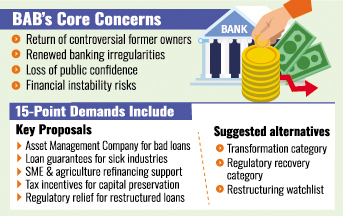
Bank owners' apex body deplores recent changes to the bank-resolution law which they fear could invite controversial former shareholders to regain control of troubled banks and consequently destabilise Bangladesh's financial sector over again.
Representatives of the Bangladesh Association of Banks (BAB) raised the issue Monday during a meeting with Bangladesh Bank (BB) Governor Mostaqur Rahman at the central bank headquarters.
Emerging from the meeting, BAB Chairman Abdul Hai Sarker said the association got "worried" about aspects of the new banking-resolution framework.
"We fear that if previous owners return, unwanted complications may begin again. That would not be good for the country," he told reporters, adding that ordinary citizens are already aware of allegations surrounding large-scale irregularities and "looting" in the banking sector.
The concern centres on newly interpolated Section 18(Ka) into the Bank Resolution Act 2026, which opens a window for former shareholders to get in and regain conditional control over the merged banks.
The amendment comes months after five crisis-hit Islamic banks - EXIM Bank, First Security Islami Bank, Global Islami Bank, Union Bank and Social Islami Bank - were merged into state-backed Sammilito Islami Bank PLC under a banking-resolution ordinance proclaimed by the post-uprising interim government in December last.
Mr. Sarker, also Chairman of Dhaka Bank, alleges that money siphoned out of banks has already been laundered abroad and warns that reinstating those responsible could create "serious problems" for the sector.
Responding to questions about the governor's views, he says the governor listened carefully to the concerns and assured BAB leaders that the authorities were taking steps.
BAB Vice-Chairman and UCB Bank Chairman Sharif Zahir. however, said the conditions incorporated in the law appear difficult to fulfill, suggesting that a return of former shareholders might not be easily achievable in practice.
In a separate statement, BAB says the meeting also focused on the broader crisis facing the banking industry, including rising non-performing loans, capital shortages, weak private-sector credit growth and declining investor confidence.
The platform of the bank shareholders also submitted a 15-point memorandum calling for coordinated policy support from regulators and the government to stabilise the sector.
The association also urges the continuation of employee incentive bonuses, arguing that such benefits are necessary to retain skilled workers and maintain morale in struggling banks.
The association further requests government or Bangladesh Bank guarantees for fresh loans aimed at reviving closed or sick industrial enterprises, saying that such support would reduce risk for banks and help restore market confidence.
Among its other proposals are creating a separate asset-management company to handle bad loans, regulatory relief for rescheduled loans, tax incentives for capital preservation, and expanded refinancing facilities for SME and agricultural lending.
It also mentions that the automatic migration of banks into Z Category due to temporary dividend restrictions or provisioning stress is creating severe pressure on investor confidence and banking-sector valuations.
The association proposes that banks under Bangladesh Bank-approved restructuring, recapitalization or transformation programmes should not automatically be categorised under Z Category. Separate temporary classifications may be introduced, such as transformation category, regulatory-recovery category, and restructuring watchlists
Additionally, BAB calls for broader consultation with banking stakeholders before finalising reforms related to banking governance, ownership structures and capital requirements.
jubairfe1980@gmail.com
© 2026 - All Rights with The Financial Express

