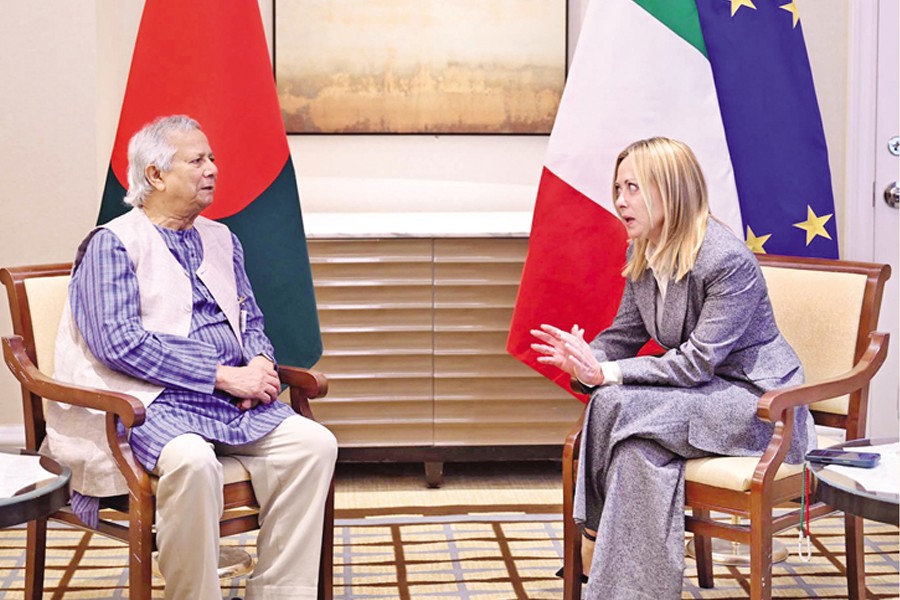
 Italian Prime Minister Giorgia Meloni holds talks with Bangladesh Chief Adviser Prof Muhammad Yunus at a hotel in New York on Thursday. — PID
 Bangladesh is undergoing a profound political transition through reforms as it prepares for elections in February so that a return of authoritarian rule is prevented, Chief Adviser Muhammad Yunus has told world leaders.
Trade, migration, bilateral and greater economic cooperation and current global issues of common concern figured high in his talks with the heads of state or government of Pakistan, Italy, Finland and Kosovo, said a spokesman for the CA Office on Thursday.
In a string of meetings on the sidelines of the UN general assembly in New York on Wednesday, Prof Yunus said the interim government adopted sweeping recommendations from 11 national commissions and was guiding parties towards signing 'July Charter' incorporating constitutional and political reforms.
"These reforms are aimed at preventing the rise of another autocrat in Bangladesh," he said, stressing that for the first time in 15 years, citizens are expecting to cast their vote in "a free and festive atmosphere".
Yunus met Pakistani Prime Minister Shehbaz Sharif discussing trade, investment and cooperation in a region where Saarc has remained largely moribund.
Sharif, whose country just witnessed devastating floods that killed more than 1,000 people, blamed the climate crisis for intensifying disasters.
Yunus offered condolences and expressed readiness to deepen cooperation, while Sharif invited him to Islamabad before his government's term ends.
In talks with Giorgia Meloni, the Italian prime minister, he proposed an Italy-Bangladesh business forum to encourage investment. Migration dominated the discussion, with Meloni urging safer pathways and stronger action against traffickers. Yunus responded that his government adopted a zero-tolerance policy on human smuggling.
Both leaders raised the Rohingya refugee crisis, and Meloni pledged to dispatch a delegation to next week's UN conference. She praised Yunus' leadership and promised EU support to ensure Bangladesh's election is credible.
In his meeting with the CA, Finnish President Alexander Stubb focused on Bangladesh's foreign-policy direction, the Russia-Ukraine war and the need to reform the UN.
Yunus said Bangladesh was seeking ASEAN membership to act as a bridge between South and South-east Asia.
The head of post-uprising government also noted that the trials of deposed former prime minister Sheikh Hasina and her allies were being conducted under international standards. "Despite facing trial, she continues to make incendiary and destabilising remarks," he said.
While meeting Dr Yunus, Kosovo's president, Vjosa Osmani, thanked Bangladesh for recognising her country early and called for new agreements in trade and textiles, as well as formal labour-recruitment channels. She highlighted Kosovo's economic growth and the contribution of Bangladeshi workers. Yunus welcomed the proposals and extended an invitation for Osmani to visit Dhaka.
Across his meetings, Yunus repeatedly underlined his government's mission: to stabilise a country that has been without a fair election for more than a decade and a half.
"Our people have been deprived of a free and fair election for the past 15 years. Now they are eagerly looking forward to February," he said.
mirmostafiz@yahoo.com
© 2026 - All Rights with The Financial Express

