Bangladesh's private bank owners have urged the government to toughen laws to help recover huge default loans and heal the ills facing banks following "massive looting" during the past political regime.
They placed the demand Tuesday at a meeting with Finance Minister Amir Khosru Mahmud Chowdhury at his secretariat office in the capital, ahead of a crucial budget coming soon.
Chairman of Bangladesh Association of Banks (BAB) Abdul Hai Sarker led the delegation of bank owners at the meeting, where a detailed discussion took place on banking situation.
"If the government toughens the laws, at least 60 per cent of bad loans can be recovered very easily," Mr Sarker told The Financial Express after the meeting, referring to their talks with the minister.
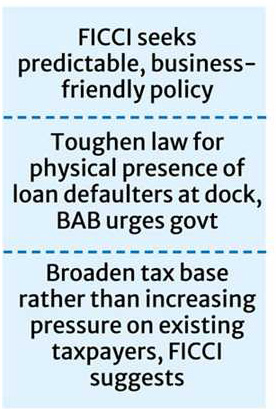
He says they demanded preparing a law on mandatory physical presence of the loan defaulters at the court dock instead of allowing them to be represented by a lawyer only.
"Many loan defaulters who fled abroad are avoiding repayment of loans, and at the same time, ensuring presence at court by a representative which leads to inordinate delay in loan recovery."
Also, the BAB demanded bringing an amendment regarding how many people of a family can be director of a bank company.
Mr Sarker says they requested the finance minister to take measures so that people's confidence in banking sector can be restored. He says the finance minister has assured the bank owners that the government will follow international best practices in the case of banking sector.
"Necessary measures will be taken to eliminate the irregularities," Mr Sarker quoted the minister as saying.
Earlier, a delegation of the Foreign Investors' Chamber of Commerce and Industry (FICCI), led by its president Rupali Haque Chowdhury, met the finance minister at his office discussing the upcoming national budget for FY 2026-27 and broader economic priorities under the new government.
During the meeting, the two sides exchanged views on the country's investment climate, current economic challenges, and measures needed to attract greater foreign direct investment (FDI).
The FICCI representatives emphasised the importance of a predictable and business-friendly policy environment, highlighting the need for a long-term budgetary roadmap that would enable investors to better anticipate tax structures and make informed investment decisions.
The chamber also stressed the importance of competitive tax policies, policy consistency, and transparency to strengthen investor confidence and enhance Bangladesh's competitiveness among peer economies.
Ms Chowdhury told The Financial Express that during the meeting, they also discussed the corporate tax rate as nominal corporate rates may seem low but the effective tax rate remains excessively high due to various non-deductible expenses and administrative hurdles.
She underscores the need for broadening the tax base rather than increasing pressure on existing taxpayers, a principle the minister reportedly acknowledged as a necessary direction for future budgetary policy.
Senior vice-president of the FICCI Deepal Abeywickrema and vice-president Mohammad Iqbal Chowdhury also attended the meeting, among other directors.
syful-islam@outlook.com
© 2026 - All Rights with The Financial Express

