Commercial banks' interbank and central-bank borrowings continue to plummet amid credit-demand squeeze for sluggish economic activity and also liquidity saturation through foreign-exchange conversion to local currency, experts say.
The central bank intensifies its foreign-exchange-market intervention to stabilise the dollar-taka exchange rate, thereby funneling local-currency liquidity into bank vaults as spinoffs.
As a matter of fact, the commercial lenders manage liquidity to meet their local-currency obligations through selling the precious American greenback amid lower credit demand from the private sector.
It ultimately helps banks, which often go for borrowing either from the interbank market or Bangladesh Bank to meet their requirements, lessen their liquidity appetite and borrowing through overcoming the demand-supply mismatch.
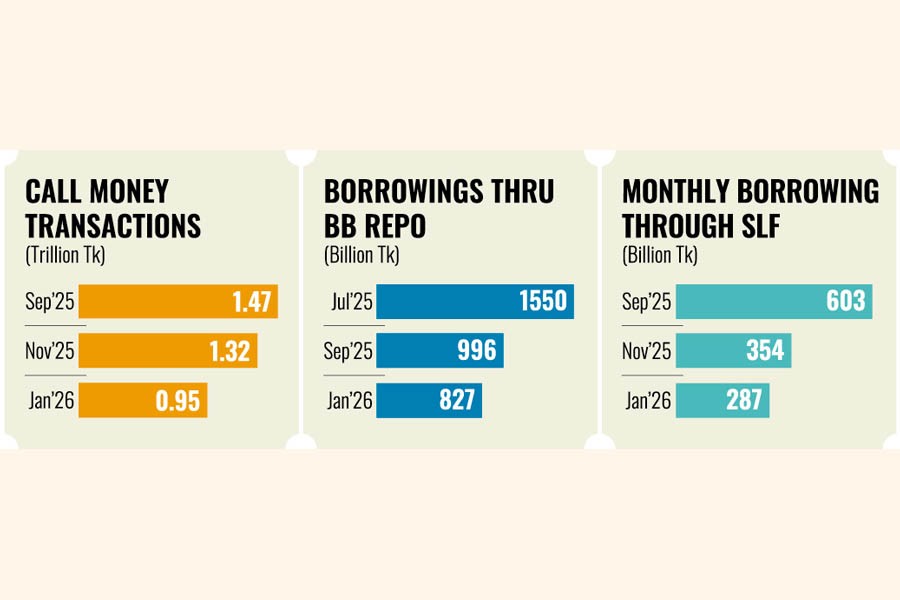
According to latest BB data, the monthly volume of call-money transactions through which banks make short-term borrowing within themselves dropped to Tk 954 billion in January last from Tk 1.47 trillion and Tk 1.32 trillion recorded in September and November last year respectively.
Central bank repo is another major instrument through which the banks can borrow funds from the regulator and the data showed that commercial banks altogether borrowed Tk 1.55 trillion in July last year but the monthly borrowing dropped to Tk 996 billion in September and Tk 827 billion in January 2026.
On the other hand¸ through the special liquidity facility under which there is seven borrowing windows like ALS (assured liquidity support), AR (assured repo) and IBLF (Islami Banks Liquidity Facility), the banks overall borrowed Tk 1.43 trillion from the central bank in July.
The monthly-borrowing volume declined to Tk 603 billion, Tk 354 billion and Tk 287 billion in September and November last year and January this year respectively.
Seeking anonymity, a BB official says the banking regulator kept purchasing the US dollar from the banks since July 13 last year to stabilise taka-dollar exchange. Under such forex-market intervention, the central bank has so far bought $5.26 billion from the market and injected more than Tk 650 billion into the banks.
"This intervention plays a major role behind commercial banks' plummeting borrowing trend," he told The Financial Express.
Managing Director and CEO of NRBC Bank Dr Md. Touhidul Alam Khan opines that at present, the interbank call money is trading below the Bangladesh Bank's repo rate--a situation primarily driven by the central bank's sustained foreign-exchange-market interventions.
Each such purchase involves supplying the Bangladeshi taka to commercial banks in exchange for US dollars, thereby injecting significant local-currency liquidity into the banking system.
"This injection expands the overall money supply and substantially enhances liquidity within the financial sector. With increased cash reserves, banks experience a surplus of funds, reducing their reliance on short-term borrowing and easing interbank funding pressures," he explains.
Consequently, banks are more willing to lend to one another at competitive rates, leading to a decline in the interbank call-money rate. In this environment, borrowing from other banks at lower rates becomes more attractive than accessing central bank liquidity at the comparatively higher repo rate, he also adds.
Apart from BB's dollar purchase, Managing Director of Shahjalal Islami Bank Mosleh Uddin Ahmed says, the private-sector credit growth dropped to a historical low of 6.10 per cent in December 2025.
The entrepreneurs who have been surviving in this economic sluggishness cannot afford lending rate as high as 15 per cent in the current context. "So, the private-sector players don't have credit appetite now. This is another factor," the seasoned banker observes.
He offers suggestion for the government that the economic activities ought to be made vibrant through reducing the inflation rate, policy rate and interest rate.
Director-General of Bangladesh Institute of Bank Management (BIBM) Dr Md. Ezazul Islam has said the central bank continues non-sterilized forex-market intervention to keep the exchange rate stable amid record inflows of remittance.
"And it significantly raises money supply into the market amid lower credit demand. That's the major reason behind banks' falling borrowing trend," he added.
But the money-market expert thinks the credit demand, especially from the private sector, might pick up from the last quarter of this fiscal in the post-elected-government regime.
jubairfe1980@gmail.com
© 2026 - All Rights with The Financial Express

