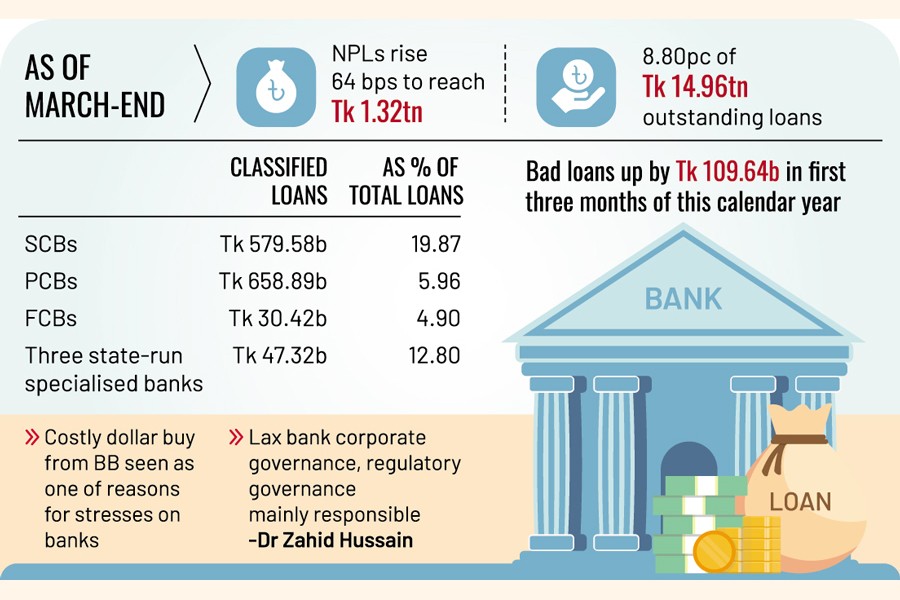
Banks' ostensible non-performing loan (NPL) buildup in Bangladesh has ballooned over Tk 1.32 trillion, sources say, although real burden is heavier with rescheduled and written-off credits apportioned through 'window-dressing'.
Bankers and economists say the pressure on the banking sector continued mounting with the NPLs or classified loans having increased by 64 basis points to reach the above-mentioned figure as per statistics available until end of last March.
In fact, they say, actual size of the stress assets in banks would be much higher than the NPL amount if the volumes of loan rescheduling and write-off are taken into account.
In the first three months of this calendar year, the amount of classified loans had gone up by Tk 109.64 billion, according to the latest data Bangladesh Bank (BB) released Sunday.
With this latest surge, the overall ratio of non-performing loan or classified loans stood at 8.80 per cent of the outstanding money lent out from banks that amounts to Tk 14.96 trillion as of March.
The NPL ratio is 64-basis-point higher than that of the previous quarter (October-December) when it was calculated as 8.16 per cent of the total lending.
In terms of category of banks, the volume of classified loans in the state-owned commercial banks (SCBs) stood at Tk 579.58 billion, or 19.87 per cent of their total outstanding. In private commercial banks (PCBs) the figure rose to Tk 658.89 billion or 5.96 per cent of their total outstanding.
The ratio of NPL in foreign commercial banks (FCBs) is 4.90 per cent or Tk 30.42 billion while it is 12.80 per cent (Tk 47.32 billion) in the country's three state-run specialised banks.
Seeking anonymity, a central banker said fall in banks' deposit growth and liquidity tightness due to buying a substantial amount of US dollar from the central bank to settle their overseas transactions threw the commercial banks under pressure.
"And the rise in NPL volume has certainly intensified the stress further. It is not a good sign for the economy and both the central bank and commercial banks need to further strengthen their monitoring to stem default loans from growing," the BB official observed.
Contacted, former lead economist at the World Bank's Dhaka office Dr Zahid Hussain said the current data of NPL that BB normally releases are a part of the stress assets. If the amounts of loan rescheduling and write-off are taken into consideration, the overall volume of stress assets could go over 20 per cent.
Terming such growing volume of dud money a serious weakness in the financial sector he held "absence of corporate governance in banks and regulatory governance" mainly responsible for the NPL snowballing.
"Corporate governance in banks needs to be seriously strengthened," the economist suggests.
He notes that those who use NPL as one of their business tools are largely benefiting from the various steps of relaxation by the central bank.
Former BB governor Dr Salehuddin Ahmed says it is very frustrating that the volume of bad loans keeps mounting for what he calls governance failure of the commercial banks.
He thinks it cannot be controlled with soft policy stance of the central bank. The BB needs to be stricter and set a periodic target to cut the NPLs.
If the BB asks the banks to lessen 10 per cent of NPLs in three months' time to avert losing facilities from the central bank, it would help reduce the burden of bad loans, he told the FE.
"Instead, the BB relaxes provisions one after another. As a result, the NPL buildups now stood at Tk 1.32 trillion, which was only Tk 220 billion while I was the BB governor in 2009," Mr Ahmed added.
Talking to the FE correspondent, Chairman of the Association of Bankers, Bangladesh (ABB) Limited Selim R. F. Hussain said banks had been trying hard to reduce the old legacy of NPL.
But the bank management face difficulties in recovering those as large corporates hold major share of the classified loans.
"I think banks cannot solve this burden alone. A comprehensive plan of actions involving all the stakeholders is needed alongside strengthening exiting legal framework introducing more courts," said Mr Hussain, also managing director and chief executive officer of BRAC Bank.
jubairfe1980@gmail.com
© 2026 - All Rights with The Financial Express

