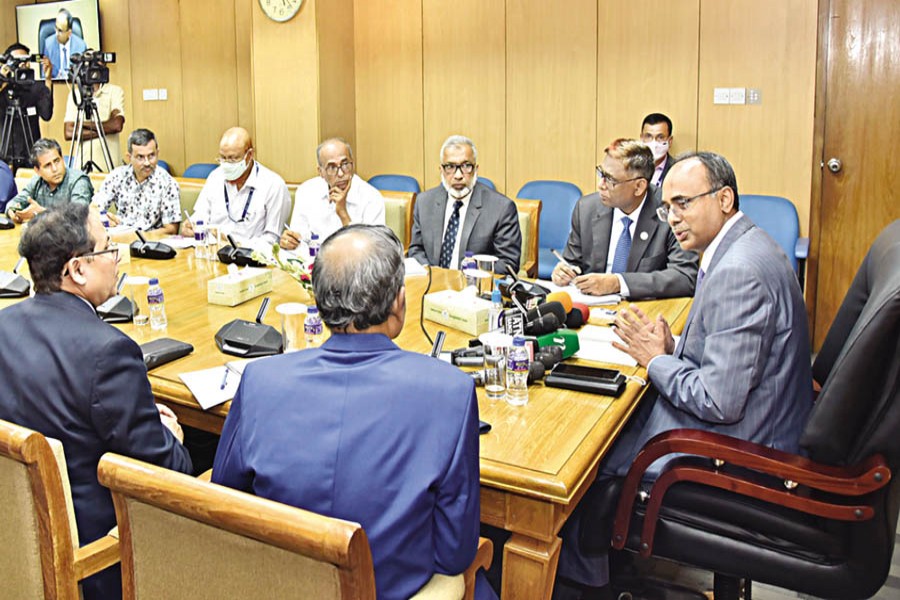
 Newly appointed Bangladesh Bank Governor Abdur Rouf Talukder (right) speaks at a press conference at the central bank on Tuesday after he takes over as the governor — Photo: Collected
 Top finance official Abdur Rouf Talukder opens his stint as Governor of Bangladesh Bank with first priority attached to curbing inflation, as people struggle to pay high prices.
Next urgent do the new governor of the central bank sets in his priorities is taming the heated foreign-exchange market that also adds up to the inflationary pressure on the economy.
"It will be possible to contain inflation through the central bank working jointly with the finance ministry of the government," the new central bank chief said Tuesday to a query at his maiden press conference after his switch from the finance ministry.
Mr Talukder took charge of the central bank on the day for the term of next four years. He succeeds former governor Fazle Kabir, whose tenure was over on July 03.
The central bank has already devised different mechanisms, including enhancing policy rate twice recently, while the government has also taken some measures to contain the inflation, the BB governor explained.
The policy rate, which is followed by banks to fix their interest rates on both loans and deposits, was raised by 50 basis points to 5.50 per cent on June 30.
"It's import-induced inflation. Now we are trying to curb the inflation through containing demand-side growth along with intervention in the supply side also," he notes.
He also mentions that both the national budget and the monetary policy have given top priority to containing inflationary pressure on the economy.
The government as well as the BB's latest moves came against the backdrop of rising trend in the inflationary pressure on the economy in recent months, following higher prices of both food and non-food items in lockstep with their global price rises.
The inflation - as measured by consumer price index (CPI) - rose to 5.99 per cent in May 2022 on a 12-month-average basis from 5.81 per cent a month before, according to the Bangladesh Bureau of Statistics (BBS) latest data.
The new central bank chief also lists six other priority tasks, including exchange-rate stability, improving the country's foreign-exchange- reserve position, ensuring financial stability, enhancing investment in the private sector, restoring confidence in the non-banking financial institutions (NBFIs) and supplying required money to achieve maximum economic growth.
"We'll work to improve the country's foreign-exchange-reserve position which will be able to meet six-month-plus import-payment obligations," the governor said while describing the latest reserves situation in Bangladesh.
He said the reserves are now under pressure mainly due to higher commodity prices on the global market.
Ensuring financial-sector stability through improving capital-to-risk weighted-asset ratio (CRAR) of the banks will be another priority task of the central bank under the new governor.
"We'll also try to rebuild the NBFIs sector for restoring public confidence," he notes, as there have been reports of deviations and deceptions.
He also said the central bank would also work to enhance investment in the cottage, micro, small and medium enterprises (CMSMEs).
"We'll also help the government for achievement of maximum economic growth through supplying required money," the governor said while replying to another query.
Regarding the upcoming International Monetary Fund (IMF) appraisal mission, the central bank governor said Bangladesh has already informed the IMF that the country wants homegrown reforms.
"We want homegrown reforms that have already been mentioned in our national budgets," he added.
About exchange-rate stability, the BB governor said the central bank would work to reduce gap between the outflow and inflow of the foreign exchange.
Actually, the local currency is maintaining a depreciating trend recently- mainly due to higher outflow of foreign exchange - following a hefty growth in import payments amid global price rises, compared to the inflow in the last few months.
The BB governor also spoke on different other issues, like lending-rate cap and autonomy of the central bank.
"Our committee and board will take decisions how to accommodate policy rate along with the lending ones," the governor said while replying to another query.
Earlier, the central bank had instructed all the scheduled banks to fix a maximum 9.0-percent interest rate on all loans, except credit cards, as part of government initiative to bring down the rate to single digit from April 01, 2020.
Meanwhile, senior economists as well as the International Monetary Fund (IMF) already suggested that the policymakers phase out cap on the lending and borrowing rates to help strengthen monetary transmission.
Mr Talukder wants to see the central bank as an intellectual institution, effective professional organization and apex regulatory body in the country's financial sector during his tenure.
Three deputy governors and other high-ups of the central bank attended the press conference, held at the central bank's headquarters in Dhaka.
On behalf of the officials of the central bank, the deputy governors welcomed the new governor with flowers earlier in the day. A ceremony was also held to mark his tenure as the new governor.
Mr Talukder held a series of meetings with the high officials of the central bank immediately after joining as the governor.
Earlier on June 11, the government picked senior secretary of the finance division Mr Talukder as the 12th governor of the BB.
Born in August 1964, Mr Talukder holds a master's degree in Development Management from the University of Birmingham in the UK and an MBA from Dhaka University's Institute of Business Administration.
He joined the Bangladesh Civil Service in February 1988 and has held a wide range of government positions during his career, specialising in public finance and economic management.
siddique.islam@gmail.com
© 2026 - All Rights with The Financial Express

