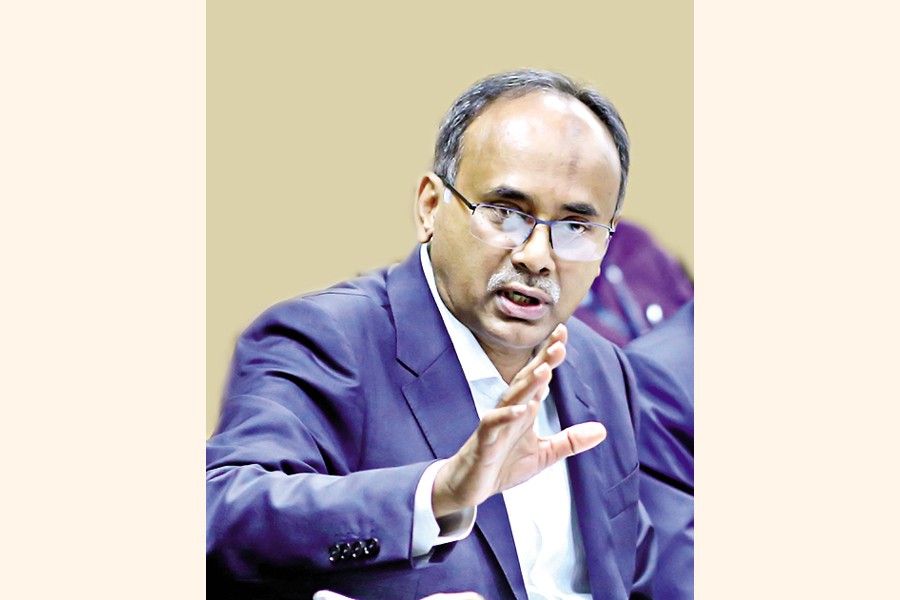
 Abdur Rouf Talukder
 Terming the latest downgrade by Moody's on some local banks as "geopolitical", Bangladesh Bank Governor Abdur Rouf Talukder said on Sunday that the global rating agency did not base the rating solely on economic indicators.
The central bank governor expressed his reaction while responding to a question during the launch of the half-yearly monetary policy statement (MPS) starting next month.
He said the international credit rating agency initially downgraded Bangladesh in 2012 when the country's reserves were US$ 10 billion and the size of per capita income, exports and imports were comparatively lower.
However, the central bank governor said that the country has made significant progress in all macroeconomic indicators over the years, as the reserves rose to US$ 48 billion, per capita income was close to US$ 3000 and exports and imports increased significantly.
Despite these improvements, the credit rater did not change the rating, said Abdur Rouf Talukder.
Surprisingly, it downgraded the banking system, even though it is now much stronger in all parameters compared to 2012, he remarked.
"So, I think it is geopolitical, it is not done purely considering economic factors. We don't think it will hamper remittance inflow and FDI [foreign direct investment] because potential oversea investors have all the data about our economy," the governor said.
He also mentioned that the rating was assigned for issuing sovereign bonds, which the economy has not yet issued, making it "insignificant" for them.
Earlier, on May 31, Moody's Investors Service downgraded the ratings of six local banks - BRAC Bank, The City Bank, Dutch-Bangla Bank Limited, Eastern Bank, NCC Bank and The Premier Bank. Besides, it revised the outlook on Bangladesh's banking system from stable to negative in a report published on March 1.
Regarding the increasing injection of high-powered money or newly circulated money, the governor said that the liquidity situation in the banking sector is under stress due to various factors in the economy, where the money base as a percentage of GDP is as low as 40 per cent.
In India, the money base is twice the size of its GDP. In economies similar to Bangladesh, such as Thailand, Cambodia and Vietnam, the money base is equivalent to their GDP. "If two or three per cent of the money drives out of the base, it has no impact on their economy."
However, commercial banks in Bangladesh have so far purchased US$ 13 billion from the Bangladesh Bank in the current fiscal year (FY'23), spending around Tk 1.24 trillion, which accounts for 6 per cent of the country's money base, according to the governor.
"It created further pressure on the liquidity situation. If we allow the government to borrow from commercial banks under the current context, the scope for getting credits by the private sector from banks will be badly affected. That we don't want," he said.
The governor said all economies, including the most advanced ones, inject high-powered money. "We need to see where money is being spent, which is important."
Typically, the government borrows from the banking system for the purpose of financing the Annual Development Programme (ADP) rather than meeting its recurring expenses. "It is an investment that offers a good return," he claimed.
Regarding the negative state of the financial account after more than a decade, the governor outlined a few reasons behind this unexpected situation.
Firstly, when the US Federal Reserve raised the exchange rate, individuals with portfolio investments and short-term loans returned to the US market in search of higher returns, said the central bank governor.
Secondly, private sector players who had taken out loans three to four years ago at much lower interest rates faced significant challenges as rates increased. These loans became very expensive, prompting entrepreneurs to repay them hastily before their maturity, he commented.
Simultaneously, the implementation progress of the ADP, particularly in areas with foreign aid, was unsatisfactory, according to the governor.
These three factors contributed to the negativity of the financial account, he explained.
The governor said that they have implemented several measures to rapidly change the situation. There is a total of US$ 50.2 billion in approved aid that remains in the pipeline due to the country's inability to spend it.
"If we can spend one-fourth [$12.5 billion] of the pipelined aid this year, it will have a positive impact on the financial account," he said.
Besides, there are signs of a declining rate in the US Fed. If this occurs in the coming months, portfolio investors will return to the economy. The country must be cautious and ensure the effective implementation of ongoing projects.
"If we can do these accordingly, the financial account will turn into a positive regime again," the governor added.
jubairfe1980@gmail.com
© 2026 - All Rights with The Financial Express

