Bangladesh is going to borrow a costly US$300-million budgetary support from Japan as the new BNP administration aggressively searches funds for minimising hefty deficit in budget financing, officials say.
The government had decided not to go for taking fresh loan with Japan's newly imposed higher interest rate. But it eventually goes for borrowing the budget support at the elevated fresh rate amid massive budget deficit this fiscal year (FY) 2025-26.
Japanese development agency JICA is likely to confirm $300 million worth of budget support to Bangladesh at a higher 3.05-percent interest rate this week.
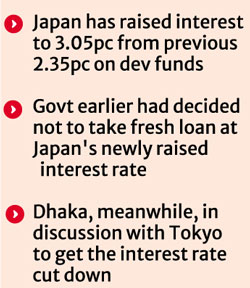 Before the proposed credit, the Japan International Cooperation Agency (JICA) would charge 2.35 per cent on its loans against different development projects in Bangladesh.
Few months back, JICA had informed Bangladesh that its lending rate would go up to 3.05 per cent for project financing.
"We have no option but to borrow the budget-support credit with higher rate due to necessity of the government. The government needs the funds within this fiscal year ending on June 30 for financing the hefty deficit in the national budget," says a senior Ministry of Finance (MoF) official.
"However, we have informed Japan that this will be the single loan with the newly imposed rate and, at the same time, we have requested the lender to reduce its newly imposed interest rate for Bangladesh."
He adds: "If we borrow at 3.05-percent rate, the Japanese loan will no more be concessional.
"Actually, we are discussing with Japan so that it does reduce the lending rate from the recently imposed higher 3.05 per cent."
Once-most-concessional loan is going to be costlier as Japan has recently proposed to increase its interest rate by 30-percentage points to 3.05 per cent for Bangladesh.
Up till now, the Japanese lender, JICA, has charged 2.35 per cent on its loans against different development projects in Bangladesh.
Even three years ago, the interest rate for the Japanese loan was less than 1.0 per cent, officials note.
Not only the rate for the infrastructure-related project loans is being proposed to be increased, the rate for the consultancy credits will also be increased to 1.0 per cent from the current rate of nearly 0.85 per cent.
The lending rate will be effective for six months up to September 2026, as the JICA changes its lending terms and conditions for Bangladesh half-yearly, he says.
Although the loan-maturity period and grace period would be same like the current ones in the next 6-month cycle, the interest rate would be charged at higher rate, he adds.
The JICA also charges 0.02-percent front-end fee for almost all the loans to Bangladesh, officials have said.
Bangladesh needs to repay the Japanese loans in 30 years where it will get 10 years as the grace period for the repayment.
As a least-developed country (LDC) with low income, Bangladesh had enjoyed Japanese loans with only 0.1-percent interest until 2015.
Another official at the MoF told The Financial Express that Bangladesh government is working with Japan to get the newly imposed 3.05-percent interest rate reduced.
"If the JICA does not lower the lending rate, it will be very difficult to engage our largest bilateral development partners with Bangladesh's next development works," he says.
"Since we have a very good relation and Bangladesh is one of the biggest trading partners of Japan, we want to continue relations with Tokyo even in our infrastructure development," the MoF official adds.
kabirhumayan10@gmail.com
© 2026 - All Rights with The Financial Express

