Bangladesh's reciprocal trade-tariff deal with the United States is bound with strings that bar it from signing any free-trade deal or preferential economic deal with "non-market" countries, including China and Russia, without US consent.
The US has officially listed 12 countries as non-market: China, Russia, Vietnam, Belarus, Armenia, Azerbaijan, Georgia, Kyrgyzstan, Moldova, Tajikistan, Turkmenistan, and Uzbekistan.
"If Bangladesh enters into a new bilateral free-trade agreement or preferential economic agreement with a non-market country, it undermines this Agreement. The United States may, if consultations with Bangladesh fail to resolve its concerns, terminate this Agreement and re-impose the applicable reciprocal tariff rate set forth in Executive Order 14257 of April 2, 2025," the deal document reads.
Bangladesh is in talks with many countries on signing bilateral free-trade agreements (FTAs) and preferential economic deals ahead of leaving the club of least-developed countries (LDCs) in November next.
Feasibility study on Bangladesh-China FTA was completed in July 2024, and in March last year, the two sides agreed to open negotiations. Also, Bangladesh is exploring ways to sign preferential trade deals with CIS (Commonwealth of Independent States) countries to boost trade with the breakaway former Soviet states.
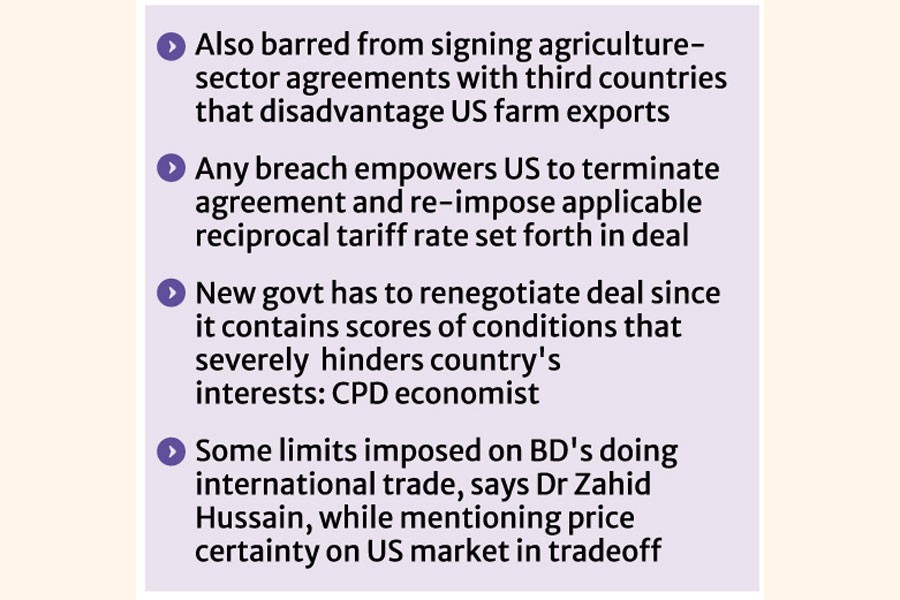
A top fellow at the Centre for Policy Dialogue (CPD) told The Financial Express Wednesday that the oncoming new government would have to renegotiate the Bangladesh-US reciprocal trade deal since it contains scores of conditions that severally hinders interests of the country.
"Through this deal, the US has bound Bangladesh hand and foot on economic, trade and political fronts," he said, preferring not to be quoted by name.
Also, in case of signing any deal on agriculture front with any country, Bangladesh will have to take clearance from the US to ensure that the deal would not disadvantage US exports to such third countries.
"Bangladesh shall not enter into agreements or understandings with third countries that include non-scientific, discriminatory, or preferential technical standards; include third-country SPS measures that are incompatible with US or international standards; or otherwise disadvantage US exports to such third countries," mentions the reciprocal tariff deal.
It also says Bangladesh shall provide non-discriminatory or preferential market access for US agricultural goods. And the country has to ensure that its sanitary and phytosanitary (SPS) measures are science-and risk-based and do not operate as disguised restrictions on bilateral trade, and shall remove unjustified SPS barriers in areas that undermine reciprocity.
On the labour front, the deal mentions that Bangladesh has to adopt and implement a prohibition on the importation of goods mined, produced, or manufactured wholly or in part by convict labour or forced or compulsory labour, including indentured labour and indentured child labour.
Dr Zahid Hussain, a former lead economist at World Bank's Dhaka office, says the total cost-benefit analysis of the reciprocal tariff deal has yet to be done.
He notes that the benefit offered under this deal is 19-percent reciprocal tariffs and zero reciprocal tariffs on goods made and exported by using US cotton.
"The tradeoff of this deal is price certainty in US market," he told The Financial Express.
Mr Hussain also mentions that Bangladesh has given up some policy autonomy which means some limits have been imposed on the country's doing international trade.
"But there is option. You can always exit from the reciprocal deal if it is found against the interest of the country," he says.
syful-islam@outlook.com
© 2026 - All Rights with The Financial Express

