Bangladesh and India have discussed strategies to absorb the shock of the ongoing Ukraine war, especially on the food supply chain and energy.
Both the parties have had an extensive discussion during a meeting between Bangladesh Foreign Minister Dr AK Abdul Momen and Indian External Affairs Minister S Jaishankar at Guwahati in India.
Commenting on the meeting, Dr Momen told the newsmen on Saturday that the discussion had taken place the previous night as both the ministers were staying at the same hotel to take part in an international conference.
As the Ukraine war has left an impact on the supply chain, both the ministers agreed to cooperate with each other to address the challenges on the economy, he informed.
India is procuring Russian oil at a reduced price, but Bangladesh cannot do that due to the sanction issue, Momen said, in response to a question.
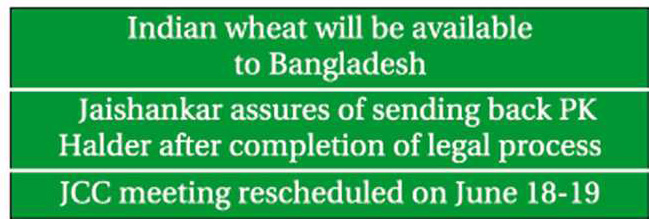
He said India had assured Bangladesh of continuing wheat exports to the latter.
The Bangladesh minister said he had raised the issue of getting back bank swindler PK Halder, who had recently been arrested in India.
In this regard, the Indian foreign minister said Halder would be sent back to Bangladesh but he did not mention when, Dr Momen said.
However, the Indian minister sounded very sincere in handing the Halder issue, the Bangladesh minister said.
During the meeting, both the foreign ministers agreed to defer the Joint Consultative Committee (JCC) meeting between the two countries which was scheduled to be held in Delhi on Monday.
Now, the JCC meeting has been deferred until June 18-19, said Dr Momen, adding that the meeting between rail ministers of the two countries and the Joint River Commission (JRC) meeting were supposed to be held before the JCC.
Mr Momen said he had requested the Indian counterpart to hold the JRC meeting before the JCC meeting and the Indian minister said he would talk to the officials concerned in this regard.
It has been 12 years since the last JRC was held, he pointed out.
Replying to a question, Mr Momen said he had raised the issue of Teesta water-sharing agreement during the meeting, while the Indian side reiterated the same explanation saying that the deal could not be materialised due to the opposition of the West Bengal state government.
Meanwhile, addressing the Asian Confluence River Conclave 2022, titled 'Natural Allies in Development and Interdependence' (NADI), both the foreign ministers stressed the need for enhancing connectivity among the countries that stand on the basin of the Ganges, Brahmaputra and the Mekong.
The event was organised by the Indian think tank Asian Confluence, in collaboration with the external affairs ministry of India and the government of Assam.
Bangladesh foreign minister told the conclave that riverine transport between Bangladesh and India had contributed to the growth of both the countries.
He narrated the improvement in the cross-border riverine and other modes of transports under transit provided to India by Bangladesh.
The Bangladesh minister also urged the regional countries to take a united and comprehensive river basin management programme to protect the river systems.
Such a united effort can help deal with the impact of siltation, erosion and the loss of navigability of regional rivers, Dr Momen opined.
At the same time, he also urged the regional countries, especially India and the ASEAN countries, to help speed up the repatriation process of one million Rohingyas from Bangladesh to their homeland in Myanmar.
Due to a long delay in the process, Rohingyas are getting involved in various crimes, posing a threat to regional security, Mr Momen argued.
As Bangladesh helped India root out terrorism from the North-Eastern states, India should similarly take measures for quick repatriation of Rohingyas in a bid to make the region free of terrorism, he pointed out.
Dr Momen said Bangladesh now has the right features to become a bridge between South Asia and South-East Asia.
He said Bangladesh had requested India to link its national waterways with the river system of Bangladesh to tap the real potentials of river communications.
In his speech, Indian External Affairs Minister S Jaishankar highlighted the importance of connecting the North-Eastern region of India with the South East Asian countries.
He also narrated the progress made in enhancing connectivity with Bangladesh in recent times.
Jaishankar noted that apart from road, transport and river communication, strengthening connectivity in power and IT sector is also crucial for growth.
The broadband connectivity from Bangladesh is helping the Indian state of Tripura, while the power connectivity from India is helping Bangladesh too, he said.
Connectivity can boost the growth immensely if the regional countries "can get the politics and economics right," the Indian foreign minister observed.
In his opening address, Chief Minister of Assam Himanta Biswas Sharma lauded Bangladesh for providing his state the access to sea ports.
He also mentioned that Bangladesh had played a crucial role in curbing insurgency in his state.
Experts, parliament members, bureaucrats and senior diplomats of the South East and South Asian regions took part in the conclave.
mirmostafiz@yahoo.com
© 2026 - All Rights with The Financial Express

