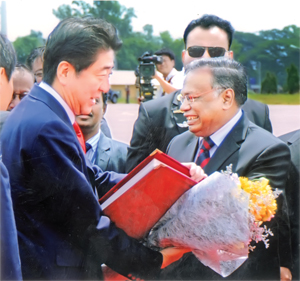
 Foreign Minister Abul Hassan Mahmood Ali saw off Japanese Prime Minister Shinzo Abe at the Dhaka airport on Sunday morning. — PID
Satisfied with broader agreements reached between the two nations at summit level to lift bilateral relations onto a higher trajectory, Japan now hopes to work with Bangladesh to promote the Bay of Bengal Industrial Growth (BIG-B) initiative.
Such initiative is aimed at faster economic progress through useful investment and infrastructure development. "There are more rooms for improvement," said a spokesman for the Japanese Prime Minister's office about the need for building on the plans set through exchanges at the highest level of two governments.
Kenko Sone, the spokesperson for the Japanese Prime Minister's office, was talking to a number of journalists at the breakfast table at Hotel Sonargaon prior to departure on Sunday morning.
The Japanese Prime Minister, Shinzo Abe, left for Sri Lanka on the last leg of his tour of two South Asian countries, wrapping up his two-day Bangladesh visit.
Mr Kenko, who is Deputy Cabinet Secretary for Public Affairs of the Prime Minister's Office, shared the success of his Prime Minister's visit to Bangladesh and said it is now necessary to strengthen the relations further based on 'comprehensive partnership'.
Bangladesh and Japanese Prime Ministers signed joint statements in Tokyo and in Dhaka during the two premiers' exchange of visits to respective countries May 25-28 and September 6-7. In the communiqués both sides committed to working for the comprehensive partnership based on the shared values of peace, democracy, human rights and the rule of law.
The spokesperson for the Japan PMO said Japan's focus on economic reform through 'Abenomics' policy is to take its seat in the global economy through overcoming its depressive economic growth for long 20 years
In this respect, he said, Bangladesh is now an important partner of Japan to work for global peace, stability and economic growth.
Prime Minister Hasina understands the role of Japan, said the deputy cabinet secretary, in an implicit reference to the developments taking on the diplomatic front globally and regionally.
Tokyo appreciated the withdrawal of the Bangladesh candidacy for a non-permanent membership of the UN Security Council in favour of Japan.
He mentioned that to promote BIG-B and to enhance economic relations, Japan had already committed to providing US$ 6.0 billion for social and physical infrastructure development of Bangladesh and made a progress within a short span of time following the visits of high-ups.
Answering to a question on selection of projects under the $6.0 billion aid commitment, the deputy cabinet secretary said apart from infrastructure development, improving investment environment, fostering connectivity particularly with south Asian countries like India, Myanmar has been given priority.
BIG-B projects, transport-improvement project, stable power supply, economic-zone development and private-sector development, including financial accessibility promotion, are likely to get into focus, he added
He mentioned an increase in Japanese investment in the Asia-Pacific region that includes some South Asian countries and said private sector is the strength for such investment.
Some 182 Japanese companies, mostly focusing on apparel and clothing industries, have offices here which have scope for expansion, Mr Kenko said.
Apart from apparels, investment is possible in medical equipment, health-service industry, food processing, disaster recovery and so, he added.
Kenko Sone, also director of Global Communications, suggested that since Bangladesh wants to graduate to the status of a middle-income country by 2021, it needs to diversify its industries from the apparel- centered to others where Japan can provide support with expertise and high technology.
He hoped that the public-private dialogue which has already been started for the first time between the two countries would continue to improve investment environment in Bangladesh.
The Japanese spokesperson also talked about the Japanese Prime Minister's meeting with opposition parties' leaders, including BNP Chairperson Begum Khaleda Zia, when she wanted to depict some investment obstacles created after the January 5.0 election.
The Japanese Prime Minister expressed his hope that the problems would be resolved in peaceful manner through dialogues.
He also talked about relations with China and noted that relationship of mutual benefit between Japan and China continued despite dispute over an island in the East China Sea.
"Japan does not want to be military superpower though the image is being tried to be depicted by China," he said, adding that Japan wants to contribute more to peacekeeping mission to work for peace-loving countries.
The Japanese Prime Minister may visit China to attend APEC forum next November when, it is hoped, bilateral meeting between the two countries may taker place.
© 2026 - All Rights with The Financial Express

