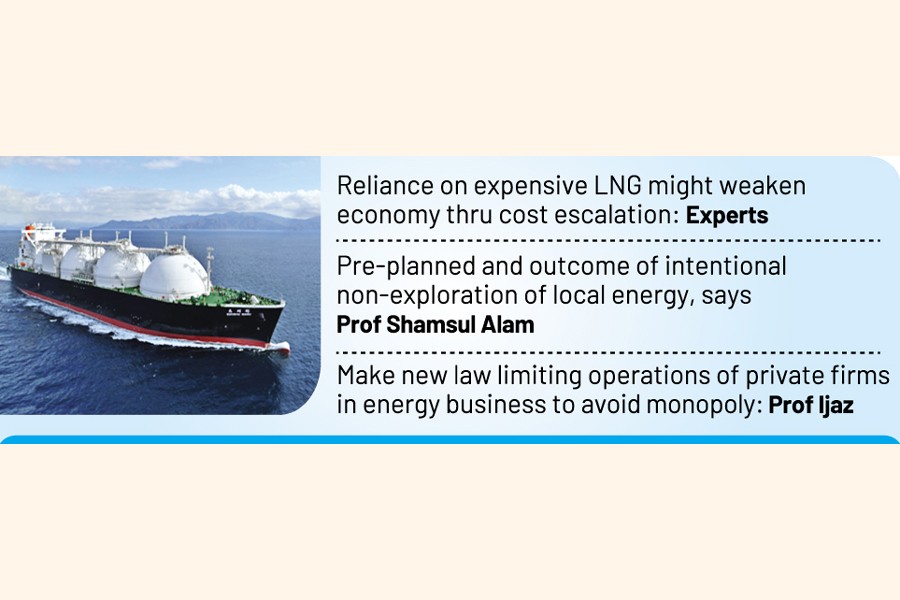
Bangladesh risks increasing reliance on costly imported LNG as its imports are projected to triple in three years, with domestic gas exploration hobbling in slow lane, sources say.
The import of expensive liquefied natural gas (LNG), only from long-term suppliers, is expected to soar threefold to around 10.50 million tonnes per year (MTPA) after three years, the sources said.
Such growing dependence on this fuel import is deemed as the government goes desperate to ramp up imports of this fuel to meet the country's mounting natural- gas demand-and keeps expanding regasification facilities under private sector.
The government currently imports around 3.5 MTPAs of LNG from existing two long-term suppliers - Qatargas and OQ Trading, previously known as Oman Trading International.
Over the past three months the state-run Petrobangla inked sales and purchase agreements (SPAs) with QatarEnergy and OQ Trading of Oman to import up to 3.0 MTPAs of LNG from 2026 onwards, said the sources.
The cabinet committee on economic affairs also approved the inking of SPAs to import LNG for a long term from Malaysia's Perintis Akal Sdn Bhd, local Summit Oil and Shipping Company Ltd (SOSCL) and US's Excelerate Energy Bangladesh Ltd. An aggregate amount of around 4.0 MTPAs will come from these sources.
Apart from the long-term suppliers, Petrobangla is expected to continue importing LNG from spot market, which will increase further the country's overall LNG imports from the international market.
The already-struggling corporation will have to count huge import costs for skyrocketing prices in the years ahead, they noted.
Rights groups and energy experts fear that the mounting imported LNG- dependence might weaken the country's overall economy.
According to the SPA between QatarEnergy and Petrobangla, the exporter will supply a total of 12 LNG cargoes in 2026 under the deal, which has option to increase the supply by 12 more cargos in 2026.
From 2027 onwards, the Qatari LNG supplier will deliver a total of 24 cargos annually, which is equivalent to around 1.50 MTPAs.
As per the SPA with the OQ Trading, the Omani company will supply four LNG cargoes during the first year of new contract in 2026, 16 LNG cargoes each year during 2027 and 2028 and, 24 cargoes per year from 2029 and onwards until 2035.
From Malaysia's Perintis Akal Sdn Bhd, Petrobangla eyes initiating import of up to 1.0 MTPAs in 2024.
As approved by the cabinet body, SOSCL, a subsidiary of Summit Group, is expected to supply up to 1.5 MTPAs of LNG from 2026 for 15 years.
Under a similar proposal, Excelerate Energy is expected to supply up to 1.5 MTPAs from 2026 for a period of 15 years.
Once fully executed, the SPAs with Excelerate Energy, SOSCL and Perintis Akal Sdn Bhd will be Bangladesh's seventh-, sixth-and fifth-term LNG-import agreements respectively, following two recent SPAs with QatarEnergy and OQ Trading that will start supply in 2026.
The government will ink all the SPAs under the Quick Enhancement of Electricity and Energy Supply (Special Provision) Act 2010, which has been extended for five years since 2021 till 2026.
The law has a provision allowing bypassing competitive tendering process with immunity given to those involved in the quick-fire energy solutions.
Bangladesh inked initial two SPAs to import LNG under long-term deals within one year on September 2017 and May 2018. The country took five years to ink its third long-term LNG deal after its second such dealmaking on June 2023.
Bangladesh's two operational floating storage and regasification units (FSRUs)-- the 77,263-deadweight-tonnage (dwt) Summit LNG and 77,348-dwt FSRU Excellence-have a combined capacity to re-gasify around 7.50 MTPAs of LNG.
They can handle contracted volumes, but may have to limit spot LNG imports.
Sources say Petrobangla is now struggling to make payment to global LNG suppliers - both long-term and spot sellers - against purchases due to a brewing currency crisis. And the overdue payments to the LNG suppliers are currently ranging around US$300 million.
"Despite delayed payment to LNG suppliers, Bangladesh is now desperate to ensure future LNG supplies to meet future demand in industries, power plants and other gas-guzzling clients," says one source.
Petrobangla inked its first-ever SPA with Qatar's RasGas, later renamed Qatargas, on September 25 2017 to buy up to 2.5 MTPAs of lean LNG over 15 years.
During the initial five years of the deal, QatarGas will supply annually around 1.8 Mtpa LNG, which will be increased up to 2.5 MTPAs in next 10 years, according to the deal.
The purchase price has been set at around 12.65 per cent of the three-month average price of Brent crude oil plus US$ 0.50 constant per-million British thermal unit (MMBtu), and the payments are to be made within 15 days of delivery.
If the corporation has more demand during the first five years, it can increase the LNG-import volume annually to 2.5 MTPAs, and during the next 10 years it has the option to reduce the amount by 10 per cent per annum.
If Bangladesh takes less than the base amount of LNG, in any year, it will have to pay the price on a take-or-pay basis.
The second SPA was inked with OQ Trdaing to import around 1.0 MTPAs of LNG for 10 years.
It is purchasing LNG at around 11.9 per cent of the three-month average of Brent crude oil prices plus $ 0.40 cents per MMBTu, and the payments are to be made within 25 days of delivery.
The deal holds the option of increasing LNG import to 1.5 MTPAs or lowering it to 0.9 MTPA without having to pay any penalty.
The growing dependence on LNG imports will jeopardize the country's future energy security, says energy adviser of the Consumers Association of Bangladesh (CAB) Prof M Shamsul Alam.
"It will make sure business of a certain quarter," he says, indicating the expansion of the local facilities under private sector pending exploration of hydrocarbons in offshore turfs in the Bay of Bengal as well as in onshore fields.
"It is pre-planned and an outcome of intentional non-exploration of local energy resources," he told the FE.
The special law has given shield to this 'misdeed' to create a monopolistic situation in energy sector, Mr Alam deplores.
It contradicts the creation of Bangladesh Competition Commission and Bangladesh Energy Regulatory Commission (BERC), the CAB leader opines.
"It will be risky if the government continues relying more on LNG imports," says another energy expert, Prof Ijaz Hossain.
Time has come to enact new law to limit operations of any private firm in energy-sector business to avoid monopoly by private firms in the sector, Mr Hossain of Bangladesh University of Engineering and Technology (BUET) suggests as a measure to avert getting trapped in 'captive market'.
Azizjst@yahoo.com
© 2026 - All Rights with The Financial Express

