Bangladesh is going to get US$3.0 billion in special drawing right (SDR) credits from the World Bank for its job-centric development works, officials say.
However, the Bank has offered both soft-and hard-term lending under its 3-year aid package, categorizing Bangladesh as a 'Blend Country' on the cusp of its transition from the LDCs.
The hard-term loan gets Bangladesh in the WB's costly window -the International Bank of Reconstruction and Development (IBRD), the officials said Wednesday.
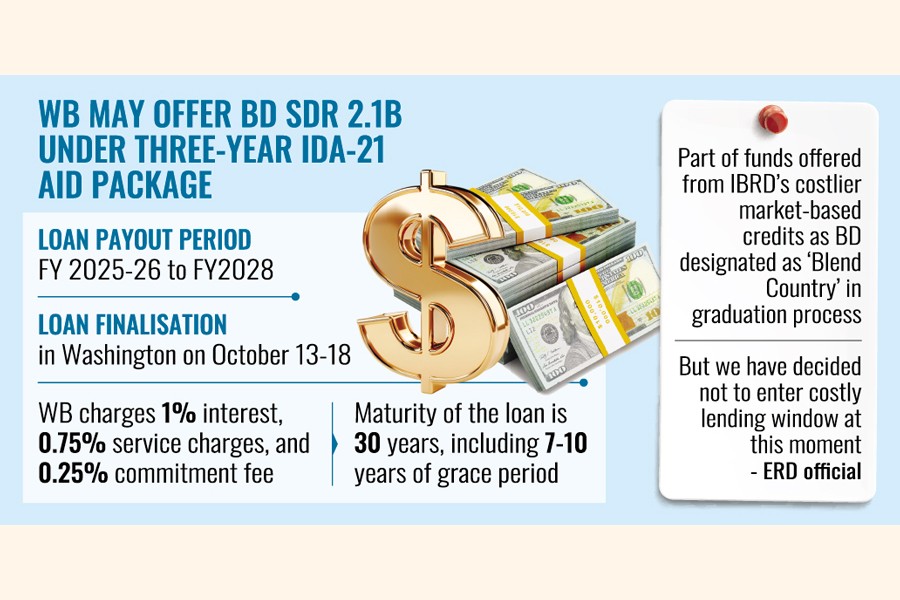
The World Bank may offer nearly SDR 2.1 billion, equivalent to US$3.0 billion, to Bangladesh, so far the largest borrower from the Bank's concessional lending window-the International Development Association or IDA.
As planned, the loan payout period is between the financial year (FY) 2025-26 and FY2028, Economic Relations Division (ERD) officials said.
The proposed financial envelope under the 3-year IDA-21 replenishment is likely to be finalised at the upcoming IMF-WB annual meeting in Washington on October 13-18.
Bangladesh is WB's largest IDA borrowing but may not be getting the facility to avail the entire aid from the concessional window this time around.
This time, the Washington-based lender has offered Bangladesh also to borrow from the IBRD, its hard-term lending arm.
The IBRD extends costlier market-based loan which can be ill affordable at this stage of Bangladesh's graduation process, experts say.
Under the last IDA-20 aid package Bangladesh received nearly $2.80 billion worth of loans and grants from the WB's $93-billion financing package to help low-income countries respond to the COVID-19 crisis and build a "greener, more resilient, and inclusive future".
The ERD Secretary, Md. Shahriar Kader Siddiky, told The Financial Express that the World Bank suggested Bangladesh take certain quantum of funds under the newly devised IDA-21 aid package through a window of the IBRD in addition to its ongoing IDA facilities.
"But we have decided not to enter into the costly lending window-IBRD--at this moment as Bangladesh is now not in a position to get higher amount of market-based loan," he said.
"In the upcoming IDA-21 meeting on the sidelines of the IMF-WB annual meet, we would request the global lender for considering us for the IDA loan as Bangladesh is passing a transitional period before becoming a developing nation after 2026," he added.
Meanwhile, the World Bank's IDA-21's 21st replenishment secured a historic $100 billion in financing for low-income countries, with donors pledging $23.7 billion to leverage these funds.
The WB Group is putting job creation at the centre of its work. IDA's investments in infrastructure, education, health systems, and private-sector growth pave the way to spur economic growth and create the jobs needed to lift people out of poverty.
Another ERD official has said the aid, offered from the IBRD segmentation of funding, has designated Bangladesh's status as 'Blend Country' that signifies its transitional state in-between an LDC and an MIC.
However, government authorities are noncommittal on borrowing the costly money at this moment, apart from the ongoing IDA and some other concessional facilities, from the global lenders, he added.
"The WB has suggested that Bangladesh borrow from the IBRD in the upcoming three-year IDA-21 aid package as the country needs more investments from foreign sources. But Bangladesh is unwilling to enter into the IBRD lending window."
Currently, Bangladesh has been placed as a 'Blend Country' in the WB borrower category under which the country can borrow concessional credits from the International Development Association and a small portion of that from market-based option like Scale-up Facility Window (SFW).
The Washington-based global lender charges 1.0-percent interest, 0.75-percent service charges and 0.25-percent commitment fee under the IDA facilities. The maturity of the loan is 30 years, including 7-10 years of grace period.
On the other hand, the IBRD loan bears market-based rates wherein SOFR-plus a spread of 2.5 per cent to 2.6 per cent will be added up.
On top of that are a front-end fee of 0.25 per cent and a commitment fee of 0.25 per cent applicable to each of the loans.
Also, the maturity of an IBRD credit is determined by short-maturity loan (SML) where the final maturity period is maximum 7 years, with a chasing 4-year grace period, according to the WB website post.
For the IBRD Special Development Policy Loans, the ending rate would be reference rate-plus- applicable adjustment spread plus minimum of 2.00 per cent. Besides, the front-end fee is 1.0 per cent of the principal loan amount, the website reads.
The final maturity of the loan will be up to 10 years with a 5-year grace period.
Since Bangladesh's economic status has been upgraded to a lower-middle-income country with effect since 2015 and it is going to graduate from the least-developed country (LDC) status to developing nation, the WB now begins beckoning Bangladesh into its harder lending arm -- IBRD, a senior Ministry of Finance (MoF) official told the FE.
The ERD official says Bangladesh is availing the facility of IDA loan where at least 15 per cent of the total borrowing would now have to be market-based.
In that case, he adds, Dhaka is willing to get the loan (15 per cent) from the SFW rather than getting into the IBRD window in next three years.
© 2026 - All Rights with The Financial Express

