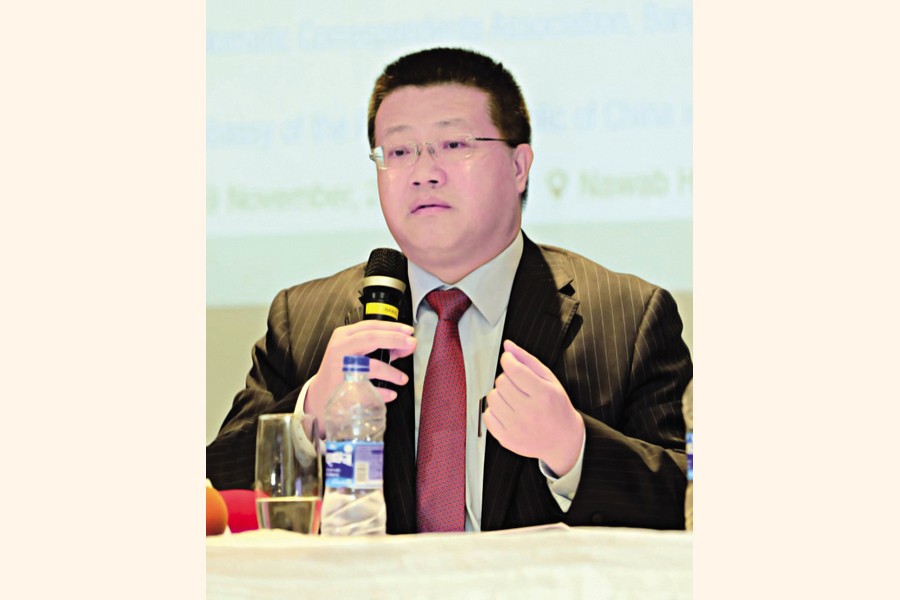
 Chinese Ambassador Yao Wen speaking at a meet with diplomatic journalists in Dhaka on Thursday — FE photo
 China wants to implement free-trade agreement with Bangladesh by 2026, Chinese Ambassador Yao Wen said Thursday while speaking on major issues of common concern that include election.
At a meet with diplomatic journalists in Dhaka, the envoy made China's stand clear on a gamut of crucial matters that cropped up during discussions, ranging from trade and investment to stalled Rohingya-refugee repatriation and much-debated polls in Bangladesh.
"We are in the stage of feasibility studies but we're looking forward. It will be completed ...by the end of this year. After feasibility studies, we will go to the stage of physical negotiations. So our objective is that, by the year 2026, there will be free-trade arrangements between China and Bangladesh," he said, responding to a question as to how to bridge a yawning trade gap between the two countries, with the balance heavily tilted towards China.
The question-answer session took place following the seminar on 'Belt and Road Initiative', jointly organised by the Chinese Embassy and the Diplomatic Correspondents Association of Bangladesh (DCAB).
Turning to the pre-poll violence in Bangladesh, the Chinese Ambassador expressed the hope that political parties would be able to bridge their differences to ensure stability during and after the general election, which he expects, will be in line with the constitution and rules of the land.
Expressing his views about bridging the trade gap, he made it clear that China doesn't want a single surplus from Bangladesh-and mentioned corrective measures taken and awaited ahead.
"The imbalance exists due to the structure of the trade, so we have to find a way out to remove this imbalance," he said. And FTA is one of the ways to narrow the deficit.
On this score, Mr Yao Wen also mentioned that China raised investment in Bangladesh through which the trade imbalance can be reduced.
"So, we want more investment into manufacturing sector of Bangladesh," he told the diplomatic correspondents and specified the fields for Chinese companies to put capital in, such as ICT, food processing, renewable or new energy, and other new sectors, so that it can have "better capacity to diversify exports."
"In this way, we can reduce the imbalance--and that is the main objective," the envoy from the world's second-largest economy says about how to boost the bilateral trade with the imbalance held in check.
The Chinese envoy also said as a friend of Bangladesh and a country with a large amount of investments, enterprises and personnel here, China sincerely hopes that all stakeholders in Bangladesh would take the fundamental interests of the people into full consideration, properly resolve their differences, and jointly maintain political and social stability.
"This year is the pre-election year in Bangladesh. Many friends from the media have come to ask me what China's observations are on the current political situation in Bangladesh. I want to underscore that the upcoming election is an internal affair of Bangladesh. As a matter of foreign policy, China adheres to the principle of non-interference in internal affairs of other countries, and opposes any force interfering in internal affairs of other countries, including Bangladesh," he said.
His explanation on China's stance comes in the wake of opposition agitations for the upcoming polls to be held under a neutral administration and western powers, including the United States, also telling the Awami League government to ensure free and neutral elections with participation of opposition political parties that threaten to resist if their demand is not met. The ruling party says the polls must be held under the current constitution that provides for vote with the ruling government in power.
The ambassador categorically said the future of Bangladesh "shall be determined by people of Bangladesh".
Asked what kind of election China wants to see in Bangladesh as many countries have already been giving their views, the Chinese diplomat said, "Bangladesh's election is its internal matter. Our policy is very clear, you know, we're not intervening, but we do hope after election, there will be stability, life will return to normal and our cooperation will continue. Definitely that is our conviction."
"And I want to say for the people who have been fighting for democracy in the last 50 years since establishment of Bangladesh, so I believe, all of us know what sort of a democracy you need are some production units."
As such, he expressed his "conviction that the election will be conducted in the parameters of constitution and law".
Asked whether China, like some other countries, will call for dialogue among the political parties, he said it's for the political parties to answer the question, not for him.
"But, hopefully, we just want to see, you know, the differences can be bridged, the uncertainty can be got over, lives can get back to normal and the political and the social stability will remain."
On the blockades and hartals and their impact on Chinese nationals living in here, the ambassador said Chinese investors are keen to invest in Bangladesh and they want to see stability.
"China wants to see that over 20,000 Chinese nationals living in Bangladesh and Chinese properties are protected," he said, adding that so far, all the Chinese people and assets here are "properly protected by the authorities".
"We feel safe so far. But, as you mentioned, we sincerely hope that the uncertainty, all this violence, you know, can be over," he told the inquisitive journalists.
"So, all the stakeholders or political parties will settle their differences and maintain political and social stability together taking the fundamental interests of people of Bangladesh into consideration."
He said both the countries are eager to settle bilateral trade through local currencies, and initial experiments are underway in this regard.
Responding to a question he said if Bangladesh would seek help from China to address foreign- exchange challenges, his country would stand by Bangladesh to resolve the issue.
To a question on Rohingya repatriation the envoy said China hoped to see implementation of the pilot project on repatriation of the displaced Myanmar people by December to get the process of sustainable repatriation started.
On China's flagship development model called BRI, Mr Wen said over the past decade, the BRI had gotten off the ground, grown rapidly and produced fruitful outcomes.
"The 3rd Belt and Road Forum for International Cooperation concluded last month was of a great success. A total of more than 10,000 representatives from 151 countries and 41 international organisations took part in the Forum. Once again, the BRI demonstrated its tremendous appeal and global influence. In his keynote speech, Chinese President Xi Jinping underscored that mankind is an interdependent community of shared destiny."
He notes that on the journey of Belt and Road cooperation, China and Bangladesh have always been good friends with mutual trust and good partners in seeking common development.
He mentioned that over the past seven years, they had built 12 highways, 21 bridges and 27 power and energy projects in Bangladesh, contributing to turning the dreams of the Bangladeshi people into reality.
Over the past seven years, the stock of Chinese investment in Bangladesh has grown from USD241 million to nearly USD1.4 billion, Mr Wen mentioned, adding that at present, there are nearly 700 Chinese enterprises operating in Bangladesh.
"These enterprises are active practitioners deeply cultivating in Bangladesh. They assume social responsibilities in Bangladesh and make significant contributions to economic development, environmental protection, community services, public welfare and charity by creating more than 550,000 jobs in Bangladesh."
He mentioned that last week, the Chinese Economic and Industrial Zone (CEIZ) in Chittagong was officially launched, and the enterprises held a ceremony of signing documents of investment intent. It is the first Chinese industrial zone in Bangladesh and a "trailblazing achievement".
The envoy pointed out that on the journey of Bangladesh's modernization, the BRI is the most compatible and befitting development-cooperation initiative with Vision 2041 and Smart Bangladesh.
China stands ready to work with Bangladesh to tighten the ties of cooperation and embrace a new stage of Belt and Road cooperation of higher quality at higher level.
"We shall fully leverage our economic complementarity and strengthen cooperation on infrastructure development, ICT, new energy, agriculture and so on, thereby ushering in the next golden decade of Belt and Road cooperation," he said.
About Chinese policy on the ongoing Middle-East conflict he said, "Unfortunately, the recent escalation of Israeli-Palestinian conflict plunged the Middle East into war once again. In just one month, more than 10,000 civilians have died in the Gaza Strip, an inferno on earth."
The veto-holding country's diplomat said the UN should play its due role in resolving the question of Palestine. "The UN Security Council needs to shoulder important responsibilities for this, build international consensus as quickly as possible and take real measures to end."?that
China thinks the root cause of the question of Palestine lies in the long delay in realizing the dream of an independent State of Palestine and the failure to redress the historical injustice suffered by the Palestinian people.
"Israel has the right to statehood, so does Palestine. The answer to the question is the two-state solution and an independent State of Palestine," the ambassador said in reaffirming Chinese stance on the matter of what looks to be primordial conflict.
Turing round to the Rohingya issue he notes that all stakeholders have increasingly become aware that repatriation is the only long-term and "most effective solution to the crisis".
This year by far, under the mediation of China, Bangladesh and Myanmar have reached important consensus on early initiation of repatriation. Officials from the two sides have kept frequent and direct talks in this regard, he mentioned.
"With joint efforts, we managed two rounds of 'come & talk' missions by Myanmar officials and one 'go & see' mission to Rakhine State by representatives of the displaced people and Bangladeshi officials. In this process, the displaced people gradually built up and enhanced confidence towards repatriation."
China has also kept in close contact with UN agencies and ASEAN states, and called upon the international community to extend understandings and supports to Bangladesh and Myanmar, so as to create proper conditions for early initiation of repatriation.
President of the Chinese Enterprise Association in Bangladesh Mr Ke Changliang gave a presentation on the Chinese projects in Bangladesh.
Responding to a question he said land acquisition remains a major challenge on the way of implementing megaprojects in Bangladesh.
"But the things are improving."
mirmostafiz@yahoo.com
© 2026 - All Rights with The Financial Express

