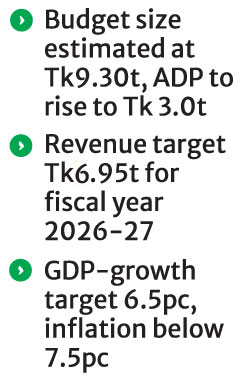
With a trillion?dollar economy in vision by 2034, the new government plans a big budget worth Tk 9.30 trillion for the next fiscal year for augmented funding of critically important sectors.
In order to finance the substantially raised annual spending plan, the government has set a target to collect some Tk 6.95 trillion as revenue in the fiscal year 2026-27, officials say.
The decisions were made at a meeting of the committee for coordination on fiscal, monetary, and currency exchange on Friday night, as the budgeting exercise is getting in gear with little over two months left before the current fiscal year ends.
Official sources say the new government will have to make large allocations to fulfill a number of its electoral pledges in the next fiscal year, face the impacts of the ongoing conflict in the Middle East, and enhance salary of employees partially, and so the budget size is going to be increased significantly.
"The Middle East conflict alone is eating up a big portion of government subsidies now, but its impacts on the economy will be much bitter in the next fiscal year," says one official.
As such, he adds, the government is giving big target to the National Board of Revenue (NBR) for collecting revenue to meet the growing expenditure.
Also, the high revenue target is set as Bangladesh's tax-to-GDP ratio remains one of the lowest in the world by many accounts. The International Monetary Fund has pushed Bangladesh to increase the ratio to 9.20 per cent in the next fiscal year from the current rate of around 6.6.
In the new budget, sources have said, the size of the Annual Development Programme (ADP) is going to be Tk 3.0 trillion, significantly higher then the current development budget amounting Tk 2.3 trillion.
The GDP-growth target has been set at 6.5 per cent for the next fiscal year while the government targets to keep inflationary pressure below 7.5 per cent then.
According to officials concerned, of the total ADP worth Tk 3.0 trillion for the next fiscal year, Tk 1.9 trillion, equivalent to 63.33 per cent of the total outlay, is set to be financed from government exchequer, while the remaining Tk 1.1 trillion is expected to be managed from external sources, mainly in the form of project loans and grants.
For the current fiscal year, the government initially approved an ADP of Tk 2.3 trillion, which was later revised down to Tk 2.0 trillion, comprising Tk 1.28 trillion from domestic resources and Tk 0.72 trillion from external financing.
The proposed allocation for the next fiscal year represents an increase of 48.44 per cent in domestic financing and 52.78 per cent in external financing.
According to Implementation Monitoring and Evaluation Division (IMED) data, ministries and divisions together spent Tk 591.34 billion up to February, accounting for 30 per cent of the total revised allocation.
The proposed ADP breakdown shows, Local Government Division (LGD) is set to receive the highest chunk of Tk 366.20 billion in the next fiscal, followed by the Road Transport and Highways Division (RTHD) with Tk 329.03 billion.
Health Services Division is likely to see a significant jump in allocation to Tk 206.08 billion, more than six-fold compared to its revised allocation of Tk 31.28 billion in the current fiscal, elevating its position to third from the 15th.
Power Division is expected to receive the fourth-highest allocation at Tk 191.86 billion, followed by the Ministry of Science and Technology with Tk 173.66 billion.
Among other sectors, Primary and Mass Education is set to receive Tk 168.48 billion in development budget, while Secondary and Higher Education Division is likely to get Tk 138.36 billion.
Sources say Finance and Planning Minister Amir Khasru Mahmud Chowdhury, who chaired the meeting, discussed the challenges now the country's economy faces due to the Middle East turmoil, especially the high import costs of fuel oils and gas and the possible way of their funding.
Also, he asked the finance officials to keep in mind "long-lasting impacts of the war fallouts on the economy, the inflationary pressure, and government's electoral pledges alongside gradual deregulation of the economy" while preparing the budget.
syful-islam@outlook.com
jahid.rn@gmail.com
© 2026 - All Rights with The Financial Express

