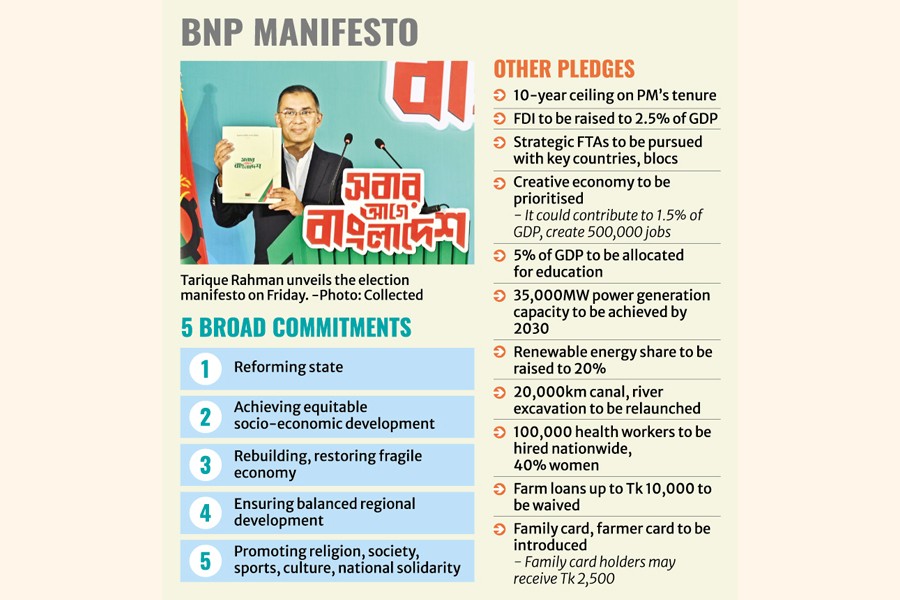
Economic and political democratisation free from oligarchs, higher foreign direct investment (FDI), financial-sector reforms, capital-market development and trade liberalisation are central to BNP vision for rebuilding a "fragile economy".
Chairman of the Bangladesh Nationalist Party (BNP) Tarique Rahman Friday expounded economic and political agenda set forth in his party's election manifesto, on the cusp of transition through the upcoming polls from the interregnum following the mass uprising.
"BNP's leadership will not be based on special privileges for any group but on the productive power of every citizen," Mr Rahman said while presenting the manifesto, based on their previously placed 31-point state-rebuilding programme and the post-uprising July Charter.
"At the centre of this vision is economic democratisation, through which the economy will be inclusive, participatory and open to all."
The BNP announced its manifesto for the 13th National Parliament election under five broad commitments: reforming the state, achieving equitable socioeconomic development and sustainable state capacity, rebuilding and restoring the fragile economy, ensuring balanced regional development, and promoting religion, society, sports, culture and national solidarity.
The manifesto presentation, moderated by BNP senior joint secretary- general Ruhul Kabir Rizvi and held at a city hotel, lasted more than two hours.
BNP secretary-general Mirza Fakhrul Islam Alamgir also spoke at the event, attended by political leaders, members of diplomatic corps and journalists.
Tarique Rahman said dismantling oligarchic structures, creating jobs and building a trillion-dollar economy by 2034 would be central priorities.
"Policy continuity and a comprehensive investment framework are essential to attract foreign investment," he said, setting a target of raising FDI to 2.5 per cent of GDP.
He proposed abolishing the banking division under the Ministry of Finance, arguing that it hampers the independence of the banking and financial sector.
"We will appoint competent and professional individuals to regulatory bodies to ensure efficiency and politics-free function," he said.
If elected to rule this time around, the former ruling party pledges a review of non-performing loans (NPLs), warning that those responsible for loan irregularities would be brought to justice.
As part of supporting agriculture, farm loans up to Tk10,000 along with interest will be waived.
Mr. Rahman said BNP would pursue strategic free-trade agreements with key countries and economic blocs across Asia, Europe, Africa and the Middle East.
The party would also prioritise the "creative economy", including film, music, theatre and digital content. Also short documentary films will be made on social values.
"If proper steps are taken, the creative economy could contribute 1.5 per cent of GDP and create 500,000 jobs," he said, citing South Korea's success in earning billions from content posts to social-media platforms.
He mentions that rapid development of the ICT sector and education reform could generate 200,000 jobs in cybersecurity, business-process outsourcing (BPO), artificial intelligence, data services, semiconductors and Industry 4.0 technologies.
The BNP chief, who had been nearly 17 years in exile in the UK, blames "corruption, opaque procurement and costly capacity charges" for high energy costs over the past decade.
He sets a target of raising power-generation capacity to 35,000 megawatts by 2030 and increasing renewable energy's share to 20 per cent of the energy mix.
He has stressed the need for independent rule of law, saying: "I know how I was victim of injustice."
To support inclusive growth, BNP plans to introduce 'Family Card' and 'Farmer Card' with a twin goal of helping families and strengthening local economies with their contributions.
Family cardholders may receive Tk2,500, while farmers, small traders, fishermen and livestock farmers would receive either cash support equivalent to input costs or direct farm inputs.
The party also pledges to strengthen local government, citing European models.
Tarique said the BNP will re-launch excavation around 20,000 kilometres of canals and rivers to improve water retention and support agriculture.
Expansion of Barind-type irrigation projects is also planned.
Mr. Rahman proposes allocating 5.0 per cent of GDP to education and introducing a "one tablet for one teacher" initiative.
Stressing the importance of healthcare, the party pledges stronger preventive care and the recruitment of 100,000 new health workers nationwide, 40 per cent of them women.
As planned, the women health workers will visit households and let them know how to prevent many diseases by changing lifestyles or eating habits.
He stresses that Bangladesh's future depends on a skilled, self-reliant and responsible youth population, with expanded employment and training opportunities.
The BNP manifesto provides for bicameral parliament and prime minister's tenures limited to total 10 years. As part of rebuilding state structure, an ombudsman will be appointed to ensure checks and balances.
jasimharoon@yahoo.com
© 2026 - All Rights with The Financial Express

