MIR MOSTAFIZUR RAHAMAN WITH SAIF UDDIN | February 14, 2026 00:00:00
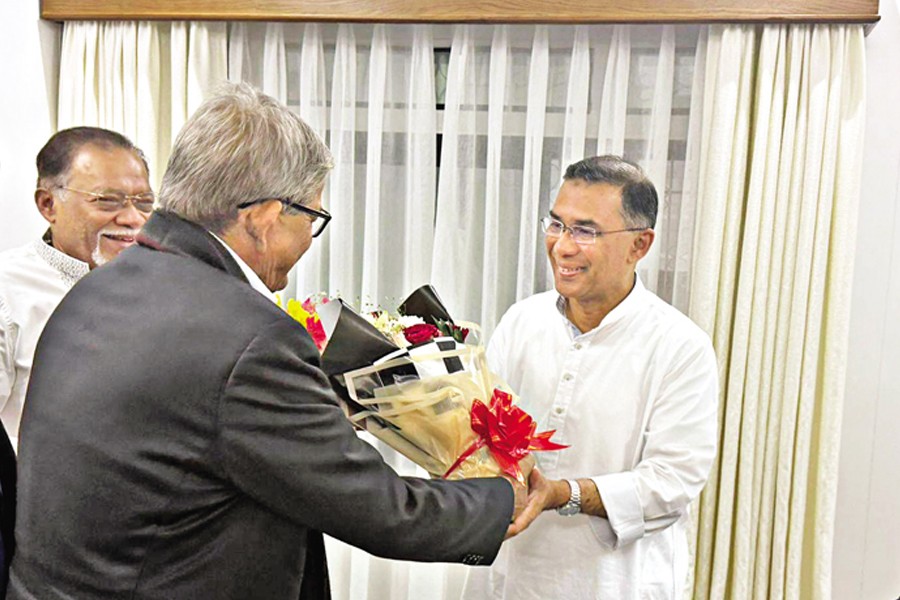 BNP Secretary General Mirza Fakhrul Islam Alamgir greets the party's Chairman Tarique Rahman with flowers on Friday to congratulate him on winning the 13th national election. — Focus Bangla
 Bangladesh Nationalist Party (BNP) begins spadework to form the government after securing a commanding two-thirds majority in a general election widely seen as a turning point in the country's turbulent political history.
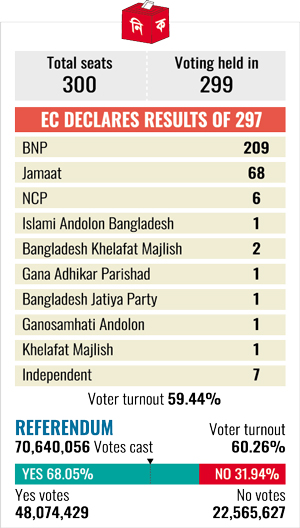 Official results announced on Friday showed the BNP won 209 of the 297 seats declared so far in the 13th Jatiya Sangsad election, comfortably clearing the threshold required to govern alone.
Voting took place in 299 of the 300 constituencies, while polling in Sherpur-3 was postponed after the death of a candidate from Bangladesh Jamaat-e-Islami, while results in two Chattogram seats remain suspended by court order.
Among BNP allies, each of Gonoodhikar Pairhsad, Bangladesh Jatiya party, and Gonosonghati Andolon bagged one seat each. Party rebels also returned in some seats.
The scale of the victory marks the party's return to power for the first time since the 2001 triumph. That year, the BNP won 195 seats and formed a four-party coalition government that included Jamaat-e-Islami.
This time around, Jamaat emerged as BNP's principal rival following the July-August 2024 uprising that routed the former ruling party, Awami League, from government and electoral race. However, Jamaat got decisively outpaced-it finished winning 68 seats.
In addition to Jamaat's attainment, among its allies, the uprising-born National Citizens Party (NCP) of young Turks bagged six seats, Bangladesh Khelafat Majlish 2, and Khelafat Majlish one.
Smaller Islamist and left-leaning parties secured a handful of seats, while independent candidates won seven.
In total, 50 political parties contested the election, fielding 2,028 candidates across 299 constituencies. The Election Commission said turnout was 59.44 per cent. A referendum held simultaneously on Thursday on the implementation of the July Charter drew slightly higher participation, with more than 48 million voters backing the proposal with ayes against 22.5 million opposing with nays.
The BNP was founded by the late president Ziaur Rahman and later led by former prime minister Khaleda Zia, who became Bangladesh's first female prime minister in 1991 after spearheading the anti-Ershad movement. Following her recent death, the party's standing committee approved her son, Tarique Rahman, as chairman on his return from political exile in London.
Rahman, having contested the polls in Dhaka-17 and Bogura-6, won both seats and was now poised to become prime minister. In a brief informal reaction on Friday, he thanked voters for their support. "I am grateful for the love you have shown for me. Please, keep me in your prayers," he said.
Later, Rahman travelled from his residence in Gulshan to the Bangladesh Navy Headquarters Mosque for Friday prayers, briefly stopping to speak with supporters who had gathered outside. Some told him they hoped to stand beside him in building a "new Bangladesh".
Party secretary-general Mirza Fakhrul Islam Alamgir framed the results as a clear popular mandate. In comments that appeared aimed at Jamaat, he said: "The people have rejected them. BNP has secured a two-thirds majority."
Rejecting the idea that the party was driven by a tight cadre structure, he argued that its victory stemmed from broad-based public support. "BNP is not a cadre-based political party--it is a people-based political party," he said, adding that voters endorsed the party's manifesto and its promises of state reform.
With a supermajority secured, the BNP now faces the task of translating electoral momentum into governance in a country still grappling with deep political divisions and expectations of institutional reform.
mirmostafiz@yahoo.com
saif.febd@gmail.com
© 2026 - All Rights with The Financial Express

