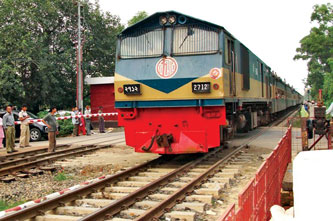
The Bangladesh Railway (BR) could not make the desired-level of progress despite a 60 per cent yearly investment increase during the last seven years, experts said.
According to official record, 70 per cent of some Tk 250-billion allocation during the last 20 years came in the last seven years from the fiscal year (FY) 2009-2010.
In some years, the investment was increased more than 100 per cent compared to previous years.
Besides, foreign investment in the railway sector also increased 3.74 times during the last seven years from total investment made between 1995 and 2008.
Sources said against the investment, the state-owned train operator -- Bangladesh Railway -- could maintain an increased level of earnings but couldn't yet meet yearly target of earnings to cut losses to the tune of billions of taka.
Though BR claimed that both passenger-and freight capacity has increased since 2009, analysts said it could not make age-old meter-gauge (MG) rail track into broad gauge (BG) as per world standards.
Railway officials said BR investment reached Tk 174.51 billion from FY 2009-10 up to October of FY 2016-17, resulting in increase of new rail tracks, new train services and locomotives alongside the upgrading of signalling system on different routes.
But, when world's rail system is getting transformed into broad-gauge and electric trains to raise its passenger-and goods-carrying capacity at high speeds, most part of BR's investment was used for keeping its age-old meter-gauge (MG) train services operative.
The investment done to add another line of BG with MG could not see completion.
Establishment of dual-gauge train services for both kinds of trains on Dhaka-Chittagong corridor has been completed up to Joydevpur. Part of western zone including Dinajpur-Panchagarh, Parbatipur-Kanchan-Panchagarh and Kanchan-Birol section was also completed.
But double line of Dhaka-Chittagong corridor has still a missing link from Laksam to Akhaura.
"At present the railway's main problem is manpower rather than its track and train services," said an official, preferring not to be named.
He said the BR does not face such problem in handling rolling stocks and line capacity but faces problem in operating stations and trains efficiently for a lack of manpower.
The official record shows that the BR has been able to add 235 kilometres of new rail lines of meter-gauge quality and 248.5km dual-gauge lines to its around 3000km network during the last seven years.
Sixty seven new stations were built, 160 stations developed and upgraded while 46 locomotives including 20 MGs and 26 BGs and 20 more DEMU were purchased during the period. With the purchase of new ones the number of carriages increased to 119.
Some 516 wagons were also bought. Besides, renovation of 288 carriages and 277 wagons was also done with the investment. Against all the purchases, the BR was able to introduce 104 new trains.
BR's recruitment plan to hire more than 9,000 staff members taken at the beginning of 2010 is in limbo for various reasons.
Sources said the process is hung-up either due to court- related complications or due to alleged corruption in recruitment process.
For lack of manpower, 55 stations remain inoperative in the eastern zone of the BR.
Despite an order from the Director-General office of the BR, traffic time of the prime passenger train services on Dhaka-Chittagong corridor could not be reduced to four hours from the present five hours. However, at times, the journey turns out to be more time-consuming.
Besides, sources said, due to the purchase of different types of locomotives and coaches from different countries, the BR is exposed to more than usual expenditure to maintain its operations.
The locomotives purchased from different sources are likely to increase the cost of overhauling in next six years and replacement cost after the end of life in 20 years.
The investment in MG locomotives would virtually become useless during the period as manufacturing or parts of MG technology would be hardly available.
BR has so far imported MG and BG locomotives from the USA, Canada, Japan, Hungary, Germany and India, but lifetime of almost 40 per cent of these locomotives will end in 20 years.
Hardly any investment was done for the modernisation of the railway workshops. Recently projects were taken to upgrade or set up new workshops, but those are still in preliminary stages.
Despite this unsatisfactory level of progress, some passengers, however, find some improvements in the train services, such as timely start and better speed. Some bus passengers, however, alleged lack of information and tickets to avail this cheap mode of transportation.
Mozaffar Hossain, a businessman of Netrakona district, said he nowadays hardly travel by bus as four train services introduced from Dhaka to Shantahar made his journey comfortable and time manageable.
Badal Roy, an inhabitant of North Bengal, who avails local train between Parbatipur and Buribari via Rangpur-Lalmonirhat, said the journey time and speed of the service have improved.
The BR officials said the railway sector has long been deprived of investment due to negligence of the past governments. "So it will take at least 10 years more to get back its old record of good services," said one of them.
He said transforming the entire BR network into standard gauge would take decades as railway-sector development needs years to make people feel desirable changes.
Director-General of BR M Amzad Hossain, however, refrained from giving any comment but said the railway is a very complex system and its development takes time. As he was about to leave the office for a personal holiday, he regretted not being able to make further comment.
smunima@yahoo.com
© 2026 - All Rights with The Financial Express

