Business leaders and analysts warn that the closure of the Strait of Hormuz could seriously disrupt global supply chains and inflict heavy losses on international trade.
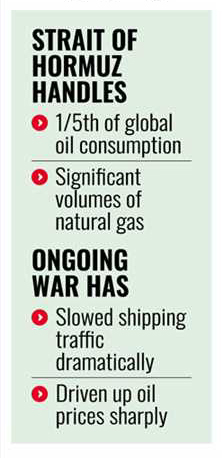
The ongoing war involving the United States, Israel, and Iran has spilled into the Strait of Hormuz - one of the world's most vital energy chokepoints - driving up oil prices sharply.
The strait handles about one-fifth of global oil consumption, along with significant volumes of natural gas.
Shipping traffic has slowed dramatically amid Iranian attacks on oil tankers.
A commander of Iran's Revolutionary Guard Corps (IRGC) said on Monday the strait was "closed" and warned that any vessel attempting to pass would be set "ablaze".
Meanwhile, China called on all sides in the Middle East war to maintain safety in the Strait of Hormuz.
"China urges all parties to immediately cease military operations, avoid further escalation of tensions, maintain the safety of shipping lanes in the Strait of Hormuz, and prevent a greater impact on the global economy," foreign ministry spokeswoman Mao Ning told a regular news conference on Tuesday.
"Energy security is of great importance to the global economy... China will take necessary measures to ensure its energy security," she said.
China is the main buyer of Iranian oil, most of which passes through the strait.
At least five tankers have reportedly been damaged, two personnel killed,and around 150 ships left stranded near the waterway between Iran and Oman.
According to Al Jazeera, oil prices climbed above $79.40 per barrel on Monday after standing at $73 on Friday, as tensions escalated ahead of joint US and Israeli strikes on Iran.
Vessel tracking firm Kpler reported limited traffic through the strait, mainly involving ships flying Iranian and Chinese flags.
Bangladesh Knitwear Manufacturers and Exporters Association (BKMEA) President Mohammad Hatem said the closure would push global oil prices even higher and create a gas supply crunch, particularly affecting liquefied petroleum gas (LPG) and liquefied natural gas (LNG).
He noted that with the route effectively blocked, most vessels would be forced to take a lengthy detour via the Cape of Good Hope in South Africa.
This would add thousands of kilometres to voyages, extending lead times and increasing freight costs, he said.
Referring to his discussions with the commerce, industries, and jute and textiles minister, Hatem said the government was working on the issue.
He expressed hope that formal talks with business leaders would be held soon to identify practical solutions and keep supply chains running smoothly.
Besides, if the conflict persisted, he stressed the need for Bangladesh to secure alternative sources of oil and gas to ensure uninterrupted industrial operations and economic stability.
Meanwhile, Danish shipping giant Maersk has suspended all new cargo bookings between the Indian subcontinent, including Bangladesh, and Upper Gulf markets amid the worsening security situation.
In an advisory posted on its website, it announced the immediate suspension of new bookings between India, Pakistan, Bangladesh, Sri Lanka, the UAE, Bahrain, Qatar, Iraq, Kuwait, and parts of Saudi Arabia (Dammam and Jubail).
But other trade routes remain unaffected.
The company has also stopped accepting reefer, dangerous, and special cargo to and from the UAE, Oman, Iraq, Kuwait, Qatar, Bahrain, and Saudi Arabia until further notice.
Other major shipping lines, including Mediterranean Shipping Company (MSC), CMA CGM, COSCO, and HMM, have also suspended Middle East cargo bookings.
In a customer advisory issued on March 1, MSC said it had paused all worldwide cargo bookings to the Middle East as a precaution and would resume services once the security situation improved.
Seeking anonymity, a leading European brand representative said over the past couple of months, their goods had been shipped via South Africa, increasing lead times to 60 days from 45.
He warned that the war would have an adverse impact on global apparel demand, with the Gulf region potentially seeing demand cut by half.
Bangladesh's apparel exports had already recorded negative growth for seven consecutive months due to the weak global economic situation affecting the demand, he added. "If the war drags on, the impact could be beyond our imagination," he said.
newsmanjasi@gmail.com
© 2026 - All Rights with The Financial Express

