The volume of cash circulating outside Bangladesh's banking system has surged to a record high, signalling weakening depositor confidence and heightened economic uncertainty despite steady growth in overall money supply.
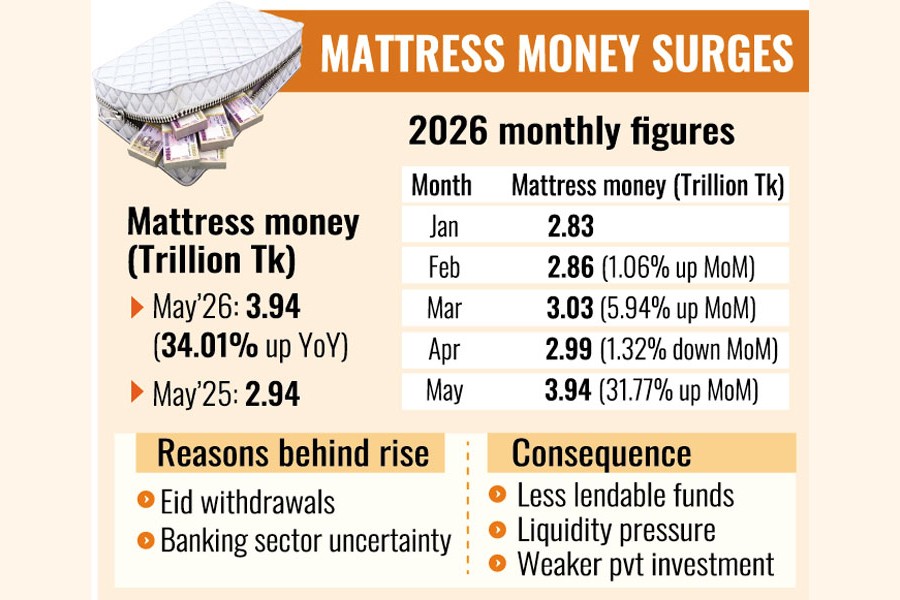
Currency outside banks - often referred to as mattress money - jumped 34.01 per cent year on year to Tk 3.94 trillion in May 2026 from Tk 2.94 trillion a year earlier, according to Bangladesh Bank (BB) data.
The sharp increase, driven by Eid-related cash withdrawals and lingering concerns over parts of the banking sector, has intensified liquidity pressure on commercial banks and raised concerns over the availability of lendable funds for productive investment.
Bankers say they are still feeling the strain on vault cash.
They also point out that the unexpected change of guard in the banking regulator and amendment to a relevant legal instrument were not taken positively by depositors and market participants, further weakening confidence in the banking sector.
The growing uncertainty has encouraged many people to hold cash outside banks instead of keeping deposits within the formal financial system, according to them.
People familiar with the development say the surge in currency outside banks in May could be attributed to two factors.
The Eid-ul-Azha festival, held towards the end of the month, led to increased cash withdrawals for sacrificial purchases, while cattle traders were likely to redeposit the proceeds in June after completing transactions.
Also, some depositors may have withdrawn funds due to lingering confidence issues surrounding a number of banks.
The key issue now is whether the withdrawn cash returns to the banking system.
A prolonged increase in cash held outside banks could constrain lenders' ability to extend credit, dampening investment, business expansion, production, and employment, with adverse implications for the broader economy, according to stakeholders.
Currency outside banks rose from Tk 2.83 trillion in January to Tk 2.86 trillion in February before climbing to Tk 3.03 trillion in March, indicating a sustained buildup of cash outside the formal banking system.
It eased slightly to Tk 2.99 trillion in April before surging to Tk 3.94 trillion in May, according to the BB data.
Meanwhile, the data shows broad money (M2) expanded by 12.46 per cent year-on-year to Tk 23.91 trillion at the end of May 2026, up from Tk 21.26 trillion in the corresponding month of the previous year, reflecting continued growth in overall liquidity in the economy.
Bankers also say rising currency holdings outside banks reduce lendable resources and weaken liquidity management in the financial sector.
Syed Mahbubur Rahman, managing director and CEO of Mutual Trust Bank, acknowledges that uncertainty in the banking sector has led some customers to hold more cash outside banks, with currency outside the system rising nearly 35 per cent year-on-year to Tk 3.94 trillion in May 2026.
"Confidence in the banking sector has faced challenges, but this also highlights the importance of strengthening trust and resilience," he says.
He notes that perceptions around bank mergers and resolution measures have contributed to public hesitation, while progress in governance, accountability, and transparency remains crucial.
"The government has a valuable opportunity to reinforce governance, accountability, and transparency. With stronger measures, public trust can be restored, and the banking system can emerge more robust and better positioned to support economic growth," he adds.
Dr Masrur Reaz, chairman and CEO of Policy Exchange Bangladesh, says the sharp rise in currency outside banks reflects both weakening depositor confidence and heightened economic uncertainty. "When households and businesses choose to hold more cash instead of keeping it in banks, it signals declining confidence in the financial system and a preference for liquidity amid uncertainty," he says.
He says a sustained increase in cash outside the banking system reduces banks' lending capacity, weakens monetary policy transmission, and could slow private sector investment.
"Restoring confidence requires stronger governance in the banking sector, greater regulatory credibility, and consistent policy actions. Unless public trust improves, a larger share of liquidity may continue to remain outside the formal financial system," he adds.
sajibur@gmail.com
© 2026 - All Rights with The Financial Express

