Latest socioeconomic status of the population is expected to feature prominently in the country's first-ever national household census scheduled to kick off in April next.
Top officials working on the census project told the Financial Express (FE) Sunday that, through analysing the data to be collected under the census, they will get a clear picture of income inequalities, poverty rates and employment scenario.
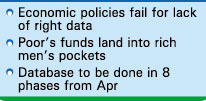
For lack of authentic and reliable statistics on the socioeconomic factors, they said, many economic policies have failed to derive desired results.
Bangladesh even lack actual employment data and people concerned mostly depend on the labour-force survey that does not depict the true picture.
Besides, most of the funds of the social safety-net programmes do not reach the target groups and land into the pockets of the rich for want of such database.
The Bangladesh Bureau of Statistics (BBS), the national statistical organisation, is implementing the Tk 3.28 billion project mostly funded by the World Bank.
Dr M Emdadul Hoque, programme director of the database project at the BBS, told the FE: "We have a plan to begin our census work in April next."
They have already taken all preparations to this end. The census will be done in eight phases.
The April phase will begin from Rangpur and Narsingdi districts.
Mr Hoque said a total of 150,000 people will be involved with the head-and-home count and collating the data.
He said all of the population will be included in the database, focussing financial strengths and weaknesses of the people.
Saitya Ranjan Mondal, deputy programme director for the project, said this will later be turned into national population register.
National Population Register (NPR) is a database on the identities of residents of a country -- and the data are usually colleted during the population census.
However, this is for the first time the BBS is embracing an electronic-device system for interviewing people.
Md Shaheen, another deputy of the project, told the FE that the database will store data of both poor and non-poor.
He said the World Bank is also assisting in technical affairs for better identification of the poor under the programme.
The Washington-based multilateral donor agency is actually funding the project to stop misuse of funds from social safety-net recipe that constitute around 14 per cent of the annual budget.
The Bank, which has a mega-project worth $500 million on the social safety-net programmes (SSNPs), is providing the major portion of the support while the government has a meagre share in the aid-to-the-poor recipe.
The project is likely to come to an end in December 2017.
After development of the database, all sections of people concerned will have access to the repository of information.
jasimharoon@yahoo.com
© 2026 - All Rights with The Financial Express

