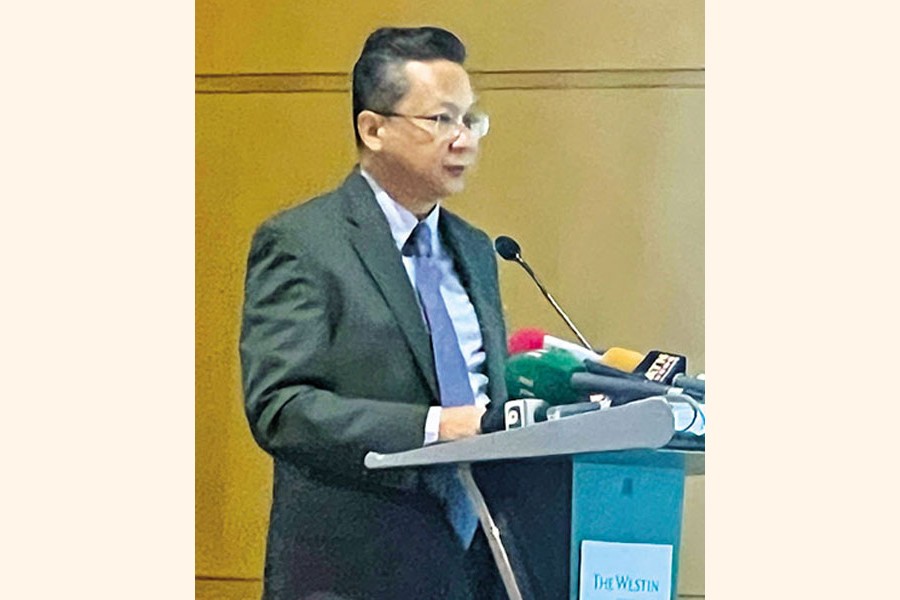
 Chinese Ambassador in Dhaka Li Jiming responding to a question after a conference on Thursday
 Despite sensitivities and worries among some, China is "very positive" about funding the Teesta river-management project in northern Bangladesh, says the Chinese envoy after a spot inspection of its necessity.
Chinese Ambassador in Dhaka Li Jiming Thursday said at a function that Beijing had been hesitant on a Bangladesh proposal for funding the 'Teesta River Comprehensive Management Project', because of certain adverse views.
Responding to a question after a conference on 'National Image of China in Bangladesh' the envoy said after having received the proposal from Bangladesh government for funding the project, China was a bit reluctant for sometimes in view of the worries in many, who thought taking loan from China would put Bangladesh in 'debt trap'.
But, the envoy notes, after talking to people living on the banks of the Teesta he found them seriously in favour of the project as it is very important for them
"We were asked by Bangladesh government officials to do something about the project one year ago. And after the assessment of the embassy, we decided that this is very important," he said.
"And now Teesta River Comprehensive Management Project is under serious assessment by relevant government agencies," the envoy said when asked to give an update of the Chinese decision about the much-talked-about project on management of the frontier river.
"But I would have to be frank, that Beijing or the Chinese side is a bit reluctant towards this project. The reason of course, you know, is that there is some sensitivity we observed," he further said about the critics.
"If someone comes out and says 'Well, this is again another case of Chinese debt trap'," he said, pointing to the reasons behind procrastination on part of his country which has been engaged in funding and executing numerous megaprojects in Bangladesh-including the iconic Padma Multipurpose Bridge.
"So I just want to make sure that the local people would welcome it-whether or not they need it, whether they support it-and, fortunately, all the answers I got from that trip were very, extremely positive.
"So it gives me great confidence, to say more to my colleagues in Beijing, to build their confidence," the diplomat said narrating why in the end China became positive about funding the project.
"I assure you that our feedbacks to my Beijing colleagues are very positive and we will tell them that people need this project eagerly and it is going to benefit more than 20 million people, who are also positive.
"So, why not to do it. Even though there are some worries or some concerns, to my opinion, we should take it very, very positively," he told the press to make clear Beijing's stance on the project.
Regarding China's involvement in resolving the Rohingya crisis he said since the beginning of the crisis, China has been active in facilitating negotiations between Bangladesh and Myanmar. And there is some progress that he won't disclose right now.
"We're doers. We're not talkers. So that is what we're doing," says the envoy of China which mediated a deal between Bangladesh and Myanmar on the refugee repatriation that has long been stalled, reportedly over the sticking point of their citizenship back home in Rakhine.
"We found that, right now, the most urgent task is confidence building," he said, reiterating his country's goal to ensure voluntary, dignified and sustainable repatriation of the Rohingya from Bangladesh frontier camps.
In response to a question on allegations of persecution by Chinese authorities against Uighur Muslims he said there have been a lot of narratives and news on this cooked up by the Western countries.
Rejecting the allegations he said there are 25 million Muslims and among them Uighur community represents a portion.
Some of the Uighur Muslims were found involved in terrorist activities and insurgencies so the authorities took measures against them as per the law of the land, the envoy said, adding that it is the norm in every country.
"And what I would like to say is that Xinjiang Uighur-related issues are not suppressing a certain minority ethnic group within China because we treat all ethnic groups in China equally. We have 56 different ethnic groups in China and Uighurs are one of them," he added.
Professor Imtiaz Ahmed, director of the Centre for Genocide Studies, made a presentation on the survey conducted by the Centre on the 'National Image of China in Bangladesh'.
Among others, Prof MM Akash, Prof Delwar Hossain and Ambassador Munshi Faiz Ahmed spoke on the occasion.
mirmostafiz@yahoo.com
© 2026 - All Rights with The Financial Express

