The proposed Commercial Courts Ordinance 2025 is expected to offer a new ray of hope for the speedy resolution of commercial disputes pending in different courts across the country.
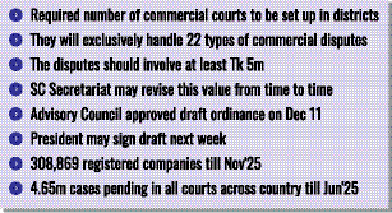
Under the ordinance, the required number of commercial courts will be established at the district level to exclusively handle commercial disputes, ensuring their speedy resolution.
After the final vetting, the Advisory Council, headed by Chief Adviser Prof Dr Muhammad Yunus, on December 11 this year approved the draft ordinance.
Now the draft is waiting to be signed by President Mohammed Shahabuddin.
Barrister Tanim Hussain Shawon, a special consultant of the law ministry who reviewed the draft ordinance, told The Financial Express the president might sign the draft next week.
A gazette notification would be issued once the president signed the draft, he added.
Till November 2025, Bangladesh had a total of 308,869 registered companies.
However, only two High Court Division benches handle corporate disputes along with other cases, leading to prolonged delays.
Till June 2025, a total of 4.65 million cases were pending before the courts across the country.
Of these, a significant number of corporate disputes were pending before the Appellate and High Court divisions of the Supreme Court, as well as the subordinate courts across the country.
In a recent seminar, the immediate past chief justice, Dr Syed Refaat Ahmed, said, "By prioritising speedy, efficient, and transparent adjudication, we are constructing a robust architecture for commercial justice. In the globalised economy of the 21st century, the quality of a nation's judiciary has become a primary economic indicator.
"Investors, both foreign and domestic, do not judge a country solely by tax incentives or infrastructure. They seek certainty. They seek assurance that contracts will be honoured, rights will be protected, and disputes will be resolved not over decades, but within months.
"By institutionalising transparency and credibility through these commercial courts, we are sending a clear and resounding message to the world that Bangladesh is open for business, and its justice system stands as the guarantor of that promise."
According to the draft ordinance, the commercial courts will adjudicate on at least 22 types of commercial disputes, including those involving banks, financial institutions, and insurance. Disputes over general transactions of businessmen, bankers, financial institutions, and merchants, including the execution and interpretation of commercial documents; export or import of goods or services; transactions relating to aircraft, aircraft engines, aircraft equipment, and helicopters, including their sales, lease, and financing; transportation of goods; and construction and infrastructure contracts, including tenders; will also be tried in the commercial courts. Apart from these, the Supreme Court Secretariat may specify any other commercial disputes under the commercial courts' jurisdiction from time to time by notification, the ordinance says.
District and sessions judges will be appointed as the judges of the commercial courts, and the chief justice will constitute one or more commercial appellate bench(es) in the High Court Division of the Supreme Court.
According to Section 7(1) of the draft ordinance, in any suit or application instituted under the ordinance, the value of the subject matter of the commercial dispute shall not be less than Tk 5.0 million.
However, the Supreme Court Secretariat may, from time to time, revise this value by notification in the official gazette.
Section 7(2)(Ka) says, "Where a remedy is sought for the recovery of money by way of a suit or application, the amount claimed, including interest accrued up to the date of filing of the suit or application, shall be deemed to be the assessed value."
Any party aggrieved by a judgment or order of the commercial court may file an appeal before the Commercial Appeal Court within 60 days from the date of such judgment or order, says Section 9(1) of the ordinance.
Again, any party aggrieved by a decision of the Commercial Appeal Court may file an appeal before the Appellate Division of the Supreme Court within 60 days from the date of such decision, according to Section 9(2).
The Commercial Appellate Court shall endeavour to dispose of an appeal within six months from the date of filing of the appeal, and the Appellate Division of the Supreme Court shall endeavour to dispose of appeals filed against orders of the Commercial Appellate Court within three months.
In the case of a dispute under the ordinance, any party to the suit may, after service of summons upon the defendant, apply for summary judgment by way of a summary trial upon framing of the issues.
bikashju@gmail.com
© 2026 - All Rights with The Financial Express

