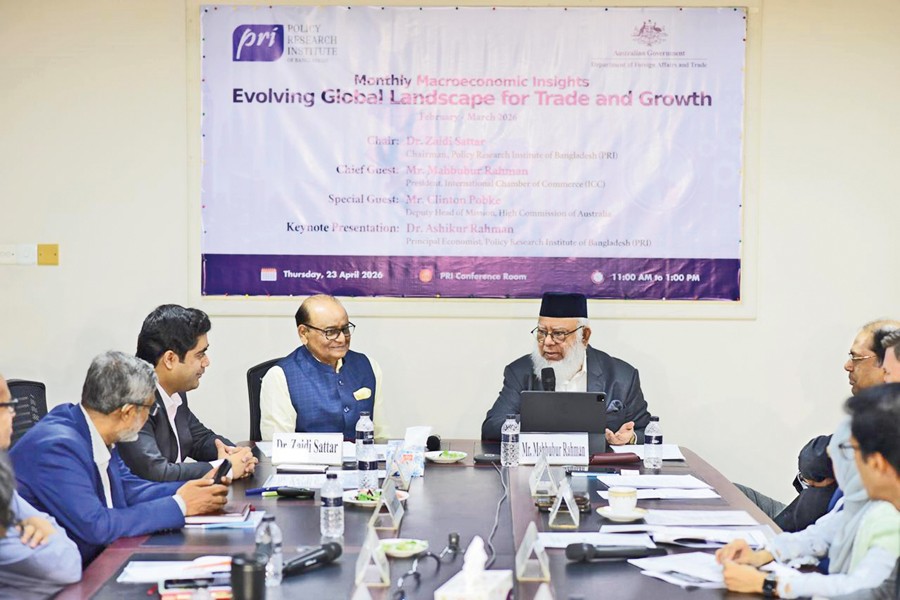
 ICCB President Mahbubur Rahman addresses a dialogue titled Macroeconomic Insights: Evolving Global Landscape for Trade and Growth in the capital on Thursday with PRI chairman Zaidi Sattar in the chair. — FE Photo
 Business leaders in Bangladesh remain uncertain and hesitant about expanding operations and making fresh investment, largely due to concerns over energy supply, says Mahbubur Rahman, president of the International Chamber of Commerce Bangladesh (ICCB).
He notes that entrepreneurs are still unsure whether they will have access to adequate gas and electricity, which is dampening investment sentiment.
To overcome the situation, he stresses the need to bridge the gap between the government and the private sector, as well as to ensure greater clarity in economic policy planning.
"The government and businesses must work together for the country," he said as the chief guest at a dialogue titled "Macroeconomic Insights: Evolving Global Landscape for Trade and Growth" and held at the Policy Research Institute (PRI) of Bangladesh office in the capital on Thursday.
The event was organised by PRI's Centre for Macroeconomic Analysis (CMEA), with support from the Department of Foreign Affairs and Trade (DFAT), as part of the ongoing efforts to promote informed and evidence-based policy dialogue.
The session was chaired by Zaidi Sattar, chairman of PRI, while Ashikur Rahman, principal economist at PRI, delivered the keynote presentation.
Mahbubur said uncertainty in the energy sector was one of the key reasons behind sluggish investment.
A lack of confidence in gas and electricity supply was discouraging entrepreneurs from undertaking new ventures, he said.
Weaknesses in the banking sector, uncertainty in accessing credit, and the rising risk of non-performing loans (NPLs) were also deterring investors, he noted.
Mahbubur pointed out that the recent decline in machinery imports reflected stagnation in investment, noting that without new investments, there was little scope for increased import of industrial equipment.
He further said Bangladesh remained heavily dependent on imported raw materials to sustain exports.
Although local value addition in the ready-made garment sector had improved somewhat, import dependence had not significantly declined, he said.
While exports to the US market remained relatively stable, the decline in European demand was a matter of concern, he said.
Highlighting macroeconomic challenges, he said high inflation was putting pressure on the ordinary people, particularly low- and middle-income groups.
Policymakers must remain cautious about containing inflation and avoid excessive money supply or unnecessary public spending, he also said.
He highlighted clear discipline gaps in the banking sector, with many banks in a fragile condition.
Tough decisions, including possible bank mergers, might be necessary, he said.
Emphasising collaboration, he said sustainable economic progress required the government and private sector to work as partners rather than competitors.
Coordinated efforts, he added, were essential to boost investment and accelerate economic growth.
Speakers at the event observed that many of the conditions set by the International Monetary Fund (IMF) could help restore discipline and drive reforms in the economy, though their implementation must consider domestic realities.
Ashikur, in his keynote, said the government had resumed printing money, warning of inflationary risks.
He noted that the government had borrowed Tk 200 billion from the Bangladesh Bank in March alone, describing it as "high-powered money" that could further fuel inflation.
He cautioned that the ongoing global economic instability, particularly tensions in the Middle East, policy uncertainties worldwide, and a lack of clarity over Bangladesh's graduation from the least developed country (LDC) status, were putting pressure on the country's economic stability.
Moving away from reforms at this stage would be "self-defeating," he warned.
"Backtracking on reforms would be suicidal. The government's retreat has created unnecessary tensions regarding the IMF," he said.
Reforms should not be viewed merely as IMF conditions but as essential for Bangladesh's own long-term economic sustainability, he added.
Joining the discussion, Khondokar Shakhawat Ali, visiting research fellow at the BRAC Institute of Governance and Development (BIGD), said Bangladesh was currently navigating a difficult economic phase both domestically and externally.
He noted that shifts in the country's political economy had contributed to the rise of "crony capitalism," which was disrupting normal investment flows.
Although deposit growth in banks remained positive, concerns persisted over governance and management, he said.
He also said despite some relief in remittance inflows due to the past central bank measures, overall confidence had yet to recover.
The ongoing decisions on bank mergers and ownership structures must be carefully evaluated for their impact on business sentiment, said Ali.
He stressed that there was no scope to retreat from economic reforms and called for continued strict action against money laundering.
Such irregularities, he said, might involve not only businesses but also influential groups across sectors, requiring coordinated responses.
Warning against inflationary financing, he said excessive money printing to support subsidies could further drive up prices, directly affecting ordinary citizens.
With employment already under pressure, declining income and purchasing power could deepen economic risks, he said.
He also cautioned that prolonged "bleeding" in the economy could undermine national capacity, urging policymakers to turn the crisis into an opportunity by advancing structural reforms.
He further highlighted the importance of remittances and suggested that policy decisions, including on dual citizenship, might be necessary.
Calling on the business community to play a more responsible role in dismantling crony capitalism, he urged identifying and, if necessary, boycotting dishonest investors, noting that institutions like the Bangladesh Bank possessed relevant data.
PRI Chairman Zaidi said the global economy had been disrupted by the ongoing Israel-US-Iran war and tensions surrounding the Strait of Hormuz, which had also affected Bangladesh's economy.
He noted that the country was navigating multiple challenges in the post-global financial crisis period, raising concerns over issues such as fuel stock security.
The new government was dealing with the challenges of LDC graduation, he said.
He pointed out that Bangladesh had faced five major economic shocks from 2019 to 2026 - the Covid-19 pandemic, Russia-Ukraine war, exchange rate volatility, domestic political changes, and the latest geopolitical tensions - and these had put pressure on overall economic stability.
In such abnormal times, he said, growth expectations should remain modest, around 5-6 per cent, in line with the government's projection of about 5 per cent, although there was optimism for improved growth in FY27.
He also observed that the tax reform agenda remained largely unaddressed, while export performance in FY26 had been on the downside.
Persistently high inflation, he warned, was not conducive to the balance of payments for a country like Bangladesh.
newsmanjasi@gmail.com
© 2026 - All Rights with The Financial Express

