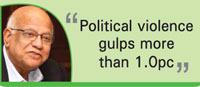
Finance Minister AMA Muhith said on Thursday corruption is eating up 2.0 to 3.0 per cent of the gross domestic product (GDP) of Bangladesh.
Besides, the country is also losing more than 1.0 per cent of the GDP due to social disturbance (political violence), he added.
The country’s GDP is estimated Tk 15.13 trillion in FY15 which was Tk 13.39 trillion in FY14.
"The cost of corruption in the country is 2.0-3.0 per cent of the GDP. ICT is the most important instrument for tackling the corruption," Mr Muhith said while addressing the development partners at the Local Consultative Group (LCG) plenary session in the capital.
The Economic Relations Division (ERD) organised the meeting of LCG, a platform of the external development partners and the government, to apprise the 7th Five Year Plan (SFYP), drafted recently by the General Economics Division (GED).
Representatives of the LCG members, including the World Bank, the Asian Development Bank, the United Kingdom's Department for International Development (DFID), the European Union (EU), the United Nations (UN), Japan and Germany, were present at the meeting.
The finance minister said the target for job creation during the SFYP period is quite "ambitious". "But if we want to achieve our economic growth target, we have to create such ambitious job opportunities in the next five years period."
The GED in the draft SFYP has set a target of creating 18.7 million additional jobs against the total 12.5 million new entrants into the job market during the next five years period.
Terming the "private sector mobilisation" is the biggest challenge for the next SFYP period, Mr Muhith said they need to increase private investment-GDP ratio to 26.6 per cent by fiscal year (FY) 2020 from the present level of 22.07 per cent.
"The private sector has a dormant capacity, which needs to be activated, and we've to think about it. The foreign contributions to development financing need to be highly accelerated for the private sector investment."
Regarding the low level of FDI inflow to the country, he said the FDI was US$1.57 billion in FY 2015, whereas the target of attracting FDI has been set at $9.6 billion in the terminal FY (2020) of the SFYP.
"So, this is one area of great importance where the development partners can make some contributions."
Mr Muhith acknowledged the latest financial sector scam as one of the biggest disasters for the economy, saying the financial sector reform is in such a position right now that it is possible to jump off in a big way.
On income inequality, the finance minister said the country has done well to address the inequality at the lower level, while within the rich group, inequality is still very high. "In next three years, we are hopeful of addressing the issue."
Terming the country's primary education satisfactory, the minister said the quality of secondary and tertiary level education needs to be enhanced.
Talking about the government's policy to address the issue of urbanisation, he said the government efforts would be there to take urban population outside Dhaka with the help of public private partnership (PPP) initiatives.
He also highlighted some areas, which will need special attention during the SFYP implementation, including education, health, agriculture and skill development.
Congratulating the government on behalf of the development partners on Bangladesh's becoming a lower middle-income country, LCG co-chair and DFID Country Representative Sarah Cooke said Bangladesh has made a significant progress in reducing poverty. Besides, the country has already met or is on the right track to meet most of the MDGs.
She said the development partners want to help Bangladesh tackle the challenges as well as to cement the country's transition to a middle-income status.
The LCG co-chair also underscored the need for speeding up DPP and TPP approval process in case of the development projects to yield better outcome.
After the first session of the plenary, the government officials sat with the LCG representatives in a close-door meeting, where journalists were not allowed to stay.
However, the meeting sources said most of the development partners have suggested the government to make the policy-making process more participatory, saying the public voice should be allowed to raise for picking up the country's development.
They also called upon the government for establishing a transparent and accountable financial sector through proper reforms.
The development partners suggested the government to ensure a proper land management system, appoint private sector audit for public spending, and ensure quality project implementation with lower cost to facilitate the country's growth.
The donors also emphasised attracting more local and foreign investments, cutting the cost of doing business in Bangladesh.
By the terminal year of SFYP (FY 2020), the government plans to raise the GDP growth to 8.0 per cent, contain inflation at 5.5 per cent, raise gross domestic investment to 34.4 per cent of GDP, raise private investment to 26.6 per cent of GDP while public investment to 7.8 per cent, and raise national savings to 32.1 per cent of GDP.
ERD Secretary Mohammad Mejbahuddin made the welcome remarks in the programme. GED Member Prof Shamsul Alam made a power-point presentation on salient features of the SFYP, to be implemented during FY 2016 and FY 2020.
Planning Minister AHM Mustafa Kamal and State Minister for Finance and Planning MA Mannan were also present.
kabirhumayan10@gmail.com
© 2026 - All Rights with The Financial Express

