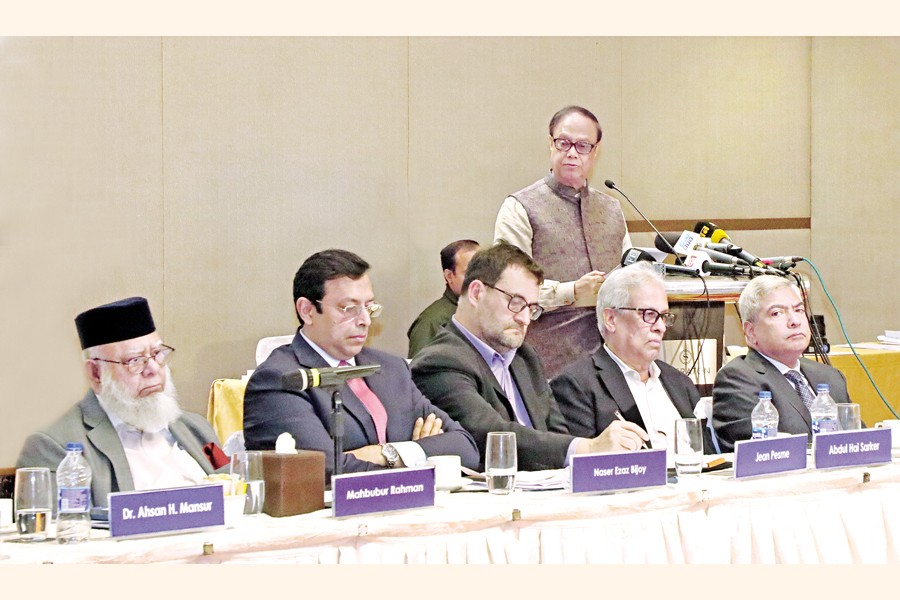
 Bangladesh Bank Governor Dr Ahsan H Mansur speaks at a roundtable titled "Implications of LDC Graduation for the Banking Industry: Bangladesh Perspective," organised by the International Chamber of Commerce Bangladesh (ICCB) at a city hotel on Tuesday. ICCB President Mahbubur Rahman moderated the event. — FE Photo
 Bangladesh is not yet fully prepared to absorb the aftershocks from least-developed country (LDC) graduation with key sectors like banking and finance and manufacturing staring at significant challenges looming large.
Economists, business leaders and experts came up with such forewarning at a roundtable discussion Tuesday, as the cutoff time for UN certification for the country's status change keeps nearing now.
They said following the graduation set for November 2026, such sectors would face difficulties adjusting the loss of preferential treatment and increased competitive pressure on the global market.
They have cautioned that without swift reforms along with adequate preparation, the transition could strain the financial system and undermine economic stability.
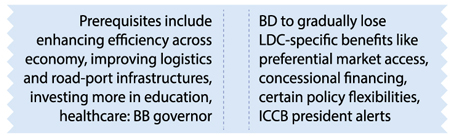 The speakers, mostly bankers, representatives of financial institutions and corporate executives, were speaking at the roundtable titled 'Implications of LDC Graduation for the Banking Industry: Bangladesh Perspective', organised by the International Chamber of Commerce Bangladesh (ICCB) at a city hotel.
.President the ICCB Mahbubur Rahman moderated discussions and shared the concerns raised at the meet.
Bangladesh Bank Governor Dr Ahsan H. Mansur attended it as chief guest while Dr Shah Md Ahsan Habib of Bangladesh Institute of Bank Management presented the keynote.
The speakers said the policymakers must now focus on enhancing competitiveness, strengthening institutional capacity and diversifying its export basket to navigate the post-LDC environment successfully.
While speaking as chief guest, the central bank governor said Bangladesh's development trajectory and its graduation from LDC status were closely linked and should be viewed as complementary processes.
"Bangladesh's development and LDC graduation go hand in hand," said Dr Mansur, urging the relevant stakeholders to look ahead and focus on long-term structural reforms and ensure sustainability.
He stressed the need for raising efficiency across the economy, improving logistics, strengthening road and port infrastructures, and investing more in education and healthcare.
Development partners, he mentions, have already been treating Bangladesh as a developing country since 2015.
The governor also underscores the importance of restoring macroeconomic stability, particularly by curbing inflation and lowering the rate of interest.
Bangladesh has historically experienced inflation in the range of 6.0-7.0 per cent, the central bank's chief executive said, but stressed that it must be brought down to 2.0-3.0 per cent to support sustainable growth.
"Inflation expectations have now become a key barrier…Local policy focus should centre on reducing inflation and borrowing costs," he told the audience.
Dr Mansur said Bangladesh could improve efficiency by as much as 30 per cent through better policy coordination and reforms.
The interim government, he mentions, has already passed several reforms, including promulgating the Bank Resolution Ordinance 2025, though some measures remain pending and are necessary to further stabilise and strengthen the financial sector.
Managing Director and CEO of Mutual Trust Bank PLC Syed Mahbubur Rahman, Managing Director and CEO of Prime Bank PLC Hassan O. Rashid, Managing Director of Plummy Fashions Limited Md. Fazlul Hoque, Deputy Managing Director of Picard Bangladesh Amrita Makin Islam, and Managing Director of Eskayef Pharmaceuticals Ltd. Simeen Rahman were panel discussants.
Besides, Chairman of Bangladesh Association of Banks (BAB) Abdul Hai Sarker, World Bank country Director Jean Pesme, ICCB Vice-President A K Azad, Chairman of Bengal Commercial Bank PLC Md. Jashim Uddin, Vice President of ICCB and Chief Executive Officer of Standard Chartered Bank Naser Ezaz Bijoy, ICC Bangladesh Secretary-General Ataur Rahman, and representatives from the World Bank, the UN, UNDP and IFC were also among others present.
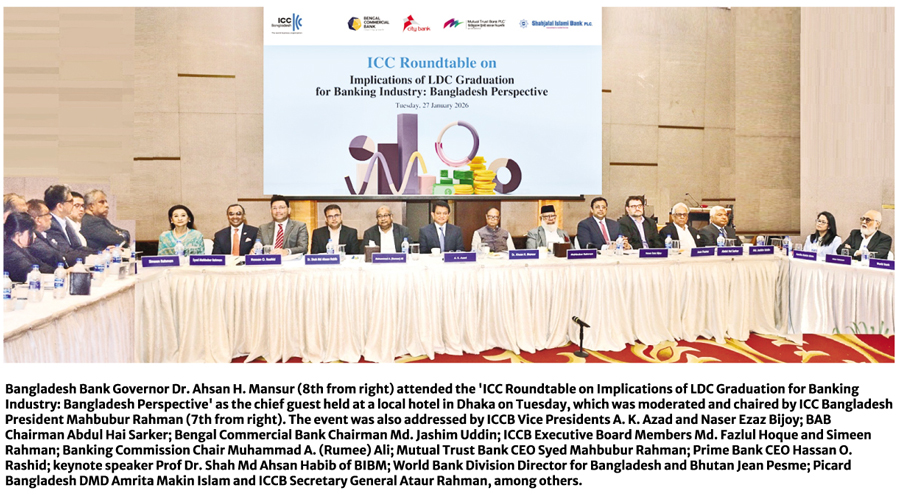
The ICCB President, Mr. Mahbubur Rahman, said with graduation, scheduled to take place in November this year, Bangladesh would gradually lose LDC-specific benefits such as preferential market access, concessional financing, and certain policy flexibilities.
"These changes will place new pressures on the economy-and in particular, on our financial system," he told the meet.
"Bangladesh's graduation, therefore, is not merely a celebratory moment--it represents a structural shift. In this transition, the role of the central bank becomes even more consequential," he added.
From a banking perspective, LDC graduation will reshape the operating environment in three fundamental ways.
From ICC Bangladesh's perspective, the post-LDC era calls for a qualitative transformation of the banking sector, guided by sound regulation and credible supervision.
The ICCB Vice President and Managing Director of Ha-Meem Group of Industries, AK Azad, vented concern about monetary policy.
"Only tightening monetary policy will not reduce inflation in the country, because it is related to many other issues, including revenue," he said.
As a result of tightening monetary policy, 1.2 million people have already lost their jobs and another 1.2 million may lose their jobs in the next six months, he added.
He also mentions that the private sector has taken only 6.0 per cent of loans from banks, while the government has taken 27 per cent which may reach 32 percent in the future.
He thinks it is not possible to manage the economy through monetary policy alone without increasing investment and employment.
He laments that although attempts were made to explain the impact of LDC graduation to the current government, they did not agree, and said, 'These problems must be brought before them immediately after the formation of the new government.'
Group Chief Executive Officer of the country's leading conglomerate - Transcom Group - Ms. Simeen Rahman said LDC graduation is not merely a change in economic classification, it represents a structural shift that will reshape policy, space, and competitiveness, particularly in sectors that directly affect people's lives.
Ms. Rahman, also managing director of Eskayef Pharmaceuticals Ltd, said pharmaceutical is one of such sectors that play a unique and critical role bridging public-health priorities and industrial capability of a country.
She underscores the need for local production of API as one of the preparatory measures.
Muhammad A. (Rumee) Ali said there had been a lot of discussions on the impact of graduation on different sectors of the economy but he did not see much discussion or pre-emptive policy suggestions on this imminent risk with any level of urgency or concerns by the banking industry.
Managing director and CEO of private commercials bank Mutual Trust Bank PLC Syed Mahbubur Rahman said the graduation process reflects decades of progress in poverty reduction, human development, and economic resilience.
"But, let us be clear, we are graduating into a world that is far more complex, competitive, and unforgiving than the one we entered as an LDC."
And it is being done at a time when the country's banking sector is under immense strain as well as the economy.
He further said Bangladesh's LDC graduation is not the end of its development journey rather it is the beginning of a new chapter-one that demands maturity, discipline, and vision.
"The banking sector must not be a passive observer in this transition. It must be an active architect of a more resilient, inclusive, and globally competitive Bangladesh," he said.
Managing director and CEO of Prime Bank PLC Hassan O. Rashid said the impact on bank will also leave impact on the capital market as there are a number of listed banks.
Underscoring the need for independence of the central bank he said: "I think this is extremely important because to tackle the headwind, we need a stable economic policy, monetary policy, stable exchange rate, inflation and interest rate."
Former president of Bangladesh Knitwear Manufacturing and Exporters Association Fazlul Hoque thinks the country is not well prepared to embrace the graduation right now.
As a private-sector representative, he says, they are not feeling very comfortable at this juncture to have the graduation in November to 2026.
For the good health of banking sector, he underscores the need for an independent and free central bank to regulate the country's banking sector.
Deputy Managing Director of Picard Bangladesh Ms. Amrita Makin Islam underscored the need for export diversification from RMG that constitutes almost 80 per cent of total export receipt.
She also points out Bangladeshi exporters, compared to the peer countries, face additional burden like extended lead time in export and poor backward linkage that need serious attention.
Former President of Dhaka Chamber of Commerce and Industry (DCCI) Rizwan Rahman, CEO and Managing Director of Renata PLC Syed S. Kaiser Kabir, and BGMEA Director Faisal Samad also spoke, among others, in the open-floor discussion session.
jasimharoon@yahoo.com, saif.febd@gmail.com
© 2026 - All Rights with The Financial Express

