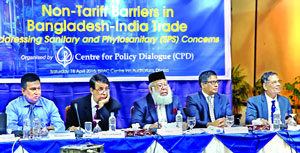
 Mahbubur Rahman, President of the International Chamber of Commerce, Bangladesh, speaks at a dialogue on Bangladesh-India trade. — FE Photo
The Centre for Policy Dialogue (CPD) has suggested inking a bilateral agreement on Sanitary and Phytosanitary (SPS) measures between Bangladesh and India to help remove the much-discussed Indian Non-Tariff Barriers (NTBs).
The think tank also said that such a deal could be signed under the South Asian Free Trade Agreement (SAFTA) framework.
It also noted that trade barriers originating from SPS need to be reviewed carefully as no country would make compromise on safety and standard of food they import.
The suggestions came at a dialogue, organised by the CPD on Saturday. It was organised to review the issues and concerns on SPS measures and identify whether SPS measures turned into NTBs in the Bangladesh-India bilateral trade.
Mahbubur Rahman, president of the International Chamber of Commerce, presided over the trade dialogue where he stressed the need for a level playing field in the bilateral trade.
"I have no reservation about importing goods from India, but Bangladeshi exporters also have to get equal opportunity," said Mr Rahman. "Many Bangladeshi products are very much global-standard. It means our manufactures have capacity."
Taking part in the discussion, Mr M Anis Ud Dowla, Chairman of ACI Limited, said sometimes it took four weeks to release exported seed from quarantine system and by that time seeds start germinating making those unusable.
He stressed political will and action to ease regulations of standards for enhancing bilateral trade and export from Bangladesh.
Mr Tanvir Islam, general manager of PRAN group, said that laboratory testing of each consignment of their products turns out to be very time- consuming.
"For export to India, we have to make separate type of packaging which is different from the rest of the world," he told the meet.
In her keynote presentation, Mrs Khaleda Akhter of CPD said that several certification, registration, testing and packaging requirements create difficulties in exporting to the Indian market. Citing an example, she said that Bangladeshi exporter of packaged food has to use 'veg' or 'non-veg' sign along with name and address of an Indian importer on the packet. The Food and Safety Standard (Packaging and Labelling) Regulation 2011 has made such tagging provision mandatory.
"Is it not a kind of NTB to discourage Bangladeshi exporters?" she added.
Prithviraj Nath, a trade expert from Consumer Unity Trust Society (CUTS) of India, however, made it clear that the provision is universal, not for any specific country. That means both the Indian local manufacturers and the exporters to India have to comply with this packaging regulation.
Dr Selim Raihan, a professor of economics at the University of Dhaka, said that India is a growing economy and its growing consumers become more conscious on quality of products, while in Bangladesh similar consciousness was increasing.
"Thus, without ensuring quality of products, Bangladeshi manufacturers and exporters can't enhance export to India. Time is coming when comparative advantage on quality will be crucial to grabbing Indian market," he continued.
Chief guest of the programme Mr Amitava Chakrovarty, additional secretary of the Ministry of Commerce, opined that as per World Trade Organisation (WTO) rule, SPS measure could be taken to ensure food safety as well as animal and plant health measures.
"But these have to have scientific basis and can't be used as an excuse for protecting domestic producers," he said.
Professor Mustafizur Rahman, executive director of the CPD, mentioned that South Asia Regional Standard Organisation (SARSO) started journey in 2011 and this body could work to harmonise product standards among the regional countries.
Mr Humayun Rashid, acting president of Dhaka Chamber of Commerce and Industry (DCCI), was present as guest of honour. asjadulk@gmail.com
© 2026 - All Rights with The Financial Express

