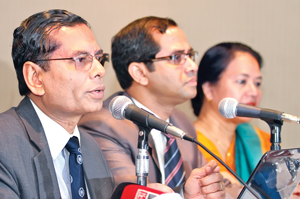
 Centre for Policy Dialogue (CPD) executive director Dr. Mustafizur Rahman speaking at its third review briefing for the outgoing fiscal year in the city Sunday — FE Photo
Local think-tank Centre for Policy Dialogue (CPD) questioned Sunday the country's economic growth estimation prepared by the Bangladesh Bureau of Statistics (BBS) recently for the outgoing fiscal year.
The CPD said Bangladesh's gross domestic product (GDP) cannot grow at so high rate at a time when the economy had faced political turbulences almost all the time in the first half of the fiscal year 2013-14.
The CPD's question regarding the real GDP growth came at its third review briefing for the outgoing fiscal year held at the Brac Inn Centre in the city.
The review was titled 'State of the Bangladesh Economy in Fiscal Year 2014'.
CPD executive director Dr. Mustafizur Rahman read out the review while its research director Dr. Fahmida Khatoon, additional director Dr. Khandker Golam Moazzem and its other high officials were present.
Dr. Rahman said it is a surprise that the service sector that had faced the worst during the political turmoil in July-December period grew by 5.8 per cent in 2013-14 against 5.5 per cent in 2012-13.
"It's a really a surprise that the service sector grew by 0.3 percentage point over its previous year which was comparatively peaceful," Dr. Rahman said.
The CPD executive director said all sub-sectors under the service sector that comprises more than 50 per cent of the economy were affected adversely during the first half of the fiscal year due to the restive political programmes over the poll-time government issue.
Dr. Rahman said according to the latest BBS estimate, the agriculture sector has grown at 3.4 per cent. "It is nearly 1.0 per cent higher than that of the last fiscal year," he said.
He said the BBS estimation showed lower growth only in the manufacturing sector at 8.4 per cent against 10.3 per cent last fiscal year.
Dr. Rahman said the construction sector was sluggish in the first half of the fiscal year but the BBS showed its growth at 8.6 per cent, 0.6 percentage point higher than that of the last fiscal year.
The CPD, however, hoped that the BBS would adjust its figures with real data in its final measurement later.
The BBS will finalise the provisional GDP growth at 6.1 per cent for the outgoing fiscal year sometime in May in 2015.
Focussing on budget deficit, the CPD suggested that Bangladesh should take a move to get more foreign aid to fund its budget deficit.
"There is around US$19 billion aid in the pipeline. We should utilise it as its cost is low," Dr. Rahman said.
He said borrowing from the domestic sources leads to higher interest payment.
He said currently around 91 per cent of the total deficit is being funded from the domestic sources.
The CPD observed that the Bangladesh Bank has been buying dollars from the local market to keep exchange rate stable. It might cause inflationary pressure on the economy, the think tank said.
The CPD also observed that capital flight has been continuously going on from the country through under-invoicing, over-invoicing or mis-pricing.
Dr Rahman said the government has formed a cell to combat it. He said it should be strengthened further as different studies show that a significant amount of money is being siphoned off out of the economy.
He said around $1.5 billion are being taken out of the country each year.
The CPD doubted capital flight through mis-invoicing as import of some items jumped abnormally in the first nine months of the current fiscal year, compared to the previous fiscal year.
To investigate the sources of the recent rise in import at a more disaggregated level, the CPD examined the detailed import shipment data for the July-March period.
It was found that 17 import items accounted for about 40 per cent of total import and 93.5 per cent of incremental growth during July-March period in the current fiscal year.
During July-March of FY14, import of tanks, casks, drums cans or iron/steel (50-300 litre) stood at $329 million, which was only $1.0 million a year ago, according to the CPD report.
During the period, transporter cranes, gantry cranes, bridge cranes and overhead travelling cranes cost $466 million, which was only $7.0 million in the previous fiscal year and aeroplanes and other aircraft of an unladen weight (2000kg) was $326 million, which was $2.0 million, it said.
"There is a possibility of illicit financial outflow from the country as import growth was abnormal on items having low or zero duty," said CPD executive director Dr. Rahman while briefing on the Bangladesh Economy in FY2014.
He urged the Bangladesh Bank and the National Board of Revenue (NBR) to scrutinise the matter.
It said data received from the Bangladesh Bank shows that these cranes were imported from France in the month of March 2014 which accounted for about $433 million.
"Import of such a large number of cranes in a single month warrants a double check," the CPD said adding that such an exceptional pattern of import figures calls for appropriate scrutiny on the part of the NBR.
It is worth mentioning that customs duty on crane product was only 2.0 per cent while on aeroplanes and other aircraft, it was zero.
According to the latest report of Global Financial Integrity (GFI), a Washington-based research and advocacy organisation, the annual average money laundering through manipulation of commercial invoices hit $1.2 billion during a period between 2002 and 2011 in Bangladesh.
The figure of trade mis-invoicing was slightly down from $1.4 billion estimated between 2001 and 2010.
Trade mis-invoicing involves the deliberate manipulation of commercial invoices in order to misreport the value of a transaction, thereby illegally shifting money across international borders without detection.
According to the report, cumulative amount of illegally siphoning off of money stood at over $11 billion during the period and over $1.7 billion was drained out of Bangladesh in 2011.
"It is a matter of great concern," he noted. The government should enforce the anti-money laundering act properly to check siphoned off money.
The CPD said restoring investors' confidence and addressing the ever-increasing infrastructure demand in a cost-effective manner will be major challenges for the country's economy in next fiscal year 2014015.
The CPD reiterated that participatory politics could be ensured and confidence of investors restored.
"It'll be possible to bring back pace in the economy," Mr. Rahman said.
While talking about public finance, He said during the first 10 months of the fiscal 2014, the NBR attained 9.2 per cent growth over the same period of fiscal 2013 against the annual target of 25.3 per cent.
He said the NBR collection will need to grow at 34.4 per cent in May and June of the current fiscal to attain the revised target.
© 2026 - All Rights with The Financial Express

