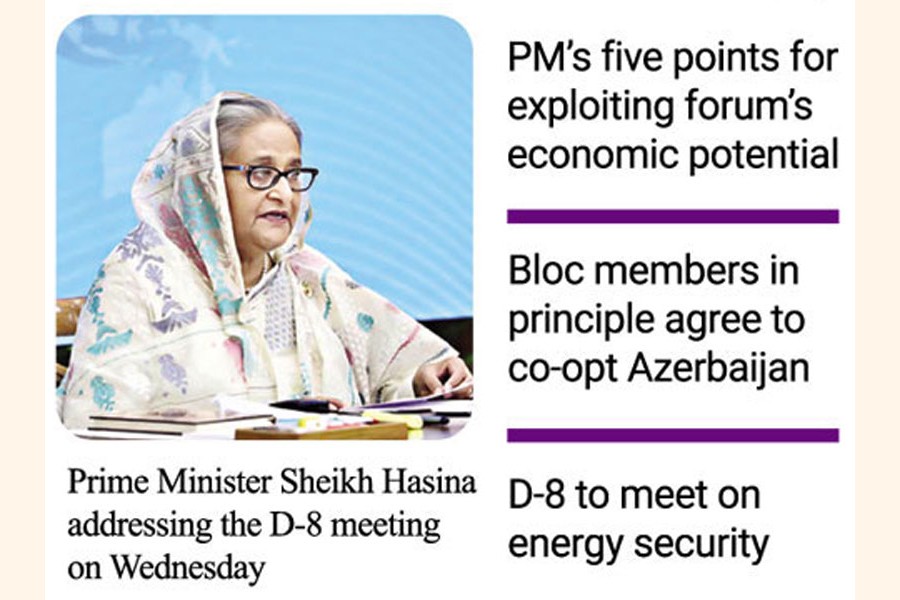
The D8 bloc agrees to implement preferential trade agreement (PTA) by next year for business boosting, at a time when economic crises sweep the world from different directions.
A meeting of the D8 Council of Ministers in Dhaka Wednesday reached the consensus among the member-countries of forum that encompasses economic corridors from Asia through the oil-rich Middle East to Central Asia and Africa.
Bangladesh Prime Minister Sheikh Hasina, while addressing the meet, also stressed the urgency of effecting the deal for enhancing trade within the grouping at his hour to make it a strong economic bloc.
"Previously, 7 members had approved the PTA proposal and today Egypt said that they agreed to it," Foreign Minister Dr AK Abdul Momen told the press in a post-meeting briefing.
The meeting put special focus on the ongoing energy crisis and a decision to hold a D8 ministerial meeting on energy security was taken.
All the members in principle agreed to co-opt Azerbaijan in the group. However, accession of the Central Asian country will be finalized following formulation of rules on inclusion of new members, Dr Momen said.
The D-8 Organisation for Economic Cooperation, also known as Developing-8, is an organisation for development cooperation among the following countries: Bangladesh, Egypt, Indonesia, Iran, Malaysia, Nigeria, Pakistan, and Turkey.
Earlier addressing the meet through virtual platform, Prime Minister Sheikh Hasina placed a five-point proposal meant for exploiting the real economic potential of the grouping.
She urged the member-countries to work together to provide "the impetus for harnessing our potential towards a prosperous future".
The forum, established twenty-five years ago, is now poised to deliver its goal of economic development through creating synergies, Hasina told the ministers and delegates gathered from across the vast belt.
Political commitment and meaningful cooperation of the group's public and private sectors were instrumental behind the advancement of the D8, she noted.
"The immense possibility that we have, if realized properly, will heighten our power as an economic bloc."
Sheikh Hasina expressed her satisfaction for the decision taken to finalise the D-8 Preferential Trade Agreement.
"It will help harmonize the intra-country trade, liberalize the barriers, and stimulate trade and economic cooperation among the member-states," she observed.
The Prime Minister said as the world was reeling from the aftermath of the Covid-19 pandemic, the Russia-Ukraine conflict pushed the world into a fresh danger.
She pointed out that the war and the subsequent sanctions and counter-sanctions have disrupted the production and supply of food, fertilizer, energy and power, and other commodities, causing suffering to countries like Bangladesh.
"Countries like Bangladesh have been bearing the brunt of the impacts of the war the most and prices of essentials have gone beyond the purchasing capacity of most people," she told her audience.
"We should all come forward to bravely address this looming humanitarian crisis," she said in her call.
The prime minister mentioned that the world is passing through a difficult time due to Covid-19 pandemic, conflicts, food and energy crises, climate change and natural disasters.
She said strengthening multilateral cooperation and global solidarity deserves more attention than ever as the world is passing through such a difficult juncture.
Sheikh Hasina said the D-8 countries have been collaborating in the six thrust areas. And she now placed five proposals for the D8 leaders to take into consideration as the forum is celebrating its 25th anniversary.
"It should formulate some specific focus areas for the next decade."
In her first proposal, she said implementation of the PTA is an important element for a successful D-8 as the states have large domestic markets and a combined market which is also considerable.
"Intra-D-8 trade will help accelerate our business prospects and opportunities. It should be our goal to double the intra-D-8 trade from 129 billion dollars in the next decade," she said.
Secondly, she said, "Bangladesh is ready to provide space at our Special Economic Zones for investment of the member states. If we begin the process now, within the next decade, we will have a robust D-8 Economic Zone."
In the third proposal, the premier said ICT is an area that has immense prospects. The youths of the D-8 countries can be turned into formidable workforce.
"About 70 per cent of Bangladesh's population is under 40 years and we have 650,000 registered IT freelancers.
"We can use this huge manpower to create IT-based industry and involve the youth in various economic activities," she added.
In her fourth proposal she said the D-8 should concentrate on diversified agriculture production to ensure food security and steady food supply.
"Bangladesh is ready to share her best practices and experience with other D-8 member states. We should focus on agriculture production to become self-sufficient in food production within the next decade," she added.
In the last proposal, the prime minister said that all the D8 member-states should be careful about energy usage and the necessity of alternative energy sources.
"I propose that the D-8 focuses developing capacity by involving other countries who have expertise in alternate energy," she concluded.
Foreign Minister Dr AK Abdul Momen, D-8 Secretary-General Ambassador Isiaka Abdulqadir Imam, State Minister for Foreign Affairs Md Shahriar Alam and President of the D-8 Chamber of Commerce and Industry (D8CCI) Sheikh Fazle Fahim also spoke on the occasion. Senior Secretary of the Ministry of Foreign Affairs Masud Bin Momen gave the address of welcome.
Listing the economic development of the country in the recent times the PM said, the country's sustained efforts in all areas of socioeconomic advances have paved the way of graduating from the LDCs.
She also said the Padma Bridge, opened last month, is an engineering marvel built entirely with the country's own finance and it is expected to contribute 1.23 per cent to the GDP.
The D-8 countries with more than one billion people have enormous potential for economic cooperation.
"Bangladesh has been attracting investment through our liberal, friendly investment policies and arrangement of linkages between foreign and local businesses," she said.
The premier said that Bangladesh's export earnings increased from USD 18 billion in 2010 to over 52 billion in the last fiscal year.
Bangladesh, currently the 41st-largest economy in the world, is set to become 25th by 2035, she said.
Though Bangladesh was scheduled to hand over the chair of the group to Egypt from the meeting, Egypt requested Bangladesh to continue in the chairmanship for another one year.
The forum conference took up the issues at a time when the Russia-Ukraine war in the hubs of food and fossil fuels and anti-Russia sanctions have blocked supply lines, causing the entire outside world, including the western countries, to suffer from severe supply shortages and go for rationing of the essentials.
An agreement between the warring countries-mediated by Turkey, a major member of the D8 bloc-on clearing the supply chains has yet to be fully effective.
mirmostafiz@yahoo.com
© 2026 - All Rights with The Financial Express

