A roadmap on deregulation of the economy and liberalisation of trade and investment forms focal policy features in the national budget the new government prepares to present in parliament, sources say.
Deregulation and liberalisation both are election pledges of the government of the Bangladesh Nationalists Party (BNP) that came to power through an election in February.
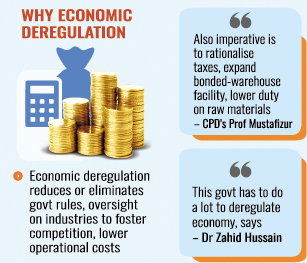
Deregulation of the economy leads to reduction in or elimination of government rules and oversight on industries, aimed at fostering competition, lowering operational costs, and boosting economic growth.
This unclasping of controls means lifting barriers to entry, allowing firms to operate more freely, theoretically lowering consumer prices, and promoting innovation.
Trade liberalisation means the removal of or reduction in trade restrictions or barriers, like tariffs, on the free exchange of goods between nations, according to investopedia.com.
Finance Division officials are now busy formulating fiscal budget for 2026-27, scheduled for rollout on June 11, and on Wednesday, they had meeting with the Prime Minister to apprise him of the budget updates.
At the meeting, sources have said, Prime Minister Tarique Rahman asked the Finance Minister and his team to incorporate as much election pledges as possible in the next budget measures to help reinvigorate the economy and multiply people's welfare.
According to officials concerned, the Finance Division last month asked the ministries and departments concerned to let it know what deregulation-and liberalisation-related measures they have taken so far and what plans they have for the days ahead.
Sources say most of the ministries informed the finance division about the deregulation and liberalisation measures taken in the past. Only a few ministries proposed what measures they plan to pursue in the future for reduction or elimination of government rules and oversight on industries or removal of or reduction in trade restrictions or barriers.
Finance officials now are preparing a roadmap on deregulation and liberalisation measures to be pursued during the next five years of the present government.
"We are preparing a roadmap based on the election manifesto of the BNP-led+ government," a senior finance division official told The Financial Express.
He said attracting foreign investment by removing various existing barriers and opening up the domestic market as much as possible for all will be at the core of the deregulation and liberalisation measures in the days to come.
Experts also underscore the need for removal of barriers to attracting foreign investments, allowing firms to operate more freely, and lessening cost of doing business to help boost economic growth.
Professor Mustafizur Rahman, a Distinguished Fellow at the Centre for Policy Dialogue (CPD), says rates of duty and taxes in Bangladesh have been comparatively high for a long period and so need to be made rational, expand bonded -warehouse facility and lower duty on raw materials.
He also suggests handover of loss-incurring public entities to private-sector management in the deregulation drive.
"To enhance inflow of foreign investment, one-stop service has to be ensured, logistic policy needs to be implemented, and the time consumption in public service delivery lowered," he says.
Also, Mr Rahman underscores the need for lowering turnaround time of ships in the seaports, making dispute-settlement resolution effective, and easing the repatriation of profit by foreign investors.
"The new government can give more attention on these issues to make doing business easier in the country, leading to higher local and foreign investment," he says.
Dr Zahid Hussain, a former lead economist at the World Bank's Dhaka office, recalls that during the regime of 1991-95 many barriers relating to competition in various sectors were removed.
However, he regrets, the reforms did not continue over the period. Thus, this government will have to do a lot of things to deregulate the economy.
"This government will have to take specific and effective reform measures and make it clear to people what steps it will take for that and how they will be implemented," he says.
Citing an example, he says stakeholders in the next budget want to specifically hear from the government what the National Board of Revenue (NBR) will do in tax -policy reform, what measures will be taken for higher and effective implementation of annual development programme.
syful-islam@outlook.com
© 2026 - All Rights with The Financial Express

