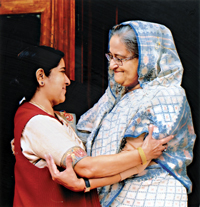
 Prime Minister Sheikh Hasina exchanging greetings with Indian External Affairs Minister Sushma Swaraj during the latter\'s visit to the PMO Thursday — PID
Bangladesh and India demonstrated Thursday their wiliness to engage in highest-level talks to bring momentum into their bilateral relations and take it to a greater height as the two countries' 'destinies are linked', reports UNB.
India termed the discussions between its External Affairs Minister Sushma Swaraj and Bangladesh leadership 'constructive, productive, fruitful and successful' while Bangladeshi sees 'stronger' and 'deeper' ties with India in the coming days.
However, there was repetition of assurances from Indian side for settling two major pending issues with Bangladesh-Teesta water sharing agreement and Land Boundary Agreement (LBA).
Foreign Minister AH Mahmood Ali and Indian External Affairs Ministry spokesperson Syed Akbaruddin briefed the media separately on the outcome of the meetings.
"We've discussed all the issues of mutual interest in a friendly environment," the Foreign Minister told reporters at the Foreign Ministry.
He said issues related to political and security cooperation, energy cooperation, trade, regional and sub-regional cooperation, water resources management, people-to-people contact and cultural exchanges were discussed during his meeting with Sushma Swaraj.
On Teesta issue, the Foreign Minister said efforts are there in India to build internal consensus on the issue. "She (Sushma) expressed her hope over signing the Teesta deal."
About LBA, Mahmood Ali said Bangladesh requested the Indian side for the ratification of the LBA.
"The Indian Minister also expressed hope over its settlement. She also mentioned that the matter is under active consideration at the Rajya Sabha," he added. The issue of Nur Hossain extradition also came up for discussion, said the foreign Minister.
FE Report adds: Indian External Affairs Minister Sushma Swaraj's meeting with the Bangladesh leadership Thursday was highly 'constructive and productive' and both sides agreed to build new momentum in the existing relations between the two countries.
The disclosure was made by Syed Akbaruddin, Joint Secretary for External Publicity of the Indian government and spokesperson of the team now visiting Dhaka with Sushma Swaraj, at a press briefing at the Sonargaon Hotel in the city.
Indian joint secretary at Bangladesh-Myanmar Desk Sripriya Ragunathan and political counselor at Indian High Commission in Dhaka Ajit Ghos were also present at the press briefing.
Mr Akbaruddin said the meeting with Prime Minister Sheikh Hasina and Foreign Minister Mahmud Ali set the 'tone and tenor' of the relations by emphasising that India considered Bangladesh a very important neighbour. So she came here first, he added.
Giving what he termed a 'broad understanding of the outcome' of the discussions, Mr Akbaruddin told reporters that Sushma Swaraj told the Bangladesh leadership that the new government in Delhi was 'keen to maintain and step up new momentum' in the existing relations.
He said the message was 'India is ready to break new ground' in the relations and cement it further in all areas of common interest.
He said India shed blood for Bangladesh in the past. Both sides were looking at the commonalities to share each other's concerns and develop together.
He said Bangladesh indicated 'unequivocal and uncompromising' support to fight terrorism and deny shelter to insurgency. India would not similarly give sanctuary to criminals from Bangladesh, he said. He also said Sushma Swaraj invited Foreign Minister AH Mahmood Ali to visit India to talk on future relations and he had accepted it.
She had also handed over a letter of Prime Minister Narendra Modi to Bangladesh Prime Minister Sheikh Hasina inviting her to visit India, he mentioned.
Modi had earlier accepted the Prime Minister's invitation to visit Bangladesh and both sides would work now on the modalities of the Indian Prime Minister's visit to Dhaka, he added.
He said India wanted to promote exchange of all types of goods, services and ideas. It wanted to further enhance connectivity increasing the sorties of the Moitre Express and extending the Kolkata-Dhaka bus services up to Guwahati via Shilong.
Though people-to-people exchange was high on the India's priority list, he said a holistic visa policy was yet not ready but India had offered to extend the tenure of multiple visas from one year to five years, initially for tourists aged below 13 and above 65.
In the power sector India had offered 500 MW of electricity to Bangladesh from the West Bengal and was working on transfer of another 100 MW from the Palatana power plant in Tripura state in the east.
To promote exchange of ideas, he said India offered seats to Bangladeshi students at the Nalenda University and Dhaka had accepted the proposal. Moreover, Bangladesh might send a team of 100 youths annually to India as part of promoting people-to-people relations.
Replying to questions, Syed Akbaruddin said Sushma Swaraj's telephonic talks prior to her visit to Dhaka were useful, but he could not say anything about its outcome in the event of expediting the Teesta water sharing deal.
He also said the elections and domestic political issues did not come up in talks with the Bangladesh leadership.
"India has great respect for Bangladesh as a sovereign country; the question of involving in domestic politics does not arise, we talked about regional and sub-regional cooperation," he said.
To a question that the election of Modi government in India provided an opportunity to resolve the Teesta water sharing and land boundary issues, Mr Akbaruddin said there had been always broad-based national consensus in India on any foreign policy issue. But the answer as to why and when the two issues might be resolved remained unclear.
The answer to a question over non-tariff and para-tariff barriers which were working as impediments to exports to the Indian market also remained unclear. It must be talked about at relevant levels, Mr Sripriya Ragunathan said.
© 2026 - All Rights with The Financial Express

