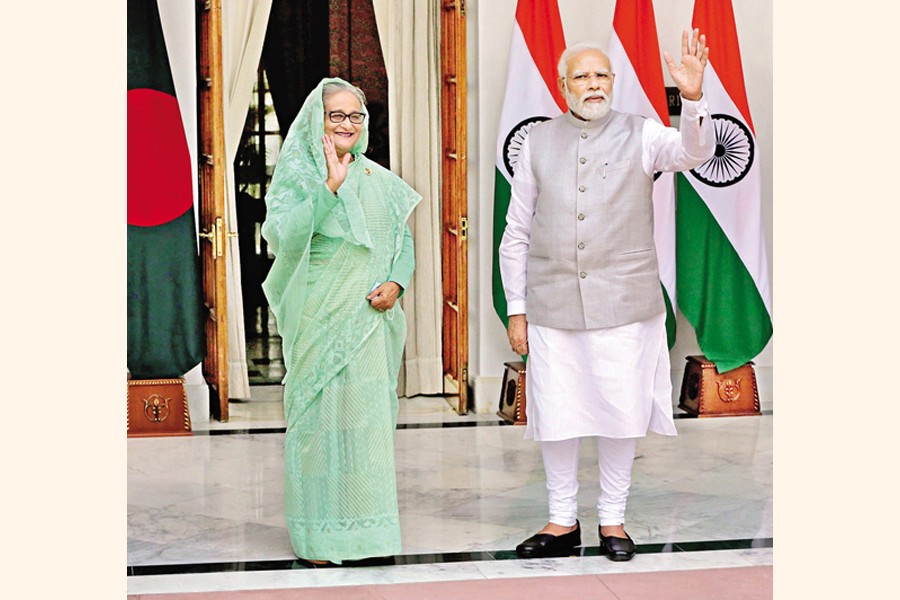
 Bangladesh Prime Minister Sheikh Hasina and her Indian counterpart Narendra Modi pose for a photo after her arrival at the Hyderabad House in Delhi on Tuesday — Focus Bangla
  NEW DELHI, Sept 6: Bangladesh and India on Tuesday signed seven accords demonstrating cooperation in a number of areas, including water sharing of the Kushiyara River.
One of the memorandums of understanding (MoUs) was signed between the Ministry of Water Resources, Bangladesh, and the Ministry of Jal Shakti, India, on withdrawal of water by Bangladesh and India from the common border river Kushiyara, reports UNB.
The MoU between the Ministry of Railways (Railway Board), India, and the Ministry of Railways, Bangladesh, was signed for training of Bangladesh Railway personnel in India.
On the other hand, an MoU between the Ministry of Railways (Railway Board), India, and the Ministry of Railways, Bangladesh, was signed on collaboration in IT systems such as FOIS and other IT applications for Bangladesh Railway.
The National Judicial Academy, India, and the Supreme Court of Bangladesh signed an MoU on training and capacity-building programme for Bangladesh judicial officers in India.
The MoU on scientific and technological cooperation was signed between Bangladesh Council of Scientific & Industrial Research (BCSIR) and Council for Scientific & Industrial Research (CSIR), India.
The two sides signed an MoU on cooperation in the area of space technology.
The MoU between the Prasar Bharti and Bangladesh Television (BTV) was signed on cooperation in broadcasting.
Prime Minister Sheikh Hasina and her Indian counterpart Narendra Modi witnessed signing of the bilateral instruments after holding bilateral talks at Hyderabad House in India's capital city as the two countries seek enhanced cooperation.
Issues related to security cooperation, investment, enhanced trade relations, power and energy sector cooperation, water sharing of common rivers, water resources management, border management, combating drug smuggling and human trafficking will get priority during the talks between PM Hasina and her Indian counterpart Modi, officials said.
The two leaders unveiled the unit-I of the Maitree power plant. The 1320 (660x2) MW super critical coal-fired thermal power plant at Rampal, Khulna is being set up at an estimated cost of approximately USD 2 billion with USD 1.6 billion as Indian Development Assista-nce under Concessi-onal Financing Scheme.
They jointly inaugurated the Rupsha Bridge. The 5.13 km Rupsha rail bridge is a key part of the 64.7 km Khulna-Mongla Port single track broad gauge rail project, connecting for the first time Mongla Port with Khulna by rail, and thereafter to Central and North Bangladesh and also to the India border at Petrapole and Gede in West Bengal.
Supply of road construction equipment and machinery - the project consists of supply of road maintenance and construction equipment and machinery in 25 packages to Bangladesh Road and Highways Department.
Khulna Darshana railway line link project - The project is upgradation of existing (doubling of Broad Gauge) infrastructure linking the current cross border rail link at Gede-Darshana to Khulna thereby augmenting the rail connections between the two countries, especially to Dhaka, but also in future to Mongla Port. The project cost is estimated at USD 312.48 million.
Parbatipur -Kaunia railway line - The conversion of the existing Metre Gauge line to Dual Gauge line project is estimated at USD 120.41 million.
Earlier Prime Minister Sheikh Hasina was accorded a warm ceremonial reception by her Indian counterpart Narendra Modi at the forecourt of Rashtrapati Bhavan.
On her arrival at the presidential palace around 9:15 am (local time), the Bangladesh prime minister was received by Modi.
A horse mounted team of the president's bodyguards escorted her motorcade from the Rashtrapati Bhavan gate to the forecourt.
Later, Hasina was given a guard of honour by a smartly turned out contingent drawn from three services of the Indian Armed Forces. The national anthems of two countries were played at the time. PM Hasina then inspected the guard and received salute.
© 2026 - All Rights with The Financial Express

