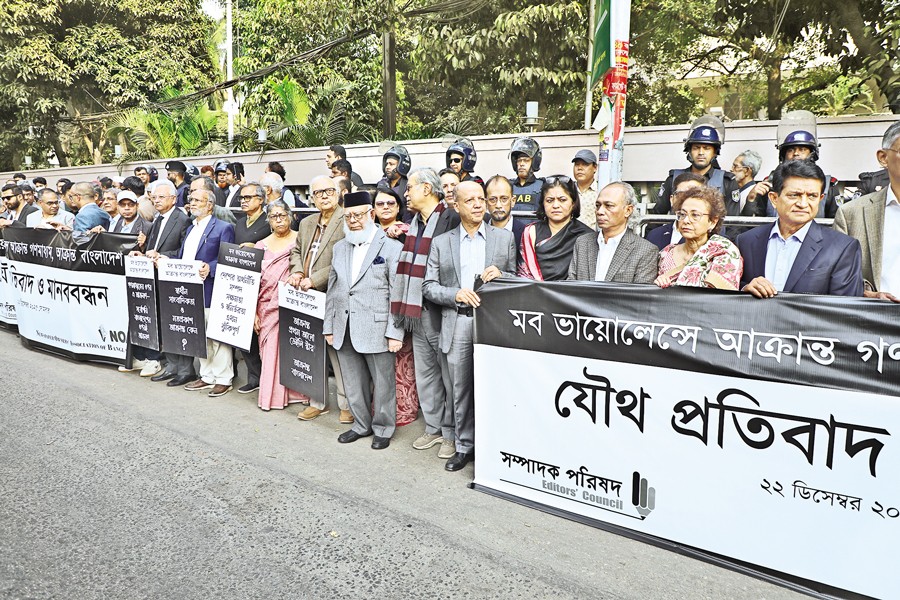
 A partial view of a human chain formed by a cross-section of people, including journalists and businessmen, in front of the Pan Pacific Sonargaon, Dhaka, to protest recent mob attacks on media houses, organised jointly by NOAB and Editors’ Council on Monday. — FE Photo by Shafiqul Alam
 A joint call comes for a united resistance against mob violence like arson attacks and threats targeting media houses which are termed "deliberate attempts to silence critical voices through fear and intimidation".
Journalists, politicians, writers, business leaders and civil-society representatives at a joint protest organised by the Editors' Council and the Newspaper Owners' Association of Bangladesh (NOAB) Monday made the call and warned that the recent mob attacks on Prothom Alo and The Daily Star constituted a "direct assault on press freedom, democratic values and the right to dissent".
Stressing that safeguarding freedom of expression is a collective responsibility, the speakers urged an impartial investigation, accountability for the perpetrators and sustained action to protect democracy and the safety of journalists.
Speaking at the protest at the Pan Pacific Sonargaon Dhaka, BNP Secretary-General Mirza Fakhrul Islam Alamgir said democracy in Bangladesh was under serious threat and called on all democratic forces to unite for a reversal of the trend.
Reflecting on his lifelong political struggle, he said the Bangladesh of today did not resemble his dream of an independent, sovereign and democratic nation.
"Today, democracy itself has been attacked," he said, adding that his right to think freely and to speak freely once again came under threat.
Referring to past movements, Fakhrul said the July movement had aimed to establish the rights of the people, but those ideals were now under attack.
Urging citizens to rise above political divisions, he said the issue transcended party lines and required collective resistance across all sectors. "Now is the time to resist."
Nahid Islam, convener of the National Citizen Party (NCP), alleged that the attacks on The Daily Star and Prothom Alo involved "a section of the government and had political backing".
Addressing the protest meet, he said the incidents were planned, adding that while the death of Sharif Osman Hadi had been anticipated, a conspiracy to exploit the situation following his killing appeared to have been prepared in advance.
Expressing deep regret, the uprising protagonist said it was particularly unfortunate that slogans of the July uprising and Hadi's name were dragged in to justify attacks on media houses and cultural institutions.
Calling for a proper investigation, Nahid said it was clear who had carried out the attacks and insisted that the government must ensure a fair probe and exemplary punishment. "Those responsible for shooting Hadi in broad daylight," he adds, "must also be brought to justice."
International Chamber of Commerce (ICC) Bangladesh President Mahbubur Rahman said democracy could not flourish in a hostile environment where dissent was stifled.
"Freedom of expression in the media," he told the gathering, "must be practised in reality rather than remaining a mere slogan."
Emphasising that freedom of dissent must be ensured regardless of which government is in power, he warns that suppressing differing opinions weakens democratic practice and fuels intolerance.
Ensuring freedom of expression and fostering a culture of tolerance, he said, are essential for building a strong and sustainable democratic system.
Criticising the interim government's response, Dr Debapriya Bhattacharya, a distinguished fellow of the Centre for Policy Dialogue (CPD), said there had been repeated public warnings that such violence could occur.
"They should remember that they are not an elected government. They may be a legitimate government, but they are not an elected one," he said.
An unelected government's ability to govern, he reminds, lasts only as long as it retains moral legitimacy, which, he argues, has been seriously eroded by the incident.
Delivering the welcome address, New Age Editor and Editors' Council President Nurul Kabir said the arson attacks on newspaper offices reflected a "medieval mindset" and a calculated effort to suppress dissent through fear.
He said generations of people in Bangladesh had struggled and made sacrifices to build a democratic society where citizens could freely express their views for democratic development. Protecting media freedom, he stresses, is not the responsibility of journalists alone.
"Safeguarding the independence of the media in greater social interest is the responsibility of entire society," he said, adding that attacks on media offices while journalists were working inside left no ambiguity about the attackers' intentions.
The NOAB President, AK Azad, noted that all speakers at the meeting, titled 'Bangladesh Under the Attack of Mob Violence', underscored the need for united resistance.
Referring to efforts to protect The Daily Star after the attack on Prothom Alo, he said editor Mahfuz Anam appealed to all relevant authorities for protection but received no assistance.
"Protection," he alleged, "arrived only after the damage had been done." Quoting journalists who witnessed the incident, Azad said although security forces were present, none intervened to stop the violence.
The Daily Star Editor, Mahfuz Anam, said the recent mob attacks were intended to "kill journalists", not merely to vandalise buildings.
He mentioned that videos circulating on social media showed attackers openly declaring their intention to kill journalists of The Daily Star and Prothom Alo by targeting them at their homes.
Describing the attack as "organised and murderous" rather than spontaneous, he said the issue went beyond freedom of expression and concerned the "fundamental right to survive".
"We are with you, and you will be with us," he told the gathering.
Chairman of the Association of Bankers Bangladesh (ABB) Mashrur Arefin said no institution was beyond criticism, including The Daily Star and Prothom Alo, but arson, vandalism and attacks on the media could never be a response to dissenting opinions.
Bangladesh Jamaat-e-Islami Assistant Secretary-General and Chief of its Central Publicity and Media Department Ahsanul Mahboob Zubair alleged that a deep conspiracy lay behind the attacks and urged everyone to unite against "vandalism and anarchism".
UN Special Rapporteur on freedom of opinion and expression Irene Khan condemned the attacks on the offices of Prothom Alo and The Daily Star, saying they were intended to intimidate the media.
Referring to the killing of Inqilab Mancha spokesperson Sharif Osman Hadi, she said he was killed in broad daylight to create a climate of fear.
She calls on the government to investigate both the killing and the attacks on media outlets "promptly, impartially and transparently, and to hold those responsible to account through due process".
Transparency International Bangladesh Executive Director Iftekharuzzaman said "mob rule" had taken root within state structures.
"Mobocracy has begun inside the state structure," he said, alleging that those in power viewed the forces behind mob violence as one of the pillars of their authority. While stressing that resisting the situation is the responsibility of all citizens, he said the primary responsibility lay with the government.
Among others who spoke are rights-activist Sheerin Huq, former caretaker government adviser Rasheda K Chowdhury, architect Shamsul Wares, National Press Club General Secretary Ayub Bhuiyan, Barrister Sara Hossain, Bangladesh Federal Union of Journalists Secretary-General Kader Gani Chowdhury, Dhaka Union of Journalists President Md Shahidul Islam, Ganasanghati Andolon Chief Coordinator Zonayed Saki, Economic Reporters' Forum President Doulot Akter Mala, Metropolitan Chamber of Commerce and Industry, Dhaka, President Kamran T Rahman, BRAC Bangladesh Executive Director Asif Saleh, and Bangladesh Chamber of Industries President Anwar-ul Alam Chowdhury (Parvez). The discussion was moderated by Bonik Barta Editor and Editors' Council General Secretary Dewan Hanif Mahmud.
Following the protest meeting, participants formed a human chain on Kazi Nazrul Islam Avenue in front of the Pan Pacific Sonargaon hotel, with representatives from business, social, political and cultural organisations joining forces in solidarity with journalists.
bdsmile@gmail.com
© 2026 - All Rights with The Financial Express

