Distressed loans across all scheduled banks in Bangladesh surged by over 47 per cent to Tk 10.08 trillion, as of end-2025 account, far outstripping overshooting the country's proposed new budget.
Economists and bankers say the lending miasma reflects the fragile condition of the country's financial sector as well as mounting risks to banking stability.
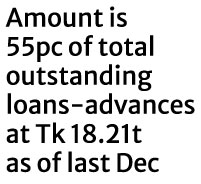 The distressed loans accounted for more than 55 per cent of the total outstanding loans and advances of Tk 18.21 trillion as of December 31, 2025, according to the central bank's latest Financial Stability Report (FSR) 2025.
If the written-off asset, which is off-balance-sheet item, is considered as distressed loans, the total figure will come to Tk 10.87 trillion and its percentage against the total outstanding loans will go up to almost 60 per cent.
Distressed loans are generally high-risk assets in which borrowers are unable to meet scheduled interest or principal repayments, making them a significant burden on banks and a source of financial vulnerability.
The volume of distressed loans is determined by combining non-performing loans (NPLs) with rescheduled and written-off loans, reflecting the overall level of asset-quality deterioration in the banking sector.
The distressed-asset portfolio comprised Tk 5.57 trillion in defaulted loans, Tk 2.69 trillion in unclassified rescheduled loans, Tk 1.82 trillion in total outstanding loans under courts' stay orders and Tk 834.79 billion in written-off loans, according to the FSR, released Tuesday.
"The sharp rise in the volume of non-performing loans (NPLs) signals a deterioration in asset quality, likely driven by imprudent lending and weak oversight of loans and advances," the Bangladesh Bank (BB) has said in the FSR.
A sluggish pace of NPL recovery has also contributed to this deterioration, the central bank explains in its report.
"Additionally, external factors such as the Russia-Ukraine war, global tensions, and domestic economic challenges are straining business operations and reducing borrowers' repayment capacity, further eroding the banking sector's asset quality," the FSR notes.
Talking to the FE, a BB official said the volume of distressed assets will remain almost same by the end of this calendar year but the amount of rescheduled loans may rise while NPLs may fall.
Regarding capital base of banks, the FSR says the capital-to-risk-weighted assets ratio (CRAR) deteriorated sharply from 3.08 per cent in 2024 to negative 2.64 per cent in 2025, signaling severe capital- adequacy weaknesses.
The CRAR is significantly below the minimum regulatory requirement of 10.00 per cent of Risk-Weighted Assets under the Basel III capital framework issued by the central bank.
The CRAR remains significantly below the minimum regulatory requirement of 10.00 per cent of risk-weighted assets under the Basel III capital framework issued by the central bank earlier.
"The capital-conservation buffer also fell to zero by year-end, reflecting heightened sectoral vulnerabilities," the central bank says in the FSR.
The deterioration was driven primarily by weakened capital positions at state-owned commercial banks (SoCBs), specialized development banks (SBs), and both conventional and Islamic private commercial banks (PCBs).
Besides, profitability indicators declined significantly, as both returns on assets (ROA) and returns on equity (ROE) fell sharply from the previous year.
Managing Director of Shahjalal Islami Bank Mosleh Uddin Ahmed says it should not be a right approach to judge the entire banking industry based on average percentage of distressed assets because there are banks experiencing extremely high volume and percentage of distressed assets.
"But there are a good number of commercial banks like ours maintaining very low level of distressed asset ratio of bellow 5.0 per cent. So, it should not be a wise approach to judge the whole industry because of underperforming banks," he adds.
siddique.islam@gmail.com, jubairfe1980@gmail.com
© 2026 - All Rights with The Financial Express

