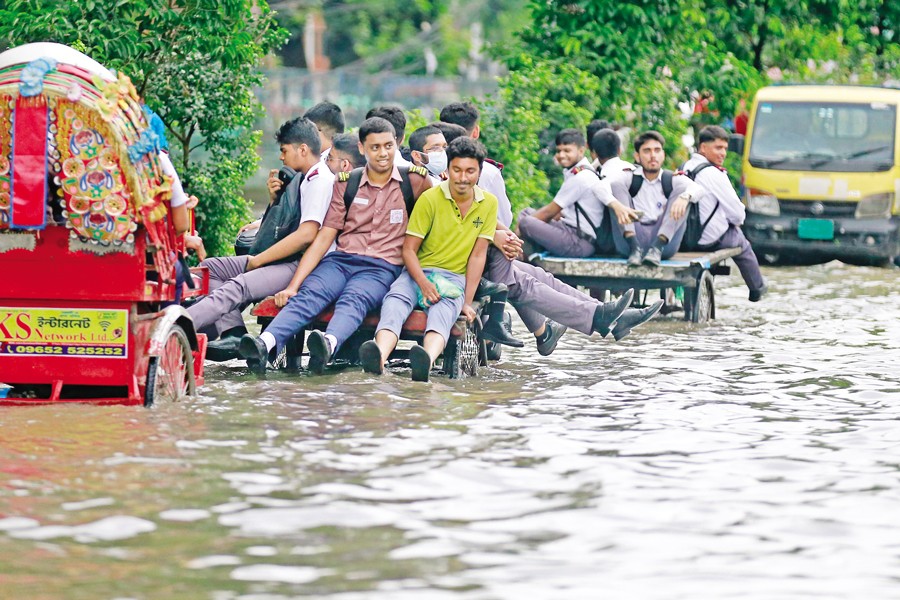
 Torrential rain submerges a large number of neighbourhoods in Dhaka city on Monday morning, causing hardship for city-dwellers. In the photo taken in the New Market area, rickshaw vans are seen ferrying students through a submerged road. — FE Photo
 A heavy spell of rain early Monday once again flooded Dhaka's streets, paralysing the mega-city for hours and exposing its long-standing waterlogging problems and inadequate drainage system.
The accumulation of water on roads led to severe traffic congestion, inconveniencing office-goers and daily commuters, sources say.
Md Amin, 30, a shop employee, collapsed near Najira Bazar intersection in Bangshal around 9:30am while wading through waterlogged streets.
"He was rushed to Dhaka Medical College Hospital (DMCH) unconscious at about 9:45am, where doctors declared him dead," said Inspector Md Faruk, in charge of the DMCH police camp.
Across the city, commuters were seen trudging through ankle- to knee-deep water, struggling to reach offices, schools, and other destinations.
Many areas, including Mirpur, Dhanmondi, Mohammadpur, Kalabagan, Karwan Bazar, Green Road, Manipuripara, New Market, Asad Gate, and Jigatola, were inundated.
In some places, water reached knee level, while in others it rose to the waist. Even around 10:30am, water remained stagnant on roads in the New Market area.
"I had to wade through waist-deep water in Fakirapool, Rajarbagh, and Kakrail on my way to my workplace at Malibagh," said Arif, an employee at a private organisation.
Knee-deep water was also reported on the roads of Rampura, Badda, Mirpur, Dhanmondi, and Mohammadpur. Many people had to walk to their offices as vehicles were scarce amid the heavy rain.
Meanwhile, rainfall was recorded across different regions of the country. A depression has formed over the Bay of Bengal, with another likely to develop by Wednesday.
Meteorologist Md Hafizur Rahman of the Bangladesh Meteorological Department (BMD) said the rainfall was caused by monsoon winds. Dhaka recorded 71mm of rainfall from 6:00am to 9:00am on Monday, and 105mm over nine hours from midnight to 9:00am.
Feni recorded the highest rainfall in the last 24 hours at 116mm. According to meteorological standards, 44 to 88mm of rain is considered heavy, while anything above that qualifies as very heavy rainfall.
Mr Rahman added that more heavy rainfall is unlikely in Dhaka later today [Monday]. However, the depression over the northern Bay is expected to bring heavy showers, particularly in the Khulna region. Another depression may form from Wednesday, though it is unlikely to have a major impact on the country's coast.
Longstanding negligence in maintaining Dhaka's drainage network has left the capital vulnerable to severe waterlogging, says DNCC Administrator Mohammad Azaz on Monday, reports UNB.
Addressing a seminar hosted by the South Asian Institute of Policy and Governance, Mr Azaz blamed decades of indifference toward the city's drainage and natural canals for the flooding.
"Industries have been prioritised while the environment was neglected. Even a little rainfall creates waterlogging," he said.
He highlighted DNCC's recent achievements, including the reclamation of 112 kilometres of canals within three months, without any extra budget allocation. Canals in Abdullahpur and Sonati areas have already been recovered, he noted.
Focusing on his six-and-a-half months in office, Azaz said, "I've learned every inch of Dhaka's rivers. With political goodwill, resolving the city's waterlogging and reclaiming rivers is very much possible."
He, however, did not mention what happens to areas such as Kalshi Road, Sewrapara. Kazipara and Section 10 of Mirpur in the event of a moderate rain. How a project to free the Kalshi- Bawania canal from unauthorised occupation failed to pick up even six years after its NEC approval also escaped his notice.
The seminar also addressed alarming river pollution. Delivering the keynote, North South University Associate Professor Abdus Samad revealed the presence of harmful heavy metals, including arsenic and cadmium, in the Buriganga, Dhaleshwari, Shitalakhya, Turag, and Balu rivers. The Buriganga and Shitalakhya are particularly afflicted, posing serious risks to public health and the livability of Dhaka.
talhabinhabib@yahoo.com
© 2026 - All Rights with The Financial Express

