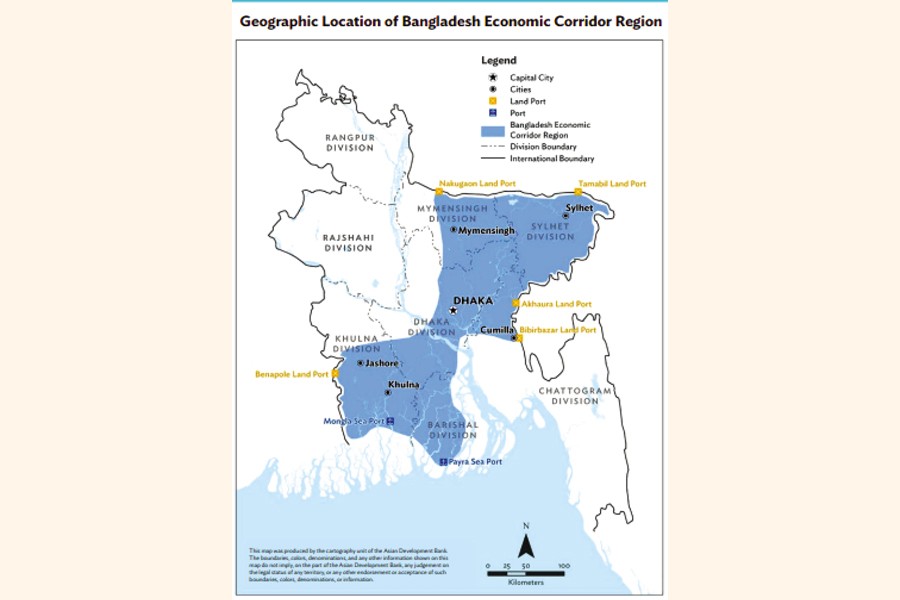
Bangladesh's southwest and northeast economic corridors, with special interventions, are estimated to increase economic output to $286 billion in 2050 from $32 billion in 2020, according to an Asian Development Bank (ADB) report.
With specific interventions, it could also create an additional 71.8 million jobs in both the southwest and northeast regions of the country, said the Manila-based lender in the report titled "Bangladesh Economic Corridor Development Highlights".
The ADB report was launched during a function in the city on Wednesday, with Planning Minister MA Mannan present as the chief guest.
Sheikh Yusuf Harun, executive chairman of the Bangladesh Economic Zones Authority (BEZA), Economic Relations Division (ERD) Additional Secretary Mostafizur Rahman, ADB Country Director Edimon Ginting, Policy Exchange Bangladesh Chairman Dr Masrur Reaz, ADB Director Sabyasachi Mitra, PRAN-RFL Group's Director Uzma Chowdhury and Bangladesh Investment Development Authority (BIDA) Executive Member Avijit Chowdhury also spoke on the occasion.
In his presentation, ADB Senior Country Specialist Soon Chan Hong said the combined output in Bangladesh's two economic corridors is expected to increase from $32 billion in 2020 to $286 billion by 2050 in the business-induced scenario (BIS) due to these interventions.
Under the BIS, Bangladesh's exports are predicted to become more diversified by 2050. The share of ready-made garments (RMG) in the export basket is anticipated to decline from the current 84 per cent to 45 per cent.
Meanwhile, the share of exports in the total basket for leather and footwear is projected to increase to 14 per cent, the automotive industry to 14 per cent, non-metallic minerals to 11 per cent and furniture to 11 per cent.
The entire economic corridor encompasses 14 districts, covering 34 per cent of the total population in the Khulna, Sylhet and Mymensingh divisions.
In the meantime, Planning Minister MA Mannan said borders among countries should not exist when it comes to trade development if this Asian region aims to progress.
"Some strong corridors have already been constructed across Bangladesh. Now, there is a need to create adequate bypasses in Dhaka to achieve maximum outputs and economic benefits in developing the economic corridors," he added.
He mentioned that in the haor region, which covers Sunamganj and Netrakona districts, the government has initiated the construction of a flyover to enhance connectivity.
To ensure optimal development, the planning minister said that there is a requirement for social, economic and political stability in the country. This stability will enable various segments of the population, including workers, farmers, day labourers and businessmen, to carry out their tasks more effectively.
BEZA Executive Chairman Sheikh Yusuf Harun said that the economic corridor will unquestionably stimulate economic enhancement and regional integration, while also generating additional employment opportunities.
In his address, ADB Country Director Edimon Ginting highlighted that the northeast and southwest regions of Bangladesh are lagging behind in terms of development. This corridor will transform them into new growth centres.
He mentioned that the economic corridor will bolster regional cooperation. Noting that India is a highly dynamic neighbour of Bangladesh, Ginting said the regional trade between India and Bangladesh remains relatively small compared to trade with ASEAN countries.
However, the development of this corridor could enhance trade potential, he added.
The ADB country director noted that the lending agency has already offered support to several development projects along the Bangladesh Economic Corridor. These include the South Asia Sub-regional Economic Cooperation Dhaka-Sylhet Corridor Road Investment Project and urban development projects in the Khulna district.
Policy Exchange Bangladesh Chairman Dr Masrur Reaz said that integrated economic planning and infrastructure development beyond the Padma Bridge are crucial to ensure that the southwest region experiences the desired developmental impact.
He said regional development requires upgrading trade gateways and improving facilities at borders, land ports and seaports.
Based on the analysis outcome of the ADB report, 12 manufacturing industries were shortlisted for the entire Bangladesh Economic Region.
These industries encompass food processing, leather and footwear, textiles and ready-made garments (RMGs), jute, nonmetallic mineral manufacturing, shipbuilding, furniture, transport equipment, pharmaceuticals, plastic products, rubber and rubber products, electrical and electronics machinery and heavy machinery.
kabirhumayan10@gmail.com
© 2026 - All Rights with The Financial Express

