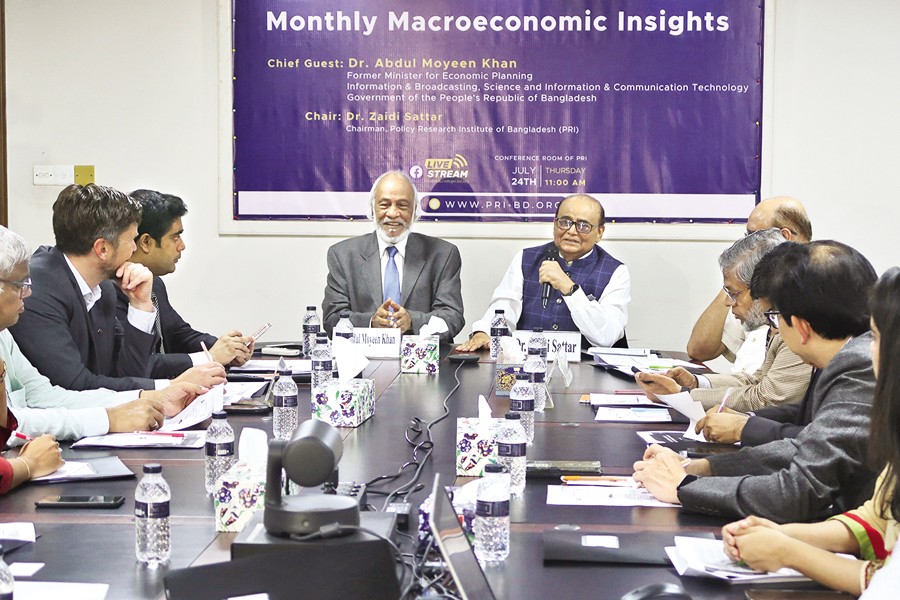
 PRI Chairman Dr Zaidi Sattar speaks at a programme marking the release of Monthly Macroeconomic Insights (MMI) at the PRI office in Dhaka on Thursday. Dr. Moyeen Khan, former minister and standing committee member of BNP, attended the event as the chief guest. — FE photo
 Despite recent signs of macroeconomic stabilisation, economy faces deep-rooted fiscal-and financial-sector challenges, economists warned on Thursday.
Speaking at an event in the capital, they listed challenges like subdued growth, persistent high rate of inflation, elevated fiscal risks, and a vulnerable banking sector and called for urgent reforms to stabilise the economy.
They recommended expanding the direct tax base, improving implementation of Annual Development Programme (ADP), phasing out export subsidies, reducing non-performing loans, and restoring the autonomy of Bangladesh Bank.
Policy Research Institute of Bangladesh (PRI) organised the event at its office to release the Monthly Macroeconomic Insights (MMI), developed by Centre for Macroeconomic Analysis (CMEA).
Dr. Moyeen Khan, former minister and standing committee member of the BNP, attended the event as chief guest. PRI Chairman Dr Zaidi Sattar presided over the meeting and delivered the keynote address jointly with Dr Ashikur Rahman, Principal Economist of the PRI.
Dr. Ashikur Rahman said that the measures and policies taken to restore good governance in the financial sector will require continuity over the next one to three years.
This makes it imperative for the next elected government to demonstrate unwavering commitment to the broader vision of restoring discipline and governance in the banking sector, he added.
Dr. Zaidi Sattar pointed out a persistent slowdown in private credit growth, reduced imports of capital machinery, and a decline in investment-which now accounts for about 29% of GDP-as key factors behind slower economic growth, despite overall macroeconomic stability.
He also stressed Bangladesh's reliance on exporting labour-intensive products like ready-made garments (RMG) and footwear to the US, leveraging comparative advantage.
"Given that the US is a large and growing market, securing a favourable trade agreement is essential," he said.
He warned that relying solely on labour-intensive competitiveness is no longer enough. "If our competitors secure better trade terms, our global competitiveness will be at risk. This emerging challenge demands urgent attention.
Dr. Khan emphasized that, "Bangladesh's export trade heavily depends on effective tariff policies with the United States; the country lags behind its competitors in securing favourable agreements."
He also highlighted that building trust within the government is crucial for achieving long-term stability.
The BNP leader warned that running a country like an NGO or corporate organization could lead to disaster. "Managing an NGO is completely different from running a nation. Governments cannot operate based on NGO or corporate policies," he said.
He also criticized the National Board of Revenue (NBR), alleging that officials accept bribes to waive taxes, resulting in significantly lower revenue collection. "This malpractice must be stopped," he said.
He further questioned Bangladesh Bank's intervention in controlling the dollar rate despite market-based announcements.
Australian Deputy Head of Mission to Bangladesh, Clinton Pobke, attended the event as a special guest. He remarked, 'The MMI event serves as a bridge to understanding complex economic issues and engaging with them effectively."
Dr. Muhammad Abdul Mazid, former Chairman of the NBR, was present as a panellist. Expressing concern, he stated, 'Our fiscal space is limited. Reforms, particularly in tax policy, debt management, and GDP calculation, are essential, even if they are painful. Without a clear separation between policymaking and implementation within the NBR, meaningful progress will remain out of reach.
Dr. Khurshid Alam, Executive Director of PRI, opened the session, noting that revenue remains a key challenge and those reforms, such as separating policymaking from implementation in the NBR, are still a work in progress.
An open floor discussion followed, offering space for vibrant audience engagement on monetary policy, inflation management, and the digitalization of revenue administration.
The keynote presented at the event anticipated a 22.9 per cent poverty rate in the current year significantly higher than the rate estimated at 18.7 per cent in 2022.
"While Bangladesh has made notable progress in reducing poverty, a significant portion of the population remains just above the poverty line and is vulnerable to economic shocks. A 10% drop in income could push an additional 10% into poverty," the report added.
jahid.rn@gmail.com
© 2026 - All Rights with The Financial Express

