Bangladesh's economy is showing signs of stabilisation, driven by steady remittance inflows, prudent fiscal management, and a gradual improvement in foreign-exchange reserves, according to the Policy Research Institute of Bangladesh (PRI).
However, the think tank cautioned that the stabilisation is fragile and still remains at a lower level, characterised by persistent inflation, declining real wages, weak consumption, and sluggish investment, particularly amid high interest rates.
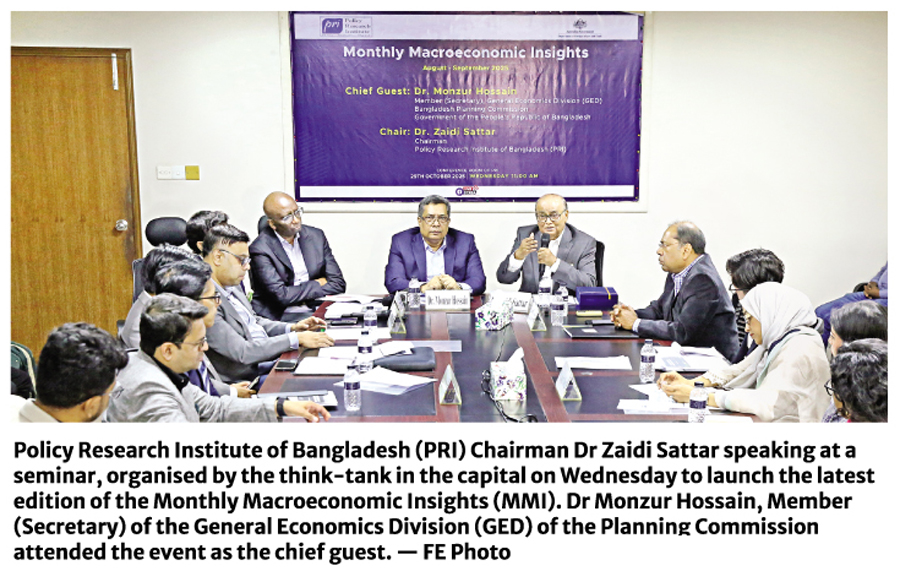
These observations were shared during a seminar hosted by PRI to launch the latest edition of the Monthly Macroeconomic Insights (MMI), developed under the institute's Centre for Macroeconomic Analysis (CMEA).
The event was held at the PRI auditorium in Dhaka on Wednesday, with Dr. Monzur Hossain, Member (Secretary) of the General Economics Division (GED) of the Planning Commission, as the chief guest. Dr. Zaidi Sattar, Chairman of PRI, presided over the seminar.
 Delivering the keynote address, Dr. Ashikur Rahman, Principal Economist at PRI, urged both the interim government and the incoming elected government to demonstrate strong political commitment to major reforms in the monetary and fiscal sectors.
He also emphasised the need to safeguard the Bangladesh Bank's independence.
While central bank independence has strengthened across 155 countries over the last 50 years, it has eroded in Bangladesh, contributing to a fragile banking system, rising non-performing loans (NPLs), and deepening capital shortfalls, Dr. Rahman said.
Dr. Zaidi Sattar said that the country's current investment-to-GDP ratio of around 29 per cent still holds potential for growth of over 5 per cent. However, global multilateral institutions have revised down Bangladesh's growth projection to below 5 per cent.
He noted that while macroeconomic stability has largely been restored, it remains at a lower level.
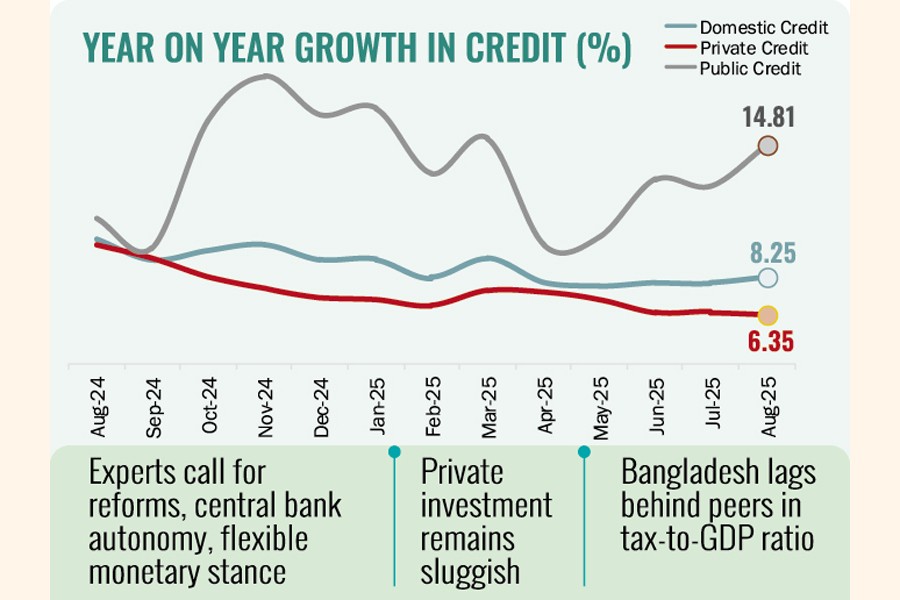
As the central bank continues to maintain a tight monetary policy, the private sector remains concerned about the high interest rate, which is discouraging new investment plan, he said.
Referring to the sources of inflation, Dr Sattar pointed to several factors: the war in Ukraine, which disrupted global supply chains, the depreciation of the taka by nearly 40 per cent, and tariff hikes that further pushed up prices.
Planning Commission Member Dr. Monzur Hossain highlighted signs of recovery under the interim government, such as moderating inflation, a stabilising exchange rate, improved foreign reserves and a positive balance of payments.
"However, private investment remains sluggish, weighed down by persistently high interest rates and public sector borrowing, which may be crowding out private credit," he said.
He also noted that while the current tight monetary stance has helped curb inflation, it raises questions about its sustainability and impact on long-term investment.
He called for a careful assessment to determine whether falling inflation rates reflect monetary policy, lower food prices, or supply-side improvement.
"Without such analysis, prolonged high interest rates could stifle investment, leaving the economy vulnerable despite signs of stabilisation."
He emphasised the need for a flexible monetary stance to reduce interest rates and encourage investment.
Dr. M. Masrur Reaz, Chairman and CEO of Policy Exchange Bangladesh, said that the Purchasing Managers' Index (PMI) for September edged up slightly, but remained at a very weak expansion level, reflecting seasonal variations.
The survey showed a slump in services, indication declining consumption, while sustained inflation at around 9 per cent continues to erode purchasing power and increase business cost, he said.
Dr. Reaz warned that without fresh greenfield investments, job creation will remain limited.
Dr. Bazlul Haque Khondker, Research Director at PRI, stressed that economic growth alone is insufficient to reduce poverty and inequality. With a tax-to-GDP ratio of only 6.6 per cent, Bangladesh lags far behind its regional peers, limiting fiscal capacity for social protection programmes.
Tanjima Mostafa highlighted challenges in international trade transactions, particularly the rejection of Letters of Credit (LCs) from local banks abroad, which is driving up import costs. "These costs are ultimately passed on to consumers, and policy certainty is urgently needed," she said. PARK Young Sik, Ambassador of the Republic of Korea to Bangladesh, stressed the importance of central bank's independence and tax reform to ensure macroeconomic stability under the next government.
Dr. Ashikur Rahman also cautioned that Bangladesh's economic growth has slowed due to contractionary monetary policy, delays in public investment, political uncertainty, and stagnation in private investment.
He warned that these factors could push both poverty and inequality higher.
"The extent to which poverty can be mitigated will depend on how effectively the next elected government expands and implements social protection programmes," Dr. Rahman added.
He emphasized that the ongoing stabilisation process is particularly costly for the poor, while wealthier segments of society are better able to absorb the impact.
On the issue of central bank's independence, he noted that weak governance in the banking sector over the past decade enabled the rise of powerful oligarchs, pushing the financial system to the brink. Politically driven measures, including interest rate caps of 6-9 per cent, reflected elite influence over monetary and credit policies, undermining the central bank's autonomy and effectiveness, he added.
Dr Rahman also flagged Bangladesh's low revenue base, with the tax-to-GDP ratio falling to 6.6 per cent in FY25 -- the lowest among regional peers-making it harder to achieve ambitious development goals.
Urging the next government to act decisively, he called for strong political commitment to central bank independence and improved governance in the financial sector.
jahid.rn@gmail.com
© 2026 - All Rights with The Financial Express

