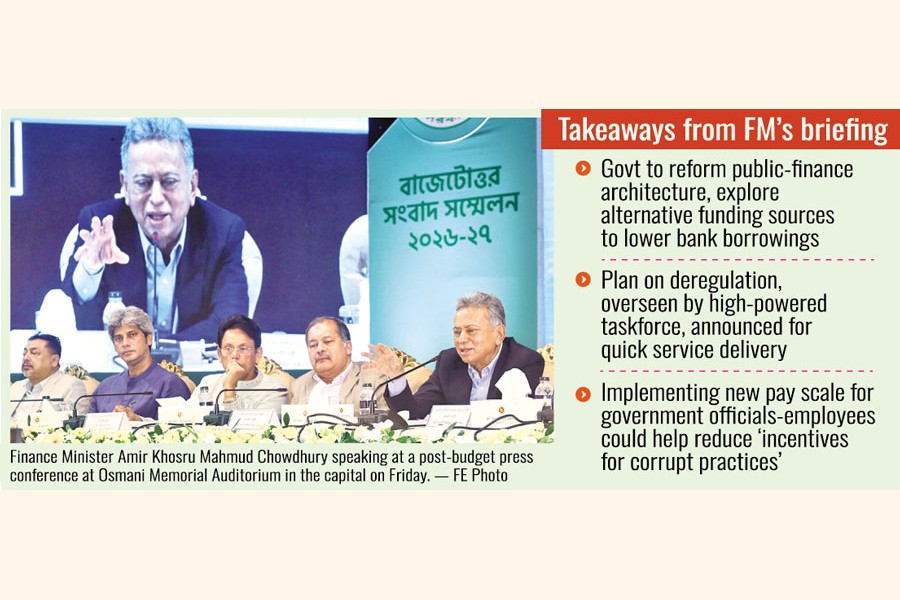
Bangladesh may need two years to take off from the present miasma and make the economy get full stability and prosperity, says Finance Minister Amir Khosru Mahmud Chowdhury.
"The country's economy will need two years from where it stands now. After that, the economy will stabilise and fully turn around in the fourth and fifth years."
He came up with the optimism a day after presenting in parliament an upscale Tk 9.38-trillion national budget replete in projected upgraded macroeconomic parameters and a wide recipe of reforms to get to the goal.
At a post-budget press conference held Friday in Dhaka, the finance and planning minister highlighted government intent to reform the country's public-finance architecture and explore alternative sources of funding to lower borrowing from banking sector.
"This year we have reduced bank borrowing by Tk 60 billion, and once the new public finance is fully designed, alterative sources will have significant contributions to the funding," he told journalists.
The minister in his budget speech Thursday said that Tk 1.12 trillion (net) will be borrowed from the banking system, down by Tk 60 billion from the revised budget of the current year (2025-26)
He notes that the proposed budget for fiscal year 2026-27 has been designed as an inclusive one aimed at bringing all sections of society into the economic mainstream.
"No class, profession, religion or caste is outside the scope of the budget this time," he told the press about the maiden budget of the Tarique Rahman-headed government that assumed office amid uprising-spurred popular aspirations for sociopolitical and economic recast.
Mr. Khosru says preparing the budget has been particularly challenging because of severe time constraints and resource constrains.
"Normally, the budget-preparation process takes at least six months. We had only one and a half to two months. Despite that, we completed the task with the cooperation of all concerned, including the journalists."
He notes that this budget has been prepared in a fundamentally different political and economic environment. "By budget, we basically mean a reflection of the will of the people."
The minister says the new government's objective is to build a more people-oriented economy rather than one benefiting only a limited group of individuals or businesses.
He claims the budget includes targeted allocations, programmes and implementation plans for different social and professional groups despite resource constraints.
Mr Khosru also highlights shifts in the global economic landscape, saying that the world is gradually moving away from a rules-based system towards greater protectionism. "This year's budget has been formulated keeping those global changes in mind."
Responding to questions on inflation, the finance minister said effective policies, improved management and lower business costs would be more effective than administrative crackdowns in controlling prices.
"There is no alternative to strengthening the supply system, reducing inefficiencies and implementing reforms."
He links the recent inflationary pressures to a combination of international and domestic factors, including global conflicts, higher import prices, shortages of capital in the banking sector and money laundering which have increased the cost of funds.
"High borrowing costs, port inefficiencies and logistical expenses continue to raise the cost of doing business," he told the journalists
"It can take six months to a year to establish a company or obtain the necessary approvals. Businesses ultimately pass those costs on to consumers," he further explains the price hikers.
The government has already initiated regulatory reforms aimed at lowering business costs and improving efficiency.
Mr Khosru stresses the importance of maintaining an efficient supply chain and building strategic reserves of key commodities.
Long-term planning and stronger buffer stocks for fuel, food and fertiliser are underscored and that Bangladesh should maintain at least three months' energy reserves to strengthen energy security.
In the past, he says, excessive reliance on spot purchases often left the country exposed to volatile prices.
"With long-term planning, adequate storage facilities and strategic stocks, costs can be reduced substantially."
The minister announces plans for deregulation, overseen by a high-powered taskforce.
"A dedicated online platform will allow businesses and citizens to report licensing and regulatory obstacles, enabling authorities to respond quickly."
The custodian of exchequer had a word on corruption, an incendiary issue in all quarters. He thinks implementing new pay scale for the government officials and employees could help reduce incentives for corrupt practices.
"When people face shortages, there is naturally a tendency to resort to corruption. There is no point in denying this reality."
The finance minister says pressure on living standards, particularly among low-income households, has prompted the government to allocate the largest-ever amount for social protection and welfare programmes.
Significant resources have been earmarked for family-support schemes, agriculture, universal healthcare and primary healthcare services.
He mentions that employment generation and skills development remain central priorities of the budget.
Major investments are being planned in education, technical training and vocational programmes to help workers secure higher-paying jobs both at home and abroad.
To support the rural economy, the government plans to provide financing, training, design support, and market access to traditional occupations under a new "Creative Economy" initiative.
This administration places greater emphasis on employment creation and quality-of-life improvements rather than pursuing large-scale megaprojects.
"Value for money and employment generation are being considered in every project," he says.
A major component of the government's strategy involves developing Bangladesh's creative economy as a new growth driver.
Mr. Khosru mentions plans for an integrated creative centre on 160 acres in Purbachal, bringing together theatre, arts, design, entertainment and cultural activities.
The project aims to create jobs, attract visitors and transform culture into an economically productive sector.
"We have to monetise creativity."
The government is launching an investment programme worth around Tk 8.0 billion to support the initiative.
The minister argues that Bangladesh possesses significant cultural assets, including music, folk traditions and performing arts, but has yet to commercialise them effectively.
He points to the global success of Korean music and drama industries as examples of how cultural products can generate export earnings and international influence.
Thousands of artists, musicians, actors and other creative professionals currently lack sufficient income opportunities, he says, adding that the new programme would help create sustainable livelihoods.
Responding to questions about tourism, Mr. Khosru said domestic tourism offers substantial untapped potential.
While foreign tourist arrivals remain limited, he argues that stronger entertainment and tourism infrastructure could stimulate economic activity and improve quality of life.
"Bangladesh is also lagging behind in soft power," he says. "Our goal is to create opportunities through culture and entertainment that generate employment, support growth and strengthen the country's global presence."
Present at the news conference were Power, Energy and Mineral Resources Minister Iqbal Hassan Mahmud Tuku, Information and Broadcasting Minister Zahir Uddin Swapan, Education Minister Dr. ANM Ehsanul Haque Milon, Agriculture, Fisheries and Water Resources Minister Mohammad Amin Ur Rashid, Health Minister Sardar Mohammad Sakhawat Hossain and State Minister for Finance and Planning Jonayed Saki.
Also present were Prime Minister's Adviser Mahdi Amin, Posts, Telecommunications and Information Technology Adviser Rehan Asif Asad, Cabinet Secretary Dr. Nasimul Ghani, Bangladesh Bank Governor Md. Mostaqur Rahman, National Board of Revenue (NBR) Chairman Md. Abdur Rahman Khan and Prime Minister's Special Assistant on Investment and Capital Market Tanvir Ghani.
jasimharoon@yahoo.com
© 2026 - All Rights with The Financial Express

