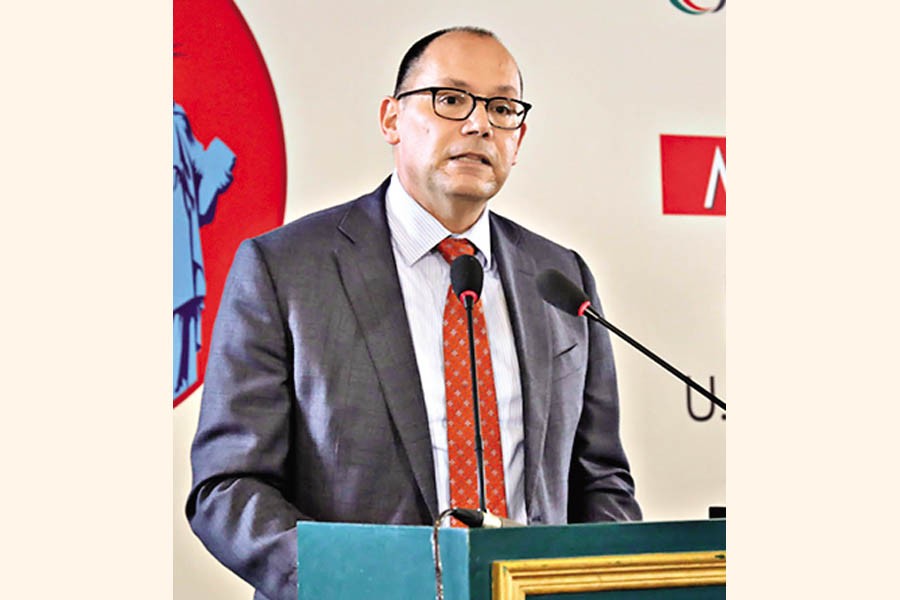
 Peter Haas
 US Ambassador in Dhaka Peter Haas on Thursday said that importing oil from Russia is not under sanctions.
Addressing the "Meet the Press" programme organised by a local think tank in the city the US ambassador also noted that sanctions on the Rapid Action Battalion (RAB) officials imposed by the US administration will continue until accountability is ensured and reform is carried out in the organisation.
During the two-hour-long interaction, the envoy dwelt upon issues related to the next general election, trade and investment, Rohingya crisis, and impact of Ukraine war on global supply chain.
Responding to a question on India and its purchase of energy from Russia, he said, "One of the things I think was a common misperception that the sanctions that have been imposed include oil and gas, include fertilizer, include agricultural products. They don't. That's not part of the sanctions that were imposed by the United States and others in the international community. So it is not a sanctionable activity".
"We're also cognizant of the fact that because of the supply-chain issues that Russia's invasion of Ukraine has caused, there are shortages in energy and that the prices have gone up."
"And so we understand that countries need to make this transition. What we do hope is that that is transition and that they move to other sources of energy and other products from countries that don't invade their neighbours," the envoy explained.
Speaking on the BRI, the US ambassador said it is entirely Bangladesh's decision whether it wants to be a part of BRI or any other organization. And so it's, it's not really for us to say whether Bangladesh be part of it or not.
On the issue of resumption of GSP facility for Bangladesh he said the US continues to have conversations with the Government of Bangladesh.
Tagging fair elections with investment he said there's no place in the world where political violence actually helps create a better environment for elections.
Stressing the need for monitoring the preparations in the run-up to general election he said, "I think the entire world will be watching these elections. The entire world will be looking to see if they are free and fair and held at an international standard. So I think that's critical for the day of elections".
He also mentioned that the preparations in the run-up to the election day is also critical.
Regarding the allegations of enforced disappearances he said "It's not any secret that we're concerned about it."
Suggesting proper probe into these incidents he said, "We remain very concerned. We look at all of the cases we see the calls from the UN and others for independent investigations."
Responding to a question on revamping of SAARC he said, "When you look at the South Asia region, interconnectivity is not very good."
"And that actually leads to a fragmentation of markets and an inability to take advantage of the size for trade for economic development and so, yes, the United States fully supports this notion of regional development, regional interconnectivity, it does require the governments to agree to it, but we are very much supportive of it and we can see or we can predict what a tremendous difference it would make to economic prosperity and security in the region".
Asked about US steps against Myanmar for violations of human rights he said the US has imposed lots of sanctions on Burmese military leaders.
He urged addressing the labour issue not only for GSP but also for getting funds from Development Finance Corporation.
"I think the bigger issue on GSP is the same reasons we would drew GSP benefits are preventing us from providing financing under the Development Finance Corporation, which is a far more important tool".
About the Indo-Pacific initiatives and Bangladesh's involvement in it he said visions of a free and open and resilient and interconnected Indo-Pacific where each country can make its own decisions without coercion is an important one.
Centre for Governance Studies organised the programme moderated by Dr Zillur Rahman.
mirmostafiz@yahoo.com
© 2026 - All Rights with The Financial Express

