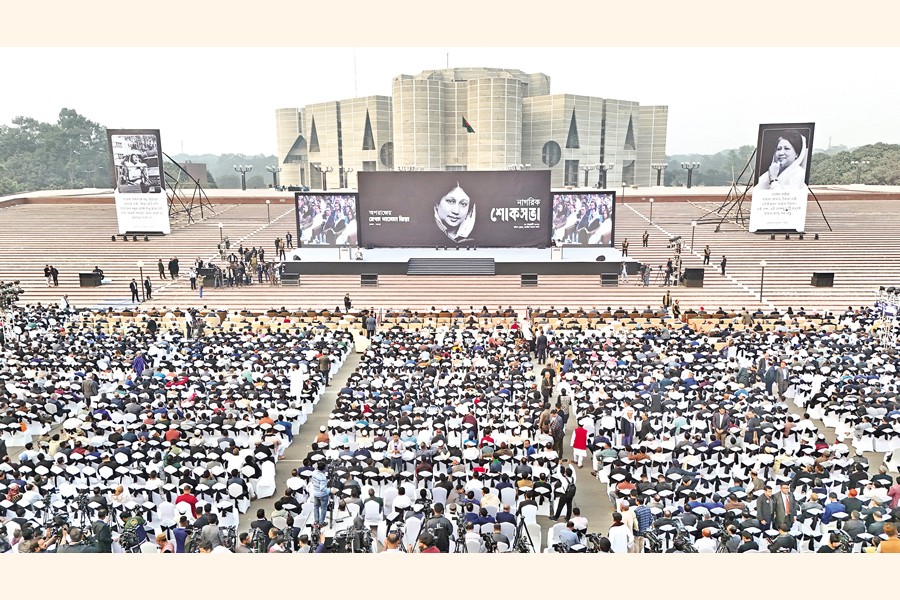
 Eminent citizens, editors, academics, professionals, and political observers attend the citizens' condolence meeting organised in memory of former prime minister Khaleda Zia at the South Plaza of Jatiya Sangsad Bhaban in the capital on Friday. — FE Photo by Asad-Uz-Zaman
 Eminent citizens, editors, academics, professionals and political observers Friday commemorated Khaleda Zia as a leader who transcended partisan politics through dignity, restraint and a steadfast commitment to democratic values, urging BNP to emulate her ideals.
Speaking at a civic condolence congregation in Dhaka, they recalled that the late former prime minister and Bangladesh Nationalist Party (BNP) chairperson had embodied these charismatic leadership qualities throughout her political life.
Speaking at the meeting, Law Adviser of the post-uprising interim government Prof Asif Nazrul recalled the period when Khaleda Zia was imprisoned, regretting that very few had spoken out in her defence at the time.
He said he had raised his voice when Khaleda Zia was in prison, at a time when "almost no one was willing to do so publicly".
Recalling a moment during court proceedings, he said Khaleda Zia had once asked whether she had ever misappropriated funds meant for orphans. That remark, he reminds, was widely portrayed as an admission of guilt, reflecting how "unfairly and poorly the legal process was conducted".
Speaking on behalf of business community, President of the International Chamber of Commerce (ICC), Bangladesh, Mahbubur Rahman emphasized that Khaleda Zia entered politics during a challenging era of autocracy and played a decisive role in the 1991 transition back to parliamentary democracy.
He notes that her leadership was instrumental in advancing the private sector during a time of significant transition.
Addressing the perspective of the business community, Rahman stated before the audience: "To the business community, democracy is not just about voting. It is a symbol of policy continuity, the rule of law, investment security, and certainty about the future."
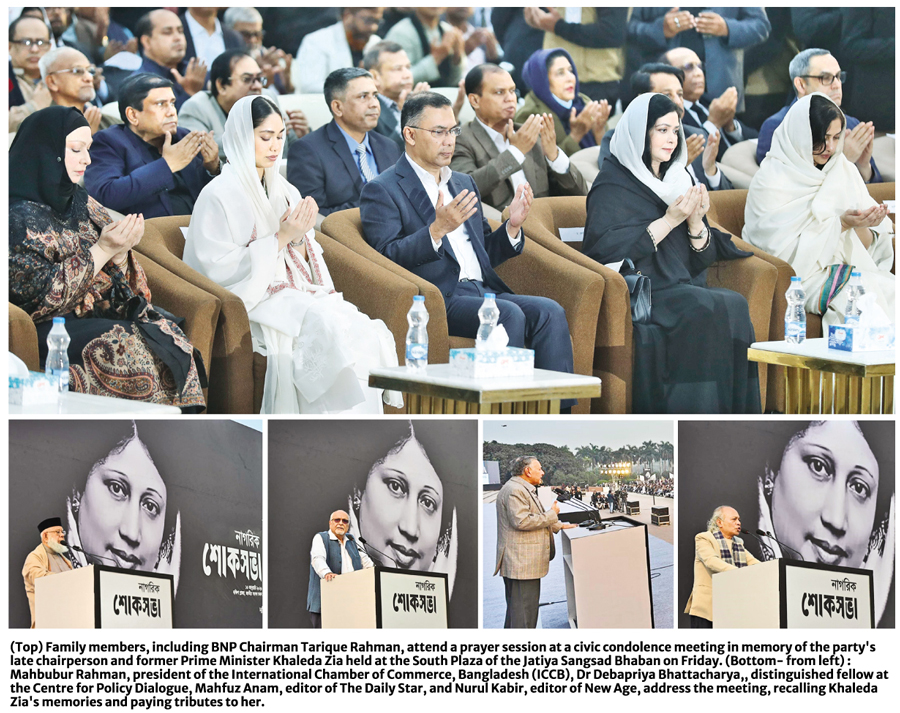
The ICC Bangladesh President highlighted that during her tenure, the country witnessed substantial economic progress and infrastructure development, which helped place the national economy on a more stable footing.
He specifically lauded her initiatives in social development, such as the "Food for Education" programme and financial assistance for female students, which paved the way for the current level of women's participation in the workforce.
Rahman remarks: "Programmes taken to increase education and human skills, such as Food for Education and assistance for girls' education, have shown a new light of hope to many poor families."
He observes that a statesperson's evaluation is not solely based on their time in power but also on how they handle crises while outside of it.
He recalls her deep-rooted commitment to the nation, quoting her sentiment that "I have no other place but Bangladesh," which he thinks serves as a reminder that the future of all citizens is inextricably linked to the country.
The business leader expressed the community's desire for a Bangladesh where rules and regulations are strong, trust is established, and the younger generation has more opportunities to move forward.
Speaking on behalf of the Editors' Council, New Age editor Nurul Kabir said Khaleda Zia was not merely the leader of a nationalist party but had truly emerged as a leader of the people and the nation.
"The presence of people from all walks of life, regardless of political affiliation, at her namaz-e-janaza reflected the respect she commanded."
Nurul Kabir noted that Khaleda Zia's dignity and restraint always stood out, particularly at a time when Bangladesh's political culture had long suffered from a lack of decency and moderation.
Despite enduring years of political attacks and personal hardship directed at her and her family, she never publicly expressed anger, resentment or condemnation. This sense of proportion and self-respect, he added, was especially vital in today's increasingly intolerant political climate.
Referring to her funerals, Nurul Kabir recalled that a BNP leader had pledged before millions of mourners that the party's future politics would be conducted in line with Khaleda Zia's democratic ideals, urging the party to honour that commitment.
Amar Desh editor Mahmudur Rahman said the political legacy and long struggle of late president Ziaur Rahman and Khaleda Zia had now been entrusted to Tarique Rahman, describing it as both a great honour and an immense responsibility.
He said in Bangladesh's 55-year history, only two leaders had emerged whose stature was difficult to match, and when such figures were parents, the burden on their children became even greater. He added: both Ziaur Rahman and Khaleda Zia entered politics with immense popularity and returned to their Creator with that popularity intact. "It's a rare and unique phenomenon in global political history."
The Daily Star editor, Mahfuz Anam, told the mass commemorative meet that he had met Khaleda Zia on several occasions and that, as an independent journalist, she had earned his respect.
He notes Khaleda Zia did not speak of revenge following her release on 7 August. Instead, she called for building a society founded on 'love, peace and knowledge rather than destruction, retaliation or hatred'.
Jaijaidin editor Shafik Rehman urged people to transform their grief into strength through democratic participation, particularly by voting. Addressing young voters, he encouraged those who would vote for the first time to reflect on the speeches delivered at the condolence gathering.
Writer Mohiuddin Ahmed said Khaleda Zia was the first prime minister in Bangladesh to be elected through a free and fair election, though she was often remembered primarily as the country's first female prime minister.
Business leader and CEO of Transcom Ltd Simeen Rahman recalled Khaleda Zia and her role to ensure a business-friendly environment in the country.
She said by reforming the tax and vat policies Khaleda Zia had improved the business environment, including for the RMG and medicine sectors.
Chairman of UGC Prof SM Faiz said Khaleda Zia was a charismatic leader who always appreciated merits and wanted to build a knowledge society. She never intervened in any matter or decision of PSC during her terms.
Economist Rashed Al Mahmud Titumir said Khaleda Zia worked to establish a structure of the country's economy taking agriculture at the core.
He also recalled Khaleda Zia helped industrialization by reforming the revenue system.
Prof Mahbub Ullah, who chaired the event staged at the south plaza of parliament, said that Khaleda Zia will be remembered for her patience, tolerance she showed against the injustice she endured and showed the path of kindness and openness.
"If the party (BNP) and the country hold her ideology, the both will be benefited, the history of the future of Bangladesh will be written taking her as the propeller," he added.
Writer Faham Abdus Salam, Basudeb Dhar, president of the Puja Udjapan Parishad, Khaleda Zia's physician FM Siddiqi, Raja Debashish Roy, special assistant to the chief adviser of a former caretaker government, CPD distinguished fellow Debapriya Bhattacharya, DPI president Abdus Sattar Dulal, former diplomat Anwar Hashim and former chief justice Syed JR Mudassir Husain spoke as the concluding speaker at the event.
Later, the event ended with prayers and munajat for Khaleda Zia.
Khaleda Zia passed away on 30 December last year while undergoing treatment in hospital. She was laid to rest with state honours at Zia Udyan the following day.
The civic condolence meeting was organised by civil-society organisations in memory of the three-time former prime minister and BNP chairperson.
Chairman of BNP Tarique Rahman attended the programme along with his family members, including his wife Zubaida Rahman, daughter Zaima Rahman, and Sharmila Rahman, the widow of his late brother Arafat Rahman Koko. BNP Secretary-General Mirza Fakhrul Islam Alamgir, members of the party's standing committee and other senior leaders were also present.
Diplomats accredited to Bangladesh, former judges, academics, editors, lawyers, business leaders, media professionals and representatives from various professions attended the gathering.
The eulogy was delivered by Saleh Uddin, executive editor of the Daily Ittefaq, at the beginning of condolence meeting.
bdsmile@gmail.com, nsrafsanju@gmail.com
© 2026 - All Rights with The Financial Express

