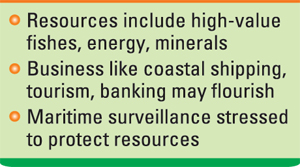
Experts called for an immediate and comprehensive survey and research to know the exact status of resources in the Bay of Bengal as they think the blessings of "blue economy" could give a further boost to the country's economy.
They also put the focus on capacity building both in public and private sectors as lack of expertise and policies restrains Bangladesh from developing blue economy, though its rights to more than 118,813 square kilometres of Bay waters have been established through international adjudications.
The demarcated maritime boundary encompasses territorial sea and exclusive economic zone extending out to 200 nautical miles (NM) across a sizable area.
It brooked no further delay, the speakers said at a roundtable arranged by the Board of Investment (BoI) in its conference room to gather ideas about how to harness the marine resources which, experts say, include both living and non-living ones of great value.
The state-run investment promoter organised the discussion with the business communities, investment experts and government officials concerned under the title 'Blue Economy of Bangladesh'.
BoI executive chairman Dr SA Samad moderated the discussion.
In the brainstorming session on the bay resources absolutely owned by Bangladesh in the demarcated area, the speakers also suggested that the government must adopt an integrated framework involving the private sector for rapid acceleration of the activities in the field of trade and investment.
Presenting a keynote paper, Rear Admiral Md. Khurshed Alam, Secretary of the Maritime Affairs Unit under the Ministry of Foreign Affairs (MoFA), said Bangladesh could be economically benefited largely by properly using the blue economy as did many developed countries in the world.
"Now we need to develop expertise and skilled manpower to explore the resources like high-value fishes, energy, heavy minerals and so on," he said.
Describing the contribution of the blue economy to the global economy, he said sea meets the protein demand of 1.0 billion people in the developed countries. And 90 per cent of the world's 350 million fishermen used to live in the developing countries.
He said the global market size of the fishes is around US$25 billion and maritime transport sector has now become the source of employment for 14 million people while global costal tourism industry players make a business of US$ 1.3 trillion a year.
Despite having the opportunity of catching fishes within 667 kilometres (kms) of the Chittagong Coast, Bangladeshi fishermen cannot go beyond 30 km in the bay with their wooden trawlers and 60 km with their steel-body fishing trawlers, Mr. Alam said to point out the shortcomings on the traditional marine-fishing front.
"We need to promote industrial fishing trawler and long-line fishing to catch high-value varieties like Salmon, Tuna, Herring, Kipper, Mackerel, Sardine and Swordfish from the deep sea," he told the meet.
Speaking on the occasion, Ferdaus Ara Begum, chief executive officer of Business Initiative Leading Development (BUILD), said the country needed an intensive study on resources in the Bay of Bengal as the concept of blue economy is still unknown to many of the people and businesses here.
"If we can go towards proper directions to this effect, various forms of business, including coastal shipping, tourism, banking and insurance will be created. And it ultimately create jobs for thousands of people," she said.
She also focused on strengthening an integrated maritime surveillance to protect those resources in the Bay.
Talking about the tasks, President of Bangladesh Chamber of Industries (BCI) AK Azad sought state measures, including easy access to bank finance and fiscal incentives, to encourage local investors in this field.
"It will be very difficult to attract local investors to the sector with the existing 14 percent bank interest. Simplified bank-loan facility and availability of gas and energy are also essentials in this connection," he said.
Secretary of the Ministry of Shipping Syed Monjurul Islam said the country needs to adopt short-, mid-and long-term plans of action to reap benefits from the opportunities.
"As part of the short-term planning, capacity building must be given top priority by paying serious attention on research and innovation," he said.
Energy Advisor to the Prime Minister, Tawfiq-e-Elahi Chowdhury, stressed the importance of a comprehensive study on status of the resources available in the Bay only to mitigate the possible risk factors for the private sector.
"We'll also go for redesigning of some of the blocks before bidding and research vessels are also needed in this matter," he said about the offshore exploration of hydrocarbons for which international oil companies are vying for contracts.
Speaking as chief guest, Foreign Minister Abul Hassan Mahmood Ali said the ministry would arrange a two-day international seminar on blue economy on September 1st where information about updated technology and methodology would be shared among the participants.
"The concept of blue economy is very important as it could further strengthen the country's GDP (gross domestic product) size by accelerating trade and business," he said.
He was critical about the controversy created over South Talpatti, saying that South Talpatti, the island which was located south of Satkhira in the Bay of Bengal, no longer exists.
© 2026 - All Rights with The Financial Express

